

What if the most important question about tirzepatide injections isn’t what results you might see, but whether the treatment fits your health history and goals? Tirzepatide acts on GIP and GLP-1 receptors, influencing blood sugar regulation and appetite. Understanding that mechanism is useful, but it’s only one part of making an informed decision.
It’s reasonable to want clear answers about potential benefits, limits, and side effects before considering a medication. Individual responses vary, and general information can’t determine whether treatment is right for you. A clinician can put the medication’s role in context, consider your health needs, and discuss what to expect.
This guide explains how tirzepatide works, what its approved uses and possible effects may mean in practice, and why clinician oversight matters. At Peptela, personalized, clinician-guided care helps connect treatment discussions with your history and goals, so you can explore your options with greater clarity.
Key Takeaways
- Approved uses for tirzepatide depend on the specific product and current FDA labeling.
- Learn how its receptor activity relates to appetite, food intake, and blood-sugar regulation.
- Understand why tirzepatide injections don’t guarantee weight loss or predictable results for every person.
- Get a high-level overview of the injection routine, guided by the instructions for the prescribed product.
- See how a clinician-guided discussion can connect your health history and goals with treatment considerations.
What Are Tirzepatide Injections Used For?
Tirzepatide is a prescription medicine given by injection. The active ingredient is tirzepatide, but approved uses depend on the specific product and its current U.S. Food and Drug Administration (FDA) labeling. This distinction matters when you’re reading about tirzepatide injections: information about one product does not automatically apply to every product containing the same active ingredient.
What does tirzepatide treat?
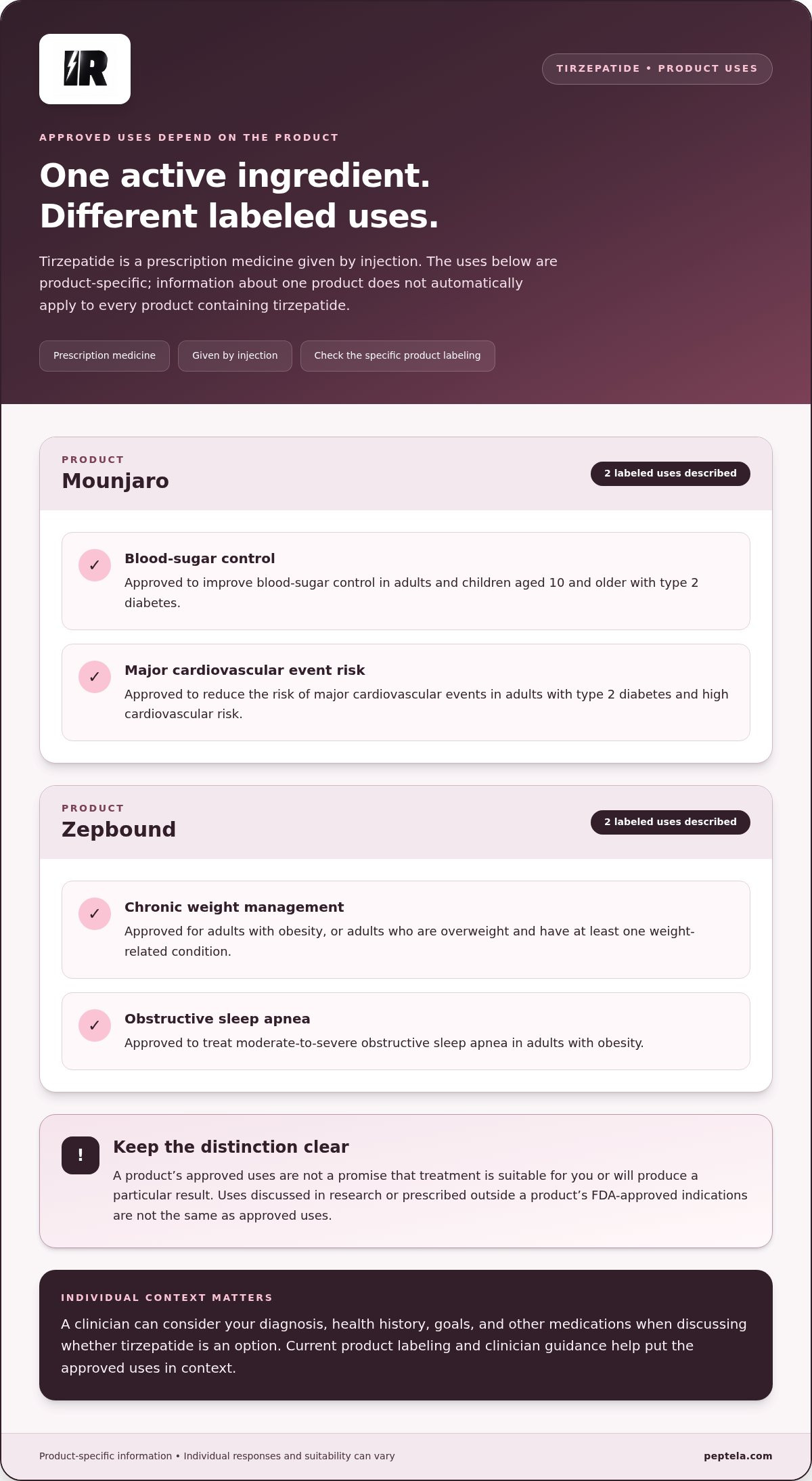
As of October 2026, FDA-approved tirzepatide products have different labeled uses. Mounjaro is approved to improve blood-sugar control in adults and children aged 10 and older with type 2 diabetes. It is also approved to reduce the risk of major cardiovascular events in adults with type 2 diabetes and high cardiovascular risk. Zepbound is approved for chronic weight management in adults with obesity, or adults who are overweight and have at least one weight-related condition. It is also approved to treat moderate-to-severe obstructive sleep apnea in adults with obesity.
These are product-specific indications, not a promise that treatment will be suitable or produce a particular result for you. A use discussed in research or prescribed outside a product’s FDA-approved indications is not the same as an approved use. A clinician can explain how current labeling relates to your health history, the reason treatment is being considered, and other relevant factors.
Is tirzepatide the same as a GLP-1 medication?
Tirzepatide activates two types of receptors: GIP and GLP-1. GIP stands for glucose-dependent insulinotropic polypeptide, and GLP-1 stands for glucagon-like peptide-1. These receptors respond to signals involved in blood-sugar regulation and appetite. In simple terms, tirzepatide acts on both pathways, while some medicines commonly called GLP-1 medications act on the GLP-1 pathway.
That shared pathway doesn’t make these medicines interchangeable. Their approved uses, product instructions, and suitability for an individual can differ. A general description of how a medicine works also can’t predict how it will affect a specific person. For a broader overview of the active ingredient and its mechanisms, see the Tirzepatide Wikipedia page; for treatment decisions, current FDA labeling and clinician guidance are more directly relevant.
Think of the indication as the starting point for a conversation, not a personal recommendation. A clinician can consider your diagnosis, health history, goals, and other medications when discussing whether tirzepatide is an option worth exploring. An individual review helps distinguish what the medicine is approved to do from what you can reasonably expect in your own care.
How Tirzepatide Injections Work in the Body
Tirzepatide’s effects begin with two receptor pathways involved in metabolic signaling. It is a dual GIP and GLP-1 receptor agonist, meaning it activates both incretin receptor pathways involved in glucose regulation and appetite. Receptor activity helps explain how the medicine can influence these processes, but it can’t predict exactly how a person will respond.
What do GIP and GLP-1 receptors do?
Think of receptors as signal receivers on cells. GIP receptors respond to glucose-dependent insulinotropic polypeptide, while GLP-1 receptors respond to glucagon-like peptide-1. Both hormones are part of the body’s incretin system, which helps coordinate responses to food. These pathways contribute to metabolic signaling, including how the body manages glucose after eating.
How can these signals affect appetite and blood sugar?
When tirzepatide activates these receptors, it can support insulin release in a glucose-dependent way, meaning the effect relates to blood-glucose levels. It can also affect appetite and food intake. The medicine slows stomach emptying, particularly early in treatment, which may influence how quickly food leaves the stomach and how full someone feels.
A simplified view of the process:
- Tirzepatide activates GIP and GLP-1 receptors.
- Those signals influence the body’s response to glucose, including insulin signaling.
- The pathways can also affect appetite, food intake, and stomach emptying.
- These combined actions may contribute to changes in blood sugar or body weight, but the effect varies between individuals.
This sequence describes biological activity, not a guaranteed outcome. A person’s response may depend on factors such as their health, treatment plan, and how their body tolerates the medicine. Receptor activation alone can’t tell you how much appetite might change, whether blood sugar will improve to a particular degree, or whether weight will change. Those questions call for individualized clinical guidance.
It also helps to separate the mechanism from the treatment decision. Two medicines can act on related pathways without being interchangeable. The appropriate medicine and its use depend on the individual and the product’s instructions. If you’re exploring tirzepatide injections, a clinician can discuss how its known actions relate to your health history and goals, rather than treating the mechanism as a promise of results.
Peptela’s clinician-guided care offers a setting to explore those questions and understand how treatment discussions connect with your needs. Learn more about Peptela’s clinician-guided care as you consider what questions to bring to a conversation with the care team.
Tirzepatide Injections: Potential Benefits, Limits, and Realistic Expectations
A medication’s potential benefits are only one part of a treatment decision. Tirzepatide may support outcomes related to its approved uses, but it isn’t a shortcut or a guarantee of weight loss. Its effects on appetite and blood sugar don’t tell you in advance how much change you’ll experience, or whether its potential benefits outweigh its limitations for you.
What outcomes can someone reasonably expect?
Clinical research can show what happened across a study group, but it can’t forecast an individual’s result. In the SURMOUNT-1 clinical trial, participants taking tirzepatide experienced average body-weight loss of up to 20.9%. That finding applies to the trial’s specific participants and conditions. It isn’t a personal estimate or a promise. A clinician can help interpret evidence alongside your health goals and treatment priorities.
Expectations can also include more than a number on the scale. Depending on why treatment is being considered, a discussion may cover blood-sugar goals, appetite, treatment tolerability, and how progress will be assessed. Relevant outcomes depend on the product’s approved use and an individual’s circumstances. Your clinician can help define meaningful goals without assuming everyone will respond in the same way.
What limitations should readers understand?
Tirzepatide isn’t appropriate for everyone. Whether it’s a reasonable option depends on an individual clinical assessment, including health history, other medicines, and the intended treatment goal. Even when treatment is appropriate, response and tolerability vary. Follow-up helps a clinician assess how things are going and whether the plan still makes sense for the person receiving care.
Think of medication as one part of a care plan, not a replacement for individualized guidance. It can’t account for your full health picture on its own, and average trial results can’t determine what you should do. A useful treatment conversation covers both potential benefits and practical limits: what outcome matters to you, what uncertainties remain, and how your care team would evaluate your response over time.
Side effects also shape expectations. Common effects can include gastrointestinal symptoms such as nausea, diarrhea, decreased appetite, and vomiting. This is a high-level overview, not a complete safety review; a dedicated guide to tirzepatide side effects can explain possible effects and precautions in more detail. Share symptoms or concerns with your clinician so they can assess them in the context of your treatment.
Before beginning, consider what you’d want to understand about the treatment beyond its potential results. How would progress be measured? What changes would matter to your health and daily life? What follow-up would help you make informed decisions? These questions keep the focus on your individual needs, rather than anecdotes or outcomes that may not reflect your experience.
What to Know About the Tirzepatide Injection Routine
Tirzepatide is administered by subcutaneous injection, which means the medicine is delivered under the skin. The routine may feel straightforward once you understand the instructions for your specific medication, but details can differ by product and delivery device. Use the current product instructions as your guide rather than relying on general descriptions or another person’s routine.
Follow the prescribed product instructions for every tirzepatide injection, including administration, storage, and missed-dose guidance.
How is a tirzepatide injection generally administered?
Subcutaneous means under the skin, rather than into a vein or muscle. Your medication’s instructions explain the appropriate injection sites and technique for that particular product. They also show how to use its prescribed delivery system. Don’t change the prescribed dose or try to adapt instructions from a different product; ask your clinician to clarify anything that feels uncertain.
Before using a new prescription, set aside time to review the medication guide and device instructions. Pay attention to steps specific to the product, including how to prepare it and complete the injection. If you’re unsure about a step, ask your clinician or care team to walk through the instructions with you. A clear routine can help you feel prepared without guessing at technique.
What should readers know about storage and missed doses?
Storage directions can be product-specific. Check the current medication guide for requirements such as where and how to store your medicine, and follow any instructions that came with your prescription. Don’t assume guidance for another tirzepatide product applies to yours. If the product has been stored outside the stated conditions, contact your clinician for direction before using it.
Missed-dose instructions may also depend on the product and timing. If you miss an injection, consult your medication guide or clinician rather than taking extra medicine or changing your routine on your own. The same principle applies if you’re uncertain whether a dose was given correctly. Reviewing the official instructions can help you decide what to do next with guidance tailored to your prescription.
A practical routine starts with a few habits:
- Keep the current medication guide and device instructions accessible.
- Follow the prescribed directions for injection technique and storage.
- Use product-specific guidance for missed doses or questions about an injection.
- Share concerns or difficulties with your clinician instead of changing the plan yourself.
These steps keep the routine grounded in the medication you were actually prescribed. Peptela’s personalized, clinician-guided care can help you discuss questions about tirzepatide injections in the context of your health history and goals. Learn more about clinician-guided tirzepatide care as you prepare for an informed treatment conversation.
How Peptela Supports a Clinician-Guided Tirzepatide Discussion
Considering tirzepatide is a personal health decision, not simply a choice based on a medication’s general effects. Peptela offers personalized, clinician-guided care that includes tirzepatide injections. The care team can help you explore how treatment considerations relate to your health history and goals, so you can ask informed questions and understand the options being discussed.
What can a personalized care conversation cover?
A thoughtful conversation can start with what you hope to address and what matters in your daily life. Sharing relevant health history, current medications, and questions gives clinicians important context. They can assess whether a treatment is appropriate for you and discuss relevant considerations. Reading an article can help you prepare, but it can’t replace an individual medical evaluation.
It may help to jot down a few questions before a discussion. What treatment goal feels most important? What concerns do you have about benefits or possible side effects? Are there details about your medical history or current medications you want the care team to understand? Raising these points can make the conversation more focused and personal.
The discussion should leave room for uncertainty, too. A clinician can explain what is known about a treatment and what can’t be predicted for one person in advance. They can connect potential benefits and limitations to your circumstances, rather than treating general information or another person’s experience as a recommendation for you.
How can readers explore clinician-guided care with Peptela?
Peptela’s in-house care team brings more than 199 years of combined clinical experience to its personalized, clinician-guided approach. That experience supports a thoughtful treatment conversation, while the focus remains on your individual history, goals, and questions. Exploring care is a way to learn about the process and discuss possibilities, not a guarantee of eligibility, a prescription, or a specific outcome.
As you consider your next step, focus on understanding the decision rather than arriving with a predetermined answer. You can ask how clinicians assess treatment suitability, what follow-up may involve, and which questions are most relevant to your situation. Clear answers can help you weigh options with greater confidence and retain an active role in your care.
To learn more, explore Peptela’s clinician-guided care. Start with your questions and take the time you need to understand whether tirzepatide fits your health needs.
Take Your Next Step With Clarity
You don’t need to decide everything at once. A thoughtful next step is to bring your questions and personal health goals into a conversation with a clinician. That can help you understand whether tirzepatide injections belong among the options worth considering for your individual circumstances.
Peptela offers personalized, clinician-guided care that includes tirzepatide injections. Its in-house care team brings more than 199 years of combined clinical experience to conversations centered on your health history, goals, and treatment considerations. That guidance can help you explore your options without assuming a particular treatment or outcome is right for you.
If you’re ready to learn more, explore Peptela’s clinician-guided care. Start with your questions, take the time you need, and keep your individual needs at the center of the conversation.
Frequently Asked Questions
Can tirzepatide be taken with insulin or other diabetes medicines?
Combining tirzepatide with insulin or other diabetes medicines calls for an individualized clinician review. These medicines can affect blood sugar in different ways, so the combination should be considered in light of your health and the current product labeling. Share a complete, up-to-date medication list, including nonprescription medicines and supplements. Don’t stop, reduce, or change any prescription on your own. Follow your medication instructions and your clinician’s guidance.
What should I do if I miss a tirzepatide injection?
For missed tirzepatide injections, follow the instructions for your specific product and your clinician’s advice. The appropriate next step can depend on the product labeling and when you missed the dose. Don’t take an extra dose or create a catch-up schedule based on general online advice. If you can’t find the relevant instructions, ask your clinician or care team how to proceed before changing your routine.
How should tirzepatide injections be stored?
Storage requirements depend on the specific medication and delivery device, so use the current product label as your reference. Check its directions for refrigeration, room-temperature limits, protection from light, and disposal. Don’t assume another product’s storage rules apply. If your medication may have been stored outside its instructions, ask your clinician or care team what to do before using it.
How long does it take to notice changes with tirzepatide?
There’s no single timeline for noticing changes; timing and degree of response vary by person and treatment goal. An early change, or no noticeable change at first, doesn’t by itself prove that treatment is succeeding or failing. Your clinician can review progress over time using measures relevant to your goals, such as agreed health markers, and discuss whether the plan remains appropriate.
Can tirzepatide affect oral birth control?
It may. Current product labeling can include guidance about oral contraceptives because tirzepatide can slow stomach emptying, which may affect how oral medicines are absorbed. Read the label for your specific medication and discuss contraception with your clinician, especially when starting treatment or changing doses. Follow the current product instructions rather than relying on general advice about time periods or additional contraceptive methods.
Is tirzepatide the same as semaglutide?
No. Tirzepatide and semaglutide are different active ingredients. Both act on pathways related to GLP-1 treatment, while tirzepatide also acts on GIP receptors. They aren’t interchangeable dose for dose, so don’t switch between them or adapt one medicine’s dose to the other. A clinician can help compare treatment options in light of your health history, goals, and current medicines.