

What if the most important part of tirzepatide care isn’t the prescription, but the conversation around it? If you’re unsure whether treatment fits your health history or worry that online care may feel one-size-fits-all, that hesitation makes sense. Clinician guided tirzepatide care connects medication decisions to your individual health context, rather than treating a prescription as the whole plan.
This article explains what clinician guidance can involve, how a clinician may consider your medical history, current medications, goals, and response over time, and what questions can help you understand the process. You’ll also learn what realistic expectations look like, without assuming a particular result is guaranteed.
At Peptela, personalized care is supported by an in-house team with more than 199 years of combined clinical experience. Learn how clinical oversight and clear information can help you make an informed choice and take an active role in your care.
Key Takeaways
- Clinician guided tirzepatide care involves medical judgment, not automatic prescribing.
- Your health history, current medications, and goals can shape whether treatment may be appropriate.
- Clinical discussions may evolve as your experience and needs become clearer.
- Guidance can support informed decisions, but it can’t guarantee eligibility, tolerability, or weight loss.
- Peptela’s in-house care team brings more than 199 years of combined clinical experience to personalized care.
What Does Clinician-Guided Tirzepatide Care Actually Mean?
A prescription is one decision. The care behind it is a broader process. Clinician guided tirzepatide care involves an individualized medical evaluation and ongoing clinical judgment to help determine whether tirzepatide may be appropriate for a person. It isn’t an automatic prescription or a promise that treatment will be recommended.
That distinction matters. Medication information can explain what tirzepatide is, but it can’t determine how treatment fits an individual’s health history and goals. Clinician guidance connects general information with a personal discussion, while leaving prescribing decisions to clinical judgment.
What role does a clinician play in tirzepatide care?
A clinician considers the person, not just the medication. The discussion may cover relevant health history, current medications, and what the person hopes to address. Together, these details help shape whether tirzepatide could be considered in that individual’s circumstances.
An online assessment can provide useful information, but completing one doesn’t guarantee a prescription. The clinician evaluates the information provided and independently decides whether prescribing is appropriate. Some people may be advised that tirzepatide isn’t a suitable option for them. That’s part of individualized care, not a failure of the process.
To make the discussion more useful, be ready to describe your goals and share relevant health details accurately. Having a clear list of current medications and past treatment experiences can help you provide specific information. You can also prepare questions so you understand the reasoning behind the decision.
How is clinician guidance different from medication information alone?
General drug information describes tirzepatide broadly. It can provide background on its uses and effects, but it doesn’t account for an individual’s full medical context. A clinician considers that context when discussing possible treatment, rather than treating general information as a personal recommendation.
For a general overview of the medication, including its mechanism and medical uses, see Tirzepatide Wikipedia. That background can help you prepare questions, but it can’t determine whether treatment is appropriate for you. Personal health circumstances shape that conversation.
For example, two people may share a similar goal but have different health histories or take different medications. Their treatment discussions may therefore differ. You don’t need to interpret your own health details or reach a conclusion before speaking with a clinician. Those details simply belong in the conversation.
- Medication information explains general facts about tirzepatide.
- Clinical guidance considers how those facts relate to an individual’s health context and goals.
- A prescribing decision reflects the clinician’s judgment, not an automatic outcome of seeking information or completing an assessment.
Medication is only one part of care. The evaluation and decisions around it help make the process personal and informed, while keeping the final choice grounded in clinical judgment.
How Clinicians Assess Whether Tirzepatide May Fit Your Health Goals
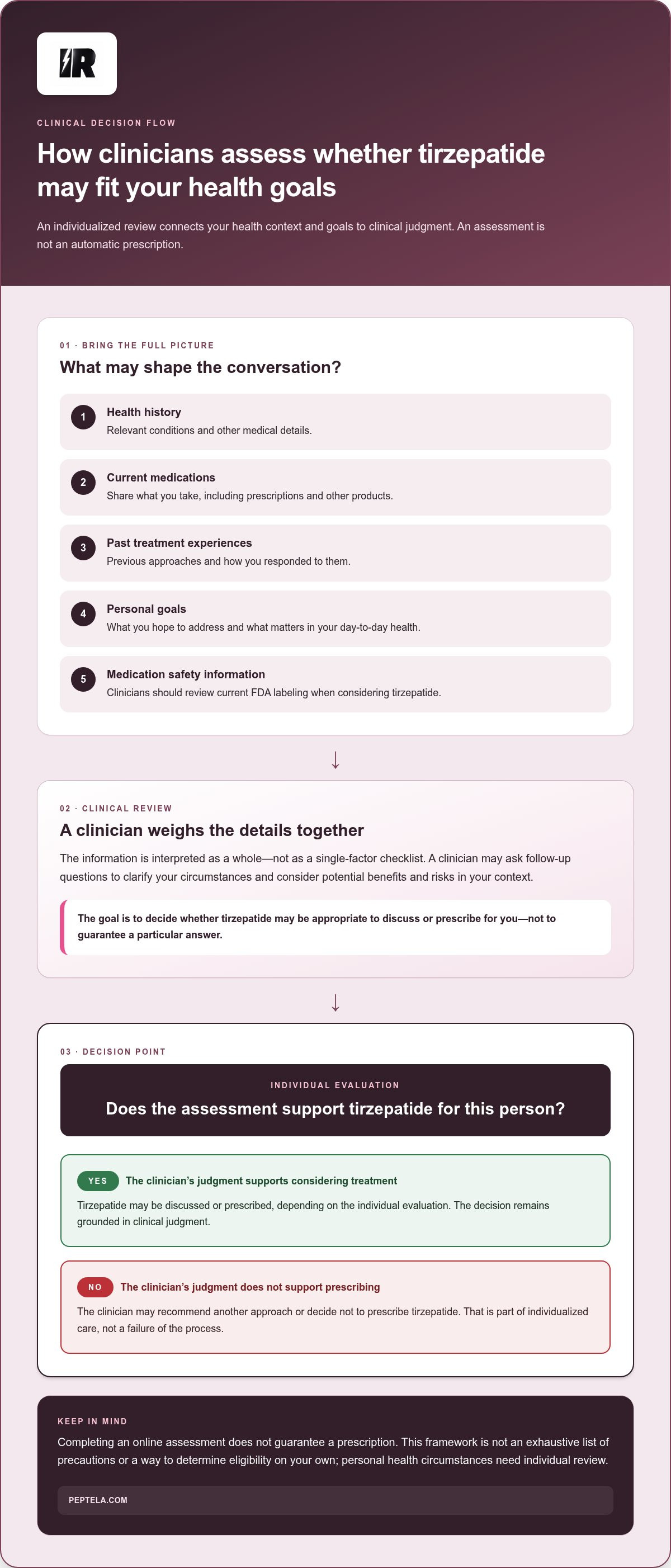
A thoughtful assessment looks beyond one goal or questionnaire response. A clinician considers your health history, current medications, and what you hope to address, then weighs those details together. The purpose is to decide whether tirzepatide may be appropriate to discuss or prescribe for you, not to guarantee a particular answer.
Which parts of your health history can matter?
Relevant health conditions, previous treatment experiences, and medications can all shape the conversation. Share what you take, including prescriptions and other products, and describe past approaches that have or haven’t worked for you. These details help a clinician consider potential benefits and risks in your circumstances, rather than relying on assumptions based on one factor alone.
Medication-specific safety information can change, so clinicians should review current FDA labeling when considering tirzepatide. This section isn’t an exhaustive list of precautions, and it can’t determine whether the medication is right for you. Your health context needs individual review.
An assessment may include discussion of several areas:
- Health history: Conditions and other relevant medical details.
- Current medications: What you take and any information that may affect treatment decisions.
- Past experiences: Previous treatments and how you responded to them.
- Personal goals: What you want to work toward and what matters in your day-to-day health.
- Medication information: Safety details and current labeling relevant to the clinical discussion.
This is a starting framework, not a checklist that determines eligibility by itself. A clinician interprets the information together and may ask follow-up questions to clarify details. The assessment may lead to a recommendation to proceed, consider another approach, or not prescribe tirzepatide. Each outcome depends on the individual evaluation.
How do personal goals shape the discussion?
Clear goals give the conversation direction, but they don’t promise what medication will achieve. If weight management is part of your goal, describe what you hope to change in practical terms, such as how you want to approach your health over time. A clinician can discuss whether tirzepatide may fit that aim while keeping expectations grounded and individual.
It can help to prepare a few questions: What information about my health is most relevant? What should I understand about possible benefits and risks? How would we decide whether this treatment remains appropriate? These questions support an active conversation without requiring you to diagnose yourself or predict your response.
Clinical research offers context, not a forecast for any one person. For example, the SURMOUNT-5 trial record on ClinicalTrials.gov describes a study design comparing tirzepatide with semaglutide for weight management. Study details can inform broader understanding, while a clinician’s assessment remains specific to your health circumstances.
If you’re exploring this option, Peptela’s personalized tirzepatide care considers treatment in the context of your health goals and clinical evaluation.
What Clinician Guidance Can Look Like Beyond the Prescription Decision
A prescription decision sets a direction, but it doesn’t answer every question that may come up during treatment. Clinician-guided care leaves room to consider a person’s experience and changing circumstances. That’s different from medication access alone, where general instructions may not explain how treatment fits an individual’s situation.
Personalized support isn’t a promise of a particular result or a plan that never changes. It means clinical decisions stay connected to the person’s needs, relevant health information, and clinician judgment. The aim is clarity: understanding why treatment is being considered and what the next steps mean.
What should personalized clinical support make clear?
Clear guidance explains the purpose of treatment, the reasoning behind the plan, and what questions remain. You should be able to share concerns or changes in your circumstances, rather than feeling that the initial decision settles everything. Personalization means a clinician considers new information as part of clinical judgment, not that they can guarantee a specific outcome.
The difference is easier to see side by side:
| Care element | Medication information alone | Clinician-guided care |
|---|---|---|
| Purpose | Provides general details about the medication. | Connects treatment discussions to the person’s health context and goals. |
| Questions | May explain general instructions but can’t address a person’s full circumstances. | Creates space to discuss questions and concerns with a clinician. |
| Changing circumstances | Doesn’t make an individualized decision about what a change means. | Allows clinical judgment to take new information into account. |
| Expected results | General information may describe treatment broadly. | Supports decisions without guaranteeing an individual result. |
The table compares purposes, not every care experience. Medication information helps explain the basics; clinical guidance adds an individual decision-making layer. In clinician guided tirzepatide care, that distinction can help you identify which questions the medication information answers and which call for a clinician’s perspective.
Why does follow-up matter during prescription treatment?
Follow-up gives a clinician an opportunity to revisit whether treatment still fits the person’s experience and circumstances. It also gives the patient a chance to share questions or changes, so ongoing decisions can take relevant context into account. Follow-up doesn’t guarantee a particular adjustment or result; it supports informed clinical judgment over time.
Keep communication direct. If something changes or a concern comes up, raise it with a qualified clinician rather than trying to interpret it alone. For medication-specific instructions and safety information, use current prescribing information and clinical advice. General online content can provide useful background, but it can’t replace an individualized medical discussion.
Realistic Expectations: What Clinician-Guided Tirzepatide Cannot Promise
Clinical guidance can make treatment decisions more informed, but it can’t remove uncertainty. An assessment doesn’t guarantee that tirzepatide is appropriate for you, that you’ll tolerate it, or that you’ll lose weight. These are separate questions, and no clinician can promise an individual outcome in advance.
This distinction is central to clinician guided tirzepatide care. Oversight means a qualified clinician uses personal health context and clinical judgment to guide decisions. It doesn’t mean everyone will qualify, have the same experience, or reach the same goal. Honest guidance makes room for possibility and uncertainty at the same time.
Does clinician guidance guarantee a particular result?
No. A clinician can evaluate whether treatment may be suitable and discuss what is known, but can’t predict exactly how one person will respond. Eligibility, tolerability, and results are individual considerations. A thoughtful process helps clarify decisions; it doesn’t make an uncertain outcome certain.
Clinical trials can offer useful evidence about groups of participants under specific study conditions. Their averages describe those groups, not a forecast for each person. Differences in health context, treatment experience, and other individual factors mean a trial result shouldn’t be read as a personal promise. If you encounter a result presented as typical or guaranteed, consider what population and study conditions it describes.
How should readers think about benefits and risks?
Consider potential benefits and risks together as part of a conversation about your health goals and circumstances. Ask not only “What might this help with?” but also “What should I understand about the treatment, and how would we make decisions if my circumstances change?” That balanced discussion supports informed choice without assuming treatment is right for everyone.
Medication-specific safety information should come from current prescribing information and a qualified clinician. Side effects can be part of that discussion, but a general article can’t assess your personal risk or advise you how to manage a symptom. Bring medication concerns to a clinician rather than relying on another person’s experience or an online anecdote. For a fuller overview, use the prescribing information alongside individualized guidance.
- Eligibility: An assessment may or may not lead to a prescription.
- Tolerability: A clinician can discuss relevant information, but can’t guarantee how you’ll feel.
- Results: Group-level findings don’t predict an individual outcome.
Realistic expectations leave you in control of an important choice: you can ask questions, weigh the information, and decide whether to explore treatment. If you’re ready to discuss tirzepatide in the context of your health goals, explore personalized care with Peptela.
Explore Personalized, Clinician-Guided Tirzepatide Care With Peptela
Exploring tirzepatide can begin with a simple question: how might this treatment fit your health goals and personal circumstances? Peptela provides personalized, clinician-guided care that puts the discussion in context. The focus is not simply on medication access. It’s on informed decision-making that considers your health information and goals, with prescribing decisions shaped by clinical judgment.
That approach leaves room for questions. Reflect on what you hope to address, share relevant health details, and learn how a clinician evaluates whether treatment may be appropriate. Exploring care doesn’t guarantee eligibility or a particular result. It gives you a way to understand the decision-making process before deciding what feels right for you.
How does Peptela frame personalized care?
Peptela’s in-house care team brings more than 199 years of combined clinical experience. This figure reflects the team’s combined experience, not a claim about any one clinician. The care approach connects clinical context with your goals, so treatment discussions focus on your circumstances rather than a standard assumption about what you need.
Personalized care also means you remain an active part of the conversation. Sharing questions and relevant health information helps inform the discussion, while clear explanations can help you understand how a clinician reaches a decision. Clinical judgment guides whether tirzepatide is appropriate to prescribe. It doesn’t guarantee a prescription, a specific formulation, or a treatment outcome.
What is a useful next step if you are considering tirzepatide?
Start by identifying what you want to understand. Consider which health goals are motivating your interest, what treatments you’ve tried before, or what questions you have about the decision process. You don’t need to arrive with a conclusion. A thoughtful conversation can help clarify which details matter and what to consider next.
- Reflect on your goals: Note what you hope to address and what progress would mean to you.
- Gather relevant context: Be ready to discuss your health history and current medications.
- Prepare questions: Ask how clinical judgment informs treatment decisions and what information can guide your choices.
These steps can make exploring clinician guided tirzepatide care more focused while keeping expectations grounded. Treatment decisions depend on individual clinical evaluation, and you can take time to understand the information before deciding how to proceed.
Peptela offers tirzepatide injections within its personalized, clinician-guided care. If you’re ready to explore the process in the context of your health goals, learn more about Peptela’s tirzepatide care.
Take Your Next Step With Clarity
Exploring treatment doesn’t require you to have every answer today. Start with what matters most to you, then use that as a guide for a thoughtful conversation about your health and options. With clinician guided tirzepatide, the goal is to make decisions in context, not rush toward a predetermined outcome.
Peptela offers personalized care and tirzepatide injections, supported by an in-house care team with more than 199 years of combined clinical experience. That experience supports a considered approach, while treatment decisions remain individual.
As you explore, consider what you’d like to ask, which health goals are important to you, and what information would help you feel informed. You can take time to understand the process and make choices with a clearer view of what’s involved.
Explore personalized, clinician-guided tirzepatide care with Peptela and take a confident next step toward a more informed conversation about your health.
Frequently Asked Questions
Is clinician-guided tirzepatide safer than taking it without clinical guidance?
Clinical guidance can help a clinician assess your health context, discuss potential risks, and make an informed prescribing decision, but it can’t eliminate every risk or guarantee how treatment will feel. Tirzepatide is a prescription medication, so follow current prescribing information and the instructions provided for your care. If you experience urgent or concerning symptoms, seek prompt medical advice rather than relying on an online article.
Can a clinician prescribe tirzepatide through an online visit?
Online prescribing may be possible if a qualified clinician can complete an appropriate evaluation and prescribing is permitted under applicable rules. Requirements can vary by state and may change, so don’t assume one online process applies everywhere. An online visit or assessment doesn’t ensure a prescription. The clinician must decide whether treatment is appropriate based on the information available and current requirements.
Does clinician-guided tirzepatide guarantee weight loss?
No. Clinical studies report outcomes for groups of participants under defined conditions, and those averages can’t predict exactly what one person will experience. Individual responses differ, and clinical guidance can’t guarantee eligibility, weight loss, or tolerability. If you’re discussing treatment, ask how the evidence applies to your circumstances and what realistic expectations look like. A result reported for a study group isn’t a personal forecast.
Is compounded tirzepatide the same as an FDA-approved tirzepatide product?
Don’t assume a compounded medication is interchangeable with an FDA-approved product. They have distinct approval status and regulatory considerations, and rules or availability may change. If a specific product is being discussed, ask a qualified clinician to explain what it is and how its status differs. Check current FDA information before relying on older summaries, especially when evaluating claims about a particular formulation.
What happens if someone stops taking tirzepatide?
What happens after stopping can vary, so discuss any plan to change or end treatment with the prescribing clinician. For example, if you’re considering stopping because of a concern or a change in your goals, explain that context before making a decision. Don’t stop, restart, or change a prescription based only on general online information. A clinician can consider your circumstances and discuss appropriate next steps.
Can tirzepatide interact with other medications?
Medication considerations depend on your health history and everything you take. Share your full medication list with the clinician, including prescriptions, nonprescription products, and supplements. For example, mention a supplement even if you use it only occasionally. An online overview can’t assess your personal medication combination or cover every possible interaction. Use current prescribing information and qualified clinical advice for individualized guidance.
