

What if personalized tirzepatide treatment means more than receiving a prescription online? Good care connects treatment decisions to your health history, goals, and changing needs. It’s reasonable to want clear answers about whether a clinician will consider your circumstances, explain medication options, and stay involved as your needs evolve.
Online care doesn’t have to feel generic. This guide explains what clinician-guided personalization can involve, what responsible oversight should make clear, and how FDA-approved tirzepatide products differ from compounded versions. You’ll also learn what to consider before taking the next step, so you can make an informed decision without assuming a particular medication or outcome is right for you.
Peptela offers personalized, clinician-guided care, including tirzepatide injections, supported by an in-house care team with 199+ years of combined clinical experience. Here’s what that kind of partnership can mean in practice, and how to approach your options with realistic expectations.
Key Takeaways
- Personalized tirzepatide treatment should reflect your health context and goals, not a one-size-fits-all pitch.
- A clinician reviews your circumstances and guides treatment decisions; an online quiz or marketing promise isn’t a substitute.
- Understand the difference between FDA-approved tirzepatide products and compounded preparations before weighing your options.
- Evaluate online care by looking for individual review, clear explanations, clinician involvement, and follow-through.
- Peptela offers clinician-guided care, including tirzepatide injections, with an in-house team bringing 199+ years of combined clinical experience.
What Personalized Tirzepatide Treatment Means for Your Care
Wanting care that considers your health context, rather than a one-size-fits-all pitch, is a reasonable place to start. Personalized tirzepatide treatment begins with a clinical conversation about whether the medication may suit your circumstances, not an automatic promise of a prescription or a specific result.
Personalized care means a clinician assesses your individual circumstances and uses that review to guide treatment decisions. It does not promise individualized results. That distinction matters. Learning about tirzepatide’s mechanism and approved uses can provide general context. The Tirzepatide Overview offers background, but your treatment decision depends on clinical assessment, not a general article or marketing claim.
What can a clinician consider when assessing treatment fit?
A clinician may review your health history, current medications, goals, and other personal circumstances before discussing whether tirzepatide is clinically appropriate. These details put the decision in context. For example, a medicine you already take or a health concern in your history may be relevant to the discussion, even if it doesn’t determine the answer on its own.
This isn’t a self-screening checklist. No single detail can confirm whether treatment is right for you, and a general online article can’t assess your individual health. A clinician evaluates the information and makes the clinical decision. Your part is to share an accurate picture of your health and ask questions when something is unclear.
Before a review, it can help to organize:
- Your relevant medical history and current medications.
- The goals you hope to discuss with a clinician.
- Questions about how the decision will be made and what happens next.
This preparation can make the conversation more focused without assuming its outcome.
What personalization does, and does not promise
Personalization means a clinician considers your circumstances rather than treating a quiz result or promotional message as a medical decision. It doesn’t guarantee eligibility, a prescription, weight loss, or another particular outcome. An assessment may lead to a discussion of options, a decision not to prescribe, or another appropriate next step.
Care shouldn’t end at the moment a prescription is issued. Individualized clinical support can include explaining the reasoning behind a decision and arranging follow-up to revisit questions or concerns. The details vary, so look for clear communication about who makes the clinical decision and how you can understand the next step.
Personalization is a process, not a label. Notice whether the discussion makes room for your health context, goals, and questions while leaving clinical judgment with the clinician. This supports informed participation without suggesting that everyone will receive the same medication or plan.
How Clinician-Guided Tirzepatide Decisions Are Made
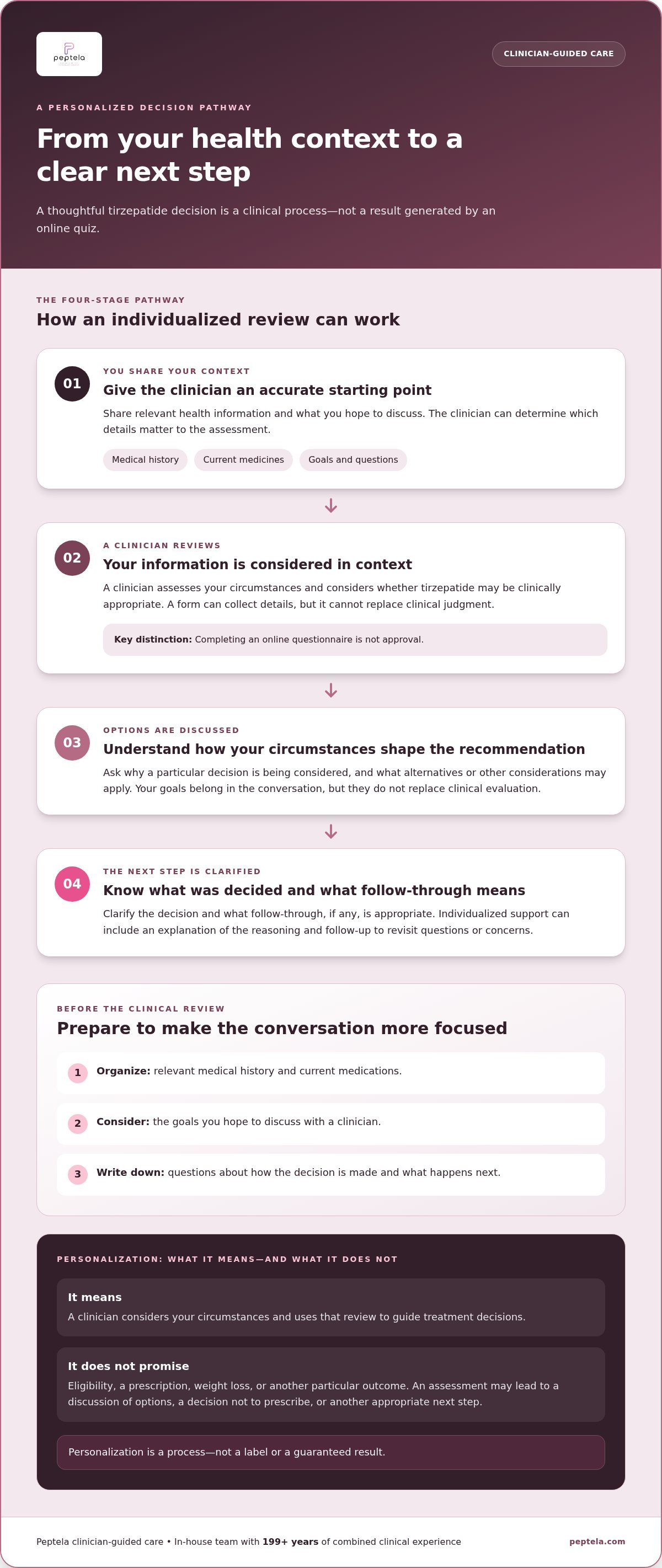
A thoughtful treatment decision is a process, not a result generated by a quiz. With personalized tirzepatide treatment, the clinician reviews the information you share, considers your health context and goals, and decides whether treatment is clinically appropriate. An online form can collect details, but it can’t replace clinical judgment.
Treatment suitability is an individualized clinical decision based on a person’s health information, goals, and circumstances. This reflects a broader principle of personalized medicine: decisions should consider the individual, not just a general category. The National Human Genome Research Institute’s resource on Understanding Personalized Medicine explains that foundation. A clinician applies relevant context when discussing a specific treatment.
How health history and goals inform a clinical review
Accurate information gives the clinician a clearer starting point. Share your relevant medical history, current medicines, and the goals you want to discuss. If you’re exploring weight management, for example, describe what you hope to address and what matters to you. This helps frame the review without assuming a particular target or outcome.
Raise questions about medical conditions or medicines you take, including anything you’re unsure is relevant. Don’t leave out a detail because you think it may rule treatment in or out. The clinician can determine what matters to the assessment and explain how it informs the decision. Your goals belong in the conversation, but they don’t replace a clinical evaluation.
A clear decision pathway
The steps can be straightforward, even when the decision requires care:
- Share your context. Provide accurate information about your health, medicines, and goals.
- Receive clinical review. A clinician assesses the information and considers whether tirzepatide may be appropriate.
- Discuss the options. Ask how your circumstances shape the recommendation and what alternatives or considerations may apply.
- Understand the next step. Clarify the decision and what follow-through, if any, is appropriate.
This sequence helps distinguish clinical care from a sales promise. An online questionnaire can organize information, but completing a form is not approval. A marketing statement can’t establish that a medication is right for you. The clinician makes that decision after reviewing your individual context.
Why oversight matters beyond the initial decision
Health circumstances and priorities can evolve. Clinician oversight connects treatment decisions to the information available at the time, rather than treating an initial assessment as the only point that matters. Follow-up can give you an opportunity to raise new questions or discuss changes in your care needs. The timing and format depend on the care arrangement, so don’t assume a particular schedule.
Peptela provides personalized, clinician-guided care, including tirzepatide injections. Explore Peptela’s clinician-guided care to learn about this approach. A clinician’s review guides the decision, but it doesn’t guarantee a prescription or a particular outcome.
FDA-Approved Tirzepatide and Compounded Options: What to Distinguish
“Personalized” describes how a clinician considers your circumstances. It doesn’t tell you whether a medication is FDA-approved or how it was prepared. Those are separate questions. Understanding the difference can help you discuss options with a licensed clinician without assuming that products containing the same active ingredient have the same regulatory review or status.
| Category | What to understand |
|---|---|
| FDA-approved products | Mounjaro and Zepbound are brand-name products containing tirzepatide. FDA approval applies to specific products and labeling; approved indications can differ. |
| Compounded preparations | These are prepared by a compounding pharmacy for a patient-specific medical need. They are not FDA-approved and do not undergo the same premarket review as FDA-approved drugs. |
| Personalization | A clinician’s assessment of your circumstances can inform a treatment decision. The word “personalized” does not establish a drug’s approval status or guarantee a particular medication. |
What does compounded tirzepatide mean?
Compounding means a pharmacy prepares a medication for an individual patient’s specific medical need. It differs from dispensing an FDA-approved, commercially manufactured drug. Compounded drugs are not FDA-approved, and the FDA doesn’t review them for safety, effectiveness, and quality before marketing in the same way it reviews approved drugs. A clinician’s involvement doesn’t change that distinction.
Rules and enforcement guidance matter. As of October 2026, the FDA had removed tirzepatide from its drug shortage list in October 2024 and reaffirmed that decision in December 2024. State-licensed 503A pharmacies may compound it on a patient-specific basis when a prescriber documents a clinical need for a customized formulation; cost alone isn’t sufficient. The FDA’s proposed exclusion of tirzepatide from the 503B bulks list had not received a final rule by October 2026. Because guidance can change, current FDA information and applicable rules are relevant to clinical decisions.
How to compare options without assuming equivalence
Keep three questions separate: What is the product’s regulatory status? Who reviews your health information and makes the treatment decision? What clinical need supports that decision? A customized formulation doesn’t automatically mean a better fit. Compounded and FDA-approved products shouldn’t be treated as interchangeable in their review, quality, safety, or effectiveness status.
Personalized tirzepatide treatment starts with an individualized clinical discussion, not self-selection based on a label or online claim. Ask a licensed clinician to explain the relevant product category, how your health context informs the decision, and what the next step means. No option is universally best for everyone; suitability depends on clinical judgment and your individual circumstances.
How to Evaluate Personalized Tirzepatide Care Online
Online care can make it easier to begin a clinical conversation, but convenience alone doesn’t show whether care is individualized. Look for a clear explanation of how a clinician reviews your health context, how decisions are made, and what support or next steps may follow. A reassuring promise of results isn’t a substitute for those details.
Signs that online care is clinically grounded
Assess the care experience by what it explains, not just how quickly it invites you to start. Clinician involvement should be clear, and it should be understandable how your medical history, current medications, and goals inform a decision. A form can collect information, but a clinician should provide the clinical judgment.
Look for plain-language explanations that help you understand the process. Useful details include:
- Individual review: Your health information and goals have a role in the clinical assessment.
- Clear reasoning: The care team explains why a treatment option may or may not fit, without implying approval is automatic.
- Understandable next steps: You can learn what follows the review and how questions or changing needs fit into care.
- Realistic communication: The information distinguishes what clinical guidance can do from outcomes no one can promise.
Online care can support a clinical relationship when clinician guidance and communication are part of the process, rather than a quiz acting as the decision-maker. Services can differ in how they organize care, so focus on whether the approach is explained clearly. If a page emphasizes convenience or guaranteed results but says little about clinical review, you may not have enough information to understand how personalization works.
Questions to resolve before choosing a care pathway
Before beginning a conversation, consider what you hope to address and what you need to understand before making a decision. Write down your goals, concerns, relevant medical history, and current medications. Ask how these details factor into the review and what the clinician will explain about the options.
Make the discussion specific to you. For example, ask, “How will my current medications be considered?” or “What happens if this treatment isn’t appropriate for me?” You can also ask how decisions and next steps will be communicated. These questions don’t replace clinical judgment, but they help you take an active role and leave with a clearer understanding.
To prepare, organize the topics you want to raise: your goals, current medicines, relevant health history, and questions about the decision process. Personalized tirzepatide treatment should feel transparent: you understand who guides the decision, how your context matters, and what the decision does or doesn’t mean.
Peptela provides personalized, clinician-guided care, including tirzepatide injections. Explore Peptela’s personalized care to learn about its approach. A clinical review determines whether treatment is appropriate for you.
Explore Personalized Tirzepatide Care with Peptela
You’ve considered what meaningful clinical oversight should include: a review that takes your circumstances seriously, clear explanations, and room to understand the decision. Peptela brings that approach to personalized, clinician-guided care, including tirzepatide injections. The aim is to support an informed clinical conversation, not to suggest that every person will receive the same recommendation.
What Peptela brings to a personalized care conversation
Good care starts with the person, not just the medication. A clinician-guided conversation can connect your health history and goals with a thoughtful review of whether tirzepatide may be appropriate. Bring your questions and concerns to the discussion while the clinician applies their judgment to the information you share.
Peptela’s in-house care team brings more than 199 years of combined clinical experience. That figure reflects the team’s combined experience, not the tenure or credentials of any individual clinician. It offers context for the team behind Peptela’s care, while the focus remains on your own assessment and the decision made for your circumstances.
Personalized tirzepatide treatment isn’t a promise of eligibility, a prescription, or a particular result. It means approaching the decision through clinical guidance and individual context. A clear care experience should help you understand the reasoning behind next steps, including if a clinician determines that tirzepatide isn’t the right fit. That clarity supports your agency, whatever the clinical decision.
A clear next step at your own pace
Exploring care doesn’t require you to arrive with every answer. It can help you learn how a clinician-guided process works, prepare questions, and decide what you want to discuss. Consider what you hope to address, which parts of your health history may be relevant, and what you need explained before feeling comfortable with a decision.
For a useful conversation, gather a current list of medications, note relevant health details, and write down questions about how your personal context will inform the review. These steps can help you communicate clearly. They don’t determine the clinical outcome, and you don’t need to make a medication decision on your own before speaking with a clinician.
Peptela’s approach centers on individualized, clinician-guided care, supported by an in-house team with combined clinical experience. If that kind of support aligns with what you’re looking for, explore Peptela’s personalized tirzepatide care as a next step toward an informed clinical conversation. Take the time you need, ask what matters to you, and let a clinician assess whether treatment is appropriate. No particular prescription or outcome is assured.
Make Your Next Step an Informed One
The best next step isn’t necessarily starting treatment. It’s getting the clarity you need to decide whether a clinical conversation fits your goals and circumstances. Bring your questions, be open about your health context, and give yourself room to understand the guidance before making a choice.
That’s the value of approaching personalized tirzepatide treatment with curiosity rather than pressure. A clinician’s assessment can help you understand whether this option may be appropriate, while your priorities remain part of the conversation. There’s no need to assume the outcome in advance. Start by learning how care is approached and what you want to discuss.
If you’re ready to take that step, explore personalized tirzepatide care with Peptela. A thoughtful conversation can help you move forward with greater understanding and confidence, at your own pace.
Frequently Asked Questions
Is personalized tirzepatide treatment different from a standard prescription?
Not necessarily. Personalized tirzepatide treatment describes how a licensed clinician considers your health history, current medications, goals, and circumstances when making a care decision. It doesn’t mean everyone receives a different medicine, and it doesn’t guarantee a prescription or a particular result. For example, two people with similar goals may receive different recommendations because their health contexts differ. A licensed clinician determines whether treatment is appropriate for you.
Is compounded tirzepatide FDA-approved?
No. Compounded drugs are not FDA-approved, and the FDA doesn’t review them for safety, effectiveness, and quality before marketing in the same way it reviews approved drugs. Compounding is subject to applicable legal requirements, which can depend on current circumstances and FDA guidance. Since shortage-related rules and guidance can change, discuss current FDA information and medication options with a licensed clinician. Don’t assume a compounded preparation has the same regulatory status as an approved product.
Can an online clinician prescribe tirzepatide?
A licensed clinician may prescribe medication if they determine it’s clinically appropriate and applicable requirements are met. An online evaluation doesn’t guarantee a prescription; the decision depends on the clinician’s review of your circumstances. Peptela provides clinician-guided care, but the outcome of an individual assessment can’t be assumed in advance. Share accurate health information, including relevant medical history and current medications, so the clinician can consider your situation responsibly.
What information may a clinician need before considering tirzepatide?
A clinician may ask about your health history, current medications, goals, and circumstances that could inform the decision. Be ready to describe the medicines you take and what you hope to address, while letting the clinician decide which details are relevant. The assessment depends on the individual and clinical judgment, so this isn’t a screening checklist. You can prepare by writing down questions about the conversation and decision process.
Does personalized tirzepatide treatment guarantee weight loss?
No treatment plan can guarantee an individual outcome. Whether tirzepatide is suitable and how a person responds can vary, so a clinician can help put expectations in context rather than promise a specific result or timeline. Ask how your personal goals will inform the discussion and what factors could shape the recommendation. An informed decision focuses on your circumstances, not on assuming a particular outcome before clinical review.
Can tirzepatide be appropriate for someone with diabetes?
It may be considered in some situations, but the decision depends on your health history, current medications, and clinical needs. Tirzepatide products have different FDA-approved indications: Mounjaro is approved for type 2 diabetes, while Zepbound has different labeled uses. They shouldn’t be treated as interchangeable. Product labeling can change, so discuss your circumstances and the relevant product information with a licensed clinician. Don’t start, stop, or change medication based on an FAQ.
What if my health goals or circumstances change during care?
Tell your clinician if your goals, health circumstances, or current medications change. A new health concern or a shift in what you hope to address may affect what should be considered in your care. The clinician can reassess the information and discuss appropriate next steps, but a specific treatment change, follow-up schedule, or result isn’t guaranteed. Sharing updates helps keep the clinical conversation grounded in your current situation.

