

Could targeting growth hormone signaling change sleep or body composition? A CJC-1295 and Ipamorelin blend for deep sleep and fat loss is intended to stimulate growth hormone release: CJC-1295 acts on pituitary signaling, while Ipamorelin also prompts growth hormone release. The blend may influence sleep and body composition, but it doesn’t guarantee deeper sleep or fat loss.
It makes sense to wonder whether a therapy connected with growth hormone could support both nighttime recovery and changes in body composition. The distinction matters: a proposed biological mechanism isn’t the same as a predictable result, and the evidence for these peptides remains limited.
This article explains what the two peptides are proposed to do, how those effects relate to sleep and fat loss, and what side effects may occur. It also outlines safety questions to discuss with a clinician before deciding whether this approach suits your health needs.
Key Takeaways
- Understand how CJC-1295 and Ipamorelin act on growth hormone signaling, and why their mechanisms are not the same as guaranteed results.
- Learn how the blend’s proposed effects relate to sleep, while keeping expectations grounded in the available evidence.
- See how body composition goals connect with nutrition, exercise, and adequate sleep.
- Recognize potential side effects, including flushing, headache, nausea, and water retention.
- Know what health factors to discuss with a clinician before considering peptide treatment.
What does Sleep & Sculpt (CJC-1295 + Ipamorelin) target?
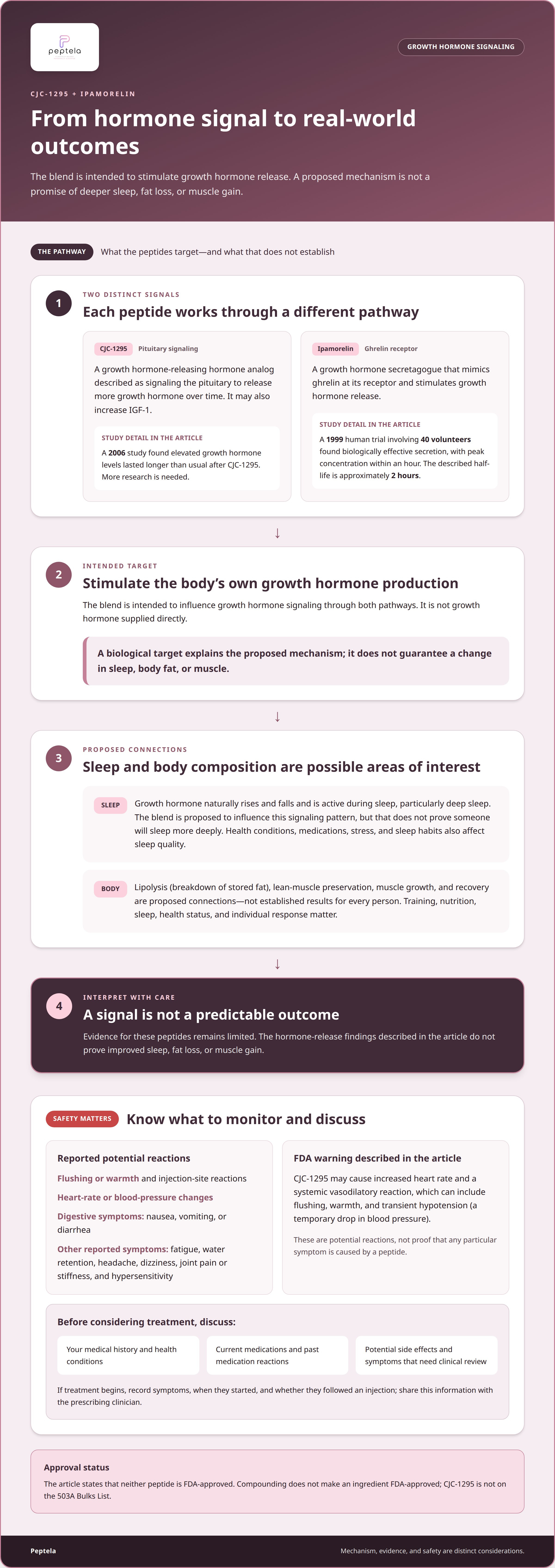
The combination targets growth hormone release through two different signaling pathways. CJC-1295 is a growth hormone-releasing hormone analog that acts on pituitary signaling. Ipamorelin is a growth hormone secretagogue that acts on ghrelin receptors. Together, these peptides are intended to stimulate the body’s own growth hormone production, not supply growth hormone directly. That mechanism describes the treatment’s target, not a guaranteed change in sleep, fat, or muscle.
CJC-1295 is described as signaling the pituitary to release more growth hormone over time. It may also increase insulin-like growth factor 1, or IGF-1. A 2006 study found elevated growth hormone levels lasted longer than usual after CJC-1295, though more research is needed. That extended signaling is one reason CJC-1295 differs from a short-acting release signal.
Ipamorelin has a distinct role in the combination. It mimics ghrelin at its receptor and stimulates growth hormone release. A 1999 human trial involving 40 volunteers found biologically effective growth hormone secretion, with peak concentration within an hour. This finding concerns hormone release, not proof of improved sleep or fat loss. Ipamorelin is described as having a half-life of approximately 2 hours, unlike CJC-1295’s longer activity.
Growth hormone naturally rises and falls rather than staying at one constant level. Production is active during sleep, particularly during deep sleep, and the combination is proposed to influence this signaling pattern. But increasing a hormone signal does not prove that someone will sleep more deeply. Sleep quality is also affected by health conditions, medications, stress, and sleep habits.
Muscle growth and recovery are proposed outcomes, not established results for every person using these peptides. Growth hormone and IGF-1 are involved in processes related to tissue growth. That biological connection helps explain interest in recovery and lean muscle, but it cannot show how much muscle a person will gain. Training, nutrition, sleep, health status, and the individual response all matter.
How do CJC-1295 and Ipamorelin compare with approved treatments for weight loss or sleep problems? They are not approved treatments for those purposes, and their proposed effects should not be treated as equivalent to approved options. A clinician considers the underlying concern and health history when discussing appropriate treatments for weight or sleep.
What does the FDA say about compounded CJC-1295 and Ipamorelin? Neither peptide is FDA-approved, and CJC-1295 is not on the 503A Bulks List. The FDA withdrew nominations for both peptides; its advisory committee voted against adding CJC-1295 to the list. Compounding does not make an ingredient FDA-approved.
How much do CJC-1295 and Ipamorelin blends cost in the United States? The price depends on the case and is given after a quote request. Formulation, clinical oversight, and dispensing arrangements affect the quote, so there is no single price that applies to every blend.
Potential side effects
Reports on CJC-1295 and Ipamorelin describe reactions ranging from injection-site flushing to symptoms affecting the whole body. Mild fatigue and water retention are listed among possible effects. Other reported reactions include headache, dizziness, nausea, vomiting, diarrhea, joint pain or stiffness, and hypersensitivity. These symptoms can affect exercise, sleep, or daily routines, so note when they occur and discuss them with a qualified clinician.
The FDA warns that CJC-1295 may cause increased heart rate and a systemic vasodilatory reaction. This reaction can include flushing, warmth, and transient hypotension, meaning a temporary drop in blood pressure. These effects differ from mild injection-site redness. A clinician can evaluate symptoms alongside the person’s medical history, current medications, and the timing of each dose.
Possible adverse effects to recognize include:
- Flushing or warmth: The FDA identifies these as possible signs of a systemic reaction to CJC-1295.
- Heart-rate or blood-pressure changes: Increased heart rate and transient hypotension are included in the FDA warning.
- Digestive symptoms: Nausea, vomiting, and diarrhea are reported potential reactions.
- Other symptoms: Fatigue, water retention, headaches, dizziness, joint discomfort, and allergic reactions are also reported.
If treatment begins, track symptoms rather than assuming every change is caused by a peptide. Record what you notice, when it started, and whether it followed an injection. Share this information with the prescribing clinician, particularly if you notice signs of hypersensitivity or changes in heart rate or blood pressure. Include any history of medication reactions or relevant health conditions in the clinical assessment before treatment.
Interest in the combination also reflects proposed effects on fat metabolism and muscle preservation. CJC-1295 and Ipamorelin are described as potentially promoting lipolysis, the breakdown of stored fat, while helping preserve lean muscle. These proposed effects do not establish that a person will lose fat or gain muscle. Exercise, nutrition, sleep, and health status remain relevant to body composition and recovery.
Muscle growth claims do not replace careful safety monitoring. If you notice joint stiffness after exercise, for example, report when it occurs and how severe it is instead of treating it as evidence of better recovery. Water retention can also change how your body feels and looks without showing fat loss or muscle gain. A clinical assessment should consider symptoms alongside your body-composition goals.
Before considering peptide treatment, discuss potential side effects, medical history, and other medications with a qualified healthcare provider. This evaluation helps identify relevant risks and establish what symptoms warrant prompt clinical attention. CJC-1295 and Ipamorelin are not FDA-approved, so proposed metabolic or muscle-related effects should not be confused with established treatment outcomes.
Muscle gain and fat loss
CJC-1295 and Ipamorelin attract interest for two body-composition goals: reducing fat while maintaining lean muscle. The proposed rationale involves growth hormone signaling, which is linked with lipolysis, the breakdown of stored fat. That mechanism alone cannot establish how much fat a person will lose or whether muscle mass will increase. A peptide therapy is not a substitute for a structured nutrition and exercise plan.
Claims about muscle growth and strength need careful interpretation. Growth hormone and IGF-1 are involved in processes related to tissue growth, but those biological roles don’t predict an individual’s results from an injection. Training history, nutrition, recovery, and health status influence strength and muscle mass. Interest in a CJC-1295 Ipamorelin blend for deep sleep and fat loss should be considered in that broader context, not as a promise of body-composition changes.
Maintaining lean muscle matters during fat loss because body weight alone cannot show which tissues have changed. A lower scale reading, for example, does not distinguish fat loss from a change in lean mass. Resistance exercise and adequate nutrition are also relevant to body composition. The combination is described as potentially helping preserve lean muscle while supporting fat breakdown, but that is not proof of an individual result.
No reliable timeline is established for changes in exercise performance, recovery, fat loss, or muscle definition with this combination. Results cannot be predicted from a set number of weeks or months, and individual outcomes may vary. Nutrition, exercise, and medical guidance do not establish a timeline for results.
Levels of growth hormone or IGF-1 do not, by themselves, tell the whole story. A clinician considers the reason for treatment, health history, medications, and relevant test results during consultation. The goal is to assess whether a proposed therapy fits the person’s health needs, rather than assuming a higher hormone level will translate into greater strength or lower body fat.
Track consistent, practical markers, such as your strength in a familiar resistance exercise, training recovery, and how your clothes fit. Where appropriate, compare these observations with clinician-guided measurements. Don’t treat a single workout or weigh-in as proof of muscle growth or fat loss. Consistent records make changes easier to discuss at follow-up.
For someone whose main goal is weight management, the treatment discussion should focus on evidence-based options matched to their health profile. Tirzepatide Injections are a separate offering from peptide therapy and shouldn’t be treated as interchangeable with CJC-1295 and Ipamorelin. The proposed role of a cjc-1295 ipamorelin blend for deep sleep and fat loss should be weighed against personal goals, medical history, and available evidence during consultation.
Sleep quality and deep sleep
Growth hormone release naturally changes across the night, with production especially active during deep sleep. That connection helps explain why CJC-1295 and Ipamorelin attract interest from people seeking better sleep. It does not establish that the combination improves sleep quality or increases deep-sleep duration. A hormone-related mechanism and a measured change in someone’s sleep are different outcomes.
Descriptions of these peptides suggest that they stimulate growth hormone signaling, which may overlap with its normal release at night. But sleep depends on more than one hormone. Stress, pain, medication effects, sleep schedules, and underlying conditions can all disrupt rest. For example, repeated awakenings due to discomfort call for a different assessment than feeling tired after an unusually late bedtime.
Fatigue also needs its own assessment. You may feel tired despite spending enough time in bed, or wake often and still feel unrested. Neither pattern shows that growth hormone release is low. A qualified healthcare provider can review your symptoms, health history, medications, and relevant tests to assess possible causes before considering peptide treatment.
For general sleep habits, adults are advised to aim for 7 to 9 hours per night. That target describes time asleep, not a guarantee of restorative sleep. A consistent bedtime, a suitable sleep environment, and attention to recurring interruptions can help clarify what is affecting rest. Keeping a simple sleep diary, including bedtimes and awakenings, gives a clinician useful context.
Sleep can relate to exercise recovery and body composition, but those connections do not prove a peptide benefit. Poor rest can make a workout feel harder, for example, while changes in lean muscle or body composition take longer than one night to assess. The science of hormone release does not establish predictable improvements in strength, recovery, or fat loss.
Are CJC-1295 and Ipamorelin FDA-approved or legally prescribed in the United States? Neither peptide is FDA-approved. CJC-1295 is not on the 503A Bulks List, and nominations for both peptides were withdrawn; approval status does not, by itself, establish whether every compounded preparation may legally be prescribed.
That distinction matters in a clinical consultation. Human clinical evidence for Ipamorelin is very limited, and its proposed sleep effects should not be treated as established care for a sleep disorder. A clinician can consider your sleep symptoms, health conditions, and medications, then discuss options suited to the underlying concern.
Focus on the sleep problem itself. If fatigue persists despite a regular schedule, or repeated awakenings affect your daily well-being, describe the pattern to a qualified healthcare provider. This can help distinguish a sleep concern from other possible causes and put any discussion of growth hormone signaling in the right clinical context.
CJC-1295 and Ipamorelin mechanisms
CJC-1295 and Ipamorelin influence growth hormone release through different signaling routes. CJC-1295 is a growth hormone-releasing hormone analog, while Ipamorelin is a growth hormone secretagogue. The first resembles a signal that prompts the pituitary; the second activates the ghrelin receptor. Their combination aims to stimulate the body’s own hormone release, rather than provide growth hormone directly.
That distinction matters. A signal can affect hormone release without proving a particular change in sleep, weight, or body composition. CJC-1295 is described as acting on pituitary signaling over time and potentially increasing IGF-1, a hormone associated with growth hormone activity. Those proposed steps help explain the mechanism, but they don’t establish a predictable clinical outcome for each patient.
Ipamorelin acts on the ghrelin receptor, which is involved in signaling growth hormone release. It is described as stimulating that release without significantly affecting cortisol or prolactin levels. “Targeted” refers to the proposed pathway, not a guarantee that only one hormone changes or that side effects are impossible. Human clinical evidence for Ipamorelin remains very limited.
The two peptides therefore aren’t duplicates. CJC-1295 is the GHRH-like component; Ipamorelin provides a separate secretagogue signal. Researchers have studied whether using both can influence growth hormone and IGF-1 signaling. The mechanism alone cannot show that peptide therapy improves recovery, muscle function, or fat metabolism in a given person.
Several steps separate a receptor signal from an experienced result: the peptide must interact with its target, hormone release may change, and the body must respond. Health status and other individual factors can affect each step. A change in hormone levels also does not prove that someone will lose weight, gain lean muscle, or sleep more deeply.
For a practical decision, connect the proposed mechanism to a specific health goal. Someone focused on weight management, for example, needs an assessment of nutrition, activity, medical history, and treatment options. Someone concerned about fatigue may need a review of sleep patterns, medications, and other possible causes. The same peptide mechanism cannot answer both questions on its own.
CJC-1295 is not FDA-approved, and Ipamorelin is also not FDA-approved. Compounded preparations should not be confused with FDA-approved medicines. The FDA has raised concerns about CJC-1295, including possible increased heart rate and systemic vasodilatory reactions. That safety context belongs alongside any discussion of hormone release or proposed benefits.
The clearest takeaway is that CJC-1295 and Ipamorelin target growth hormone signaling, but their mechanisms do not prove improvements in sleep, recovery, or body composition. Before considering treatment, a qualified clinician can assess health history, medications, goals, and potential risks. Those factors help determine whether peptide therapy is an appropriate topic for an individualized clinical discussion.
Peptela
Peptela offers personalized, clinician-guided care for people weighing peptide-related wellness goals. If you’re considering CJC-1295 and Ipamorelin, a clinical discussion can help put the proposed benefits, limited evidence, and possible risks in context. Peptela’s offerings include Peptides, Hormone Balance, and Tirzepatide Injections, with care guided by an in-house clinical team. The right conversation starts with your goals, health history, and the questions you want answered, not an assumption that one approach fits everyone.
If you’d like to discuss your wellness goals, contact Peptela.
Make your next step personal
Before considering a peptide approach, define the change you want to address. Is your main concern persistent fatigue, disrupted sleep, or weight management? Clear priorities can guide a clinical discussion about your health history, current medications, and whether a proposed approach suits your needs.
If you’re considering a CJC-1295 and Ipamorelin blend for deep sleep and fat loss, treat the decision as an individualized medical discussion, not a shortcut to a guaranteed result. Discuss your goals and questions with a qualified clinician, including potential risks and whether medical evaluation is appropriate.
Stay curious, keep your priorities clear, and make health decisions in the context of your individual needs.
Frequently Asked Questions
What are the potential benefits of CJC-1295 and Ipamorelin?
Potential benefits are often described in terms of recovery and body composition, but treat these as goals to evaluate, not expected outcomes. Before a clinical discussion, decide what would count as meaningful progress for you: fewer sleep interruptions, better exercise recovery, or a change in how your clothes fit. Clear measures make it easier to assess whether a treatment plan aligns with your priorities.
How Does It Help with Weight Loss?
The proposed weight-loss rationale focuses on fat metabolism, but it does not establish a reliable effect on body weight. If weight management is your priority, bring the broader context into a clinical discussion, including eating patterns, activity, relevant health conditions, and medications. This helps distinguish claims about a peptide from the factors shaping your care plan and supports a more useful discussion of appropriate options.
What side effects should I know about?
Before treatment, ask how possible reactions will be assessed and which symptoms need prompt attention. Record any new symptom, when it began, and whether it followed an injection or another medication. This information can help a clinician assess the situation more accurately than relying on memory. Share relevant allergies and medication reactions before making treatment decisions.
When Will I See Results?
There is no reliable personal timeline to treat as a promise or deadline. Before starting, choose a few outcomes to track, such as sleep interruptions, energy during usual activities, or performance in a familiar exercise. Review them consistently with a clinician. One good night or workout cannot establish a lasting treatment effect, and changing several habits at once can make cause and effect harder to interpret.
What are CJC-1295 and ipamorelin, and how do they work?
These investigational peptides are discussed for their potential influence on growth hormone signaling. For a practical evaluation, ask what the intended target is, how the outcome would be measured, and how the clinician would respond if adverse symptoms arise. These questions keep the discussion focused on the proposed treatment, its limitations, and your health circumstances, rather than treating a biological explanation as proof of personal benefit.
Is there clinical evidence that CJC-1295 and ipamorelin improve deep sleep?
The research summarized here does not establish that the combination improves deep sleep. When assessing a sleep claim, distinguish a measured sleep outcome from a change in hormone levels or a person’s impression of feeling rested. If sleep disruption is your main concern, describe its pattern and daytime effects to a healthcare professional so the underlying issue can be assessed.
Do CJC-1295 and ipamorelin cause meaningful fat loss in humans?
Meaningful fat loss in humans has not been established for this combination. To assess the claim, look for human studies that measure body composition directly, rather than relying only on proposed mechanisms or changes in hormone levels. In a clinical discussion, clarify whether your goal is weight change, fat loss, or preserving lean tissue. These are different outcomes and require appropriate measures.
What studies have tested CJC-1295 and ipamorelin together?
The information summarized here does not establish results from studies of the combination for sleep or fat loss. When assessing a study, check whether participants received both peptides, what researchers measured, and whether they evaluated a relevant health outcome in humans. Evidence about one peptide alone cannot answer these questions about the combination. Ask a clinician how the available evidence applies to your specific goal.


