

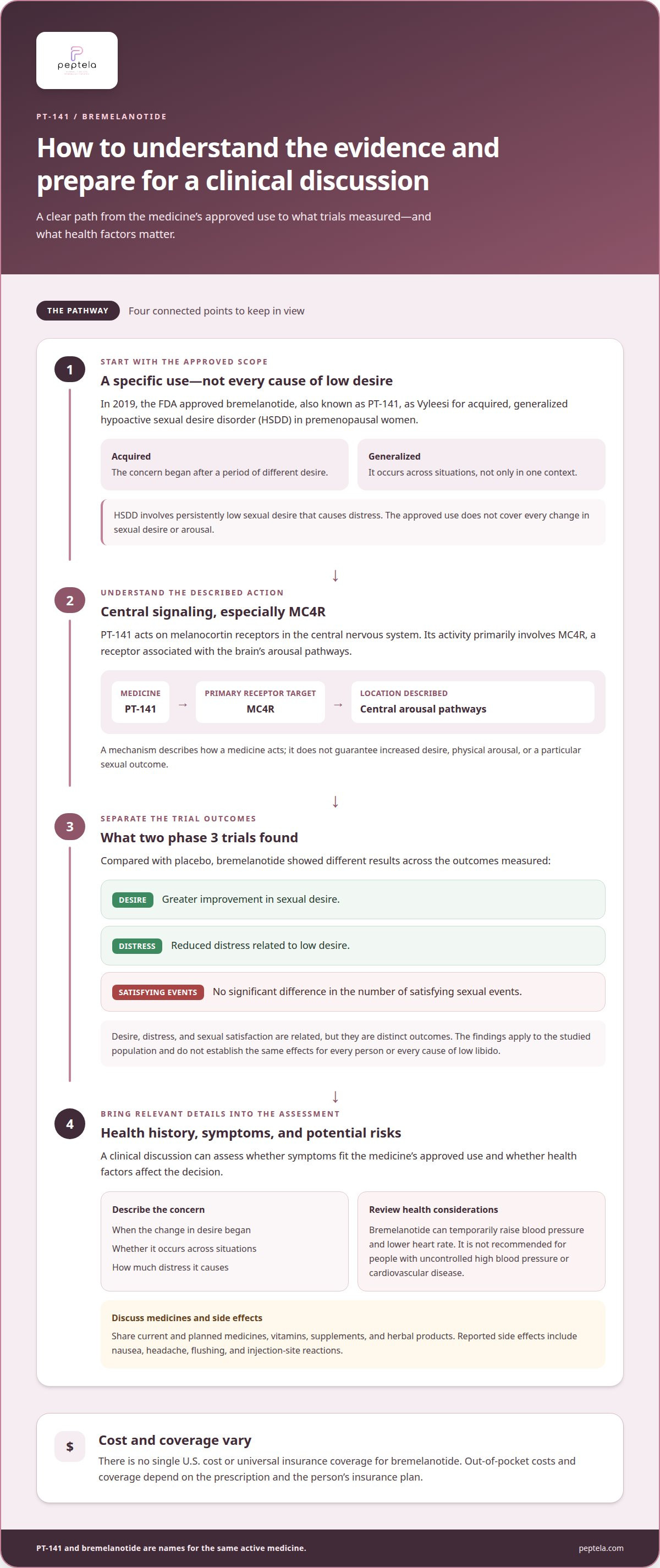
PT-141 has an FDA-approved role for a specific group of women, not as a treatment for every cause of low desire. The FDA approved bremelanotide, also known as PT-141, as Vyleesi in 2019 for acquired, generalized hypoactive sexual desire disorder (HSDD) in premenopausal women.
If you’re weighing PT-141 peptide for low female libido and arousal, it’s reasonable to want clarity on both desire and physical response. Clinical trials found that bremelanotide improved sexual desire and reduced distress related to low desire more than placebo, but did not show a significant difference in the number of satisfying sexual events.
This article explains how PT-141 may affect desire and arousal, what the FDA approval covers, and what clinical trial results do and don’t show. You’ll also learn why the distinction between an approved prescription medicine and other products sold as PT-141 matters when considering your options.
Key Takeaways
- Understand who the FDA-approved bremelanotide treatment is intended for, and how that differs from general low desire.
- Learn how PT-141 acts on central melanocortin receptors and why this matters for sexual desire and arousal.
- See what clinical trials found about changes in desire and distress, and where the evidence has limits.
- Review potential side effects and health considerations to discuss when weighing treatment options.
Generalized hypoactive sexual desire disorder in premenopausal women
In 2019, the FDA approved bremelanotide as Vyleesi for acquired, generalized hypoactive sexual desire disorder (HSDD) in premenopausal women. The approval applies to this specific condition, not every change in sexual desire or arousal.
HSDD involves persistently low sexual desire that causes distress. “Acquired” means the concern began after a period of different desire; “generalized” means it occurs across situations, not just in one context. These distinctions help define the condition covered by the medicine’s approved use.
There is no single U.S. cost or universal insurance coverage for bremelanotide. Out-of-pocket costs and coverage depend on the prescription and the person’s insurance plan.
Potential Effects on Sexual Desire
Bremelanotide is a prescription medicine that may increase sexual desire for some premenopausal women with acquired, generalized HSDD. This matters because low desire can cause distress, and treatment studies measured changes in both desire and related distress.
Two phase 3 trials found greater improvement in desire and reduced distress related to low desire with bremelanotide than with placebo. However, the trials did not find a significant difference in the number of satisfying sexual events. Desire, distress, and sexual satisfaction are related, but they are distinct outcomes.
For women considering the PT-141 peptide for low female libido and arousal, that distinction helps set realistic expectations. Evidence supports changes in desire and distress for the approved population; it does not establish the same effects for every person or every cause of low libido.
Discussion With a Clinician
A clinical discussion can help determine whether symptoms fit the medicine’s approved use and whether health factors affect the decision. Share when the change in desire began, whether it occurs across situations, and how much distress it causes. These details can help distinguish the concern being addressed from broader questions about arousal or sexual satisfaction.
Bremelanotide can temporarily raise blood pressure and lower heart rate. It is not recommended for people with uncontrolled high blood pressure or cardiovascular disease. Discuss current and planned medicines, vitamins, supplements, and herbal products too. The U.S. National Library of Medicine advises sharing these details with a doctor and pharmacist.
Include possible side effects in the discussion. Nausea, headache, flushing, and injection-site reactions have been reported. A clinician can consider these risks, your health history, and the medicine’s specific indication when assessing whether it may be appropriate.
Central melanocortin receptor activity
PT-141 acts on melanocortin receptors in the central nervous system. Its activity primarily involves MC4R, a receptor associated with the brain’s arousal pathways. This central action distinguishes its proposed mechanism from approaches focused only on circulation or hormone levels. It offers one way to understand how a treatment may influence sexual desire without framing libido as solely a blood-flow or hormone concern.
Melanocortin receptors are the targets PT-141 activates. The research describes MC4R as its primary receptor target in the central nervous system. In practical terms, the proposed sequence begins with PT-141 activating these receptors, then involves activity in brain pathways related to arousal. This describes a biological mechanism, not a guarantee that a person will experience increased desire, physical arousal, or a particular sexual outcome.
The central focus matters because hypoactive sexual desire can involve more than one dimension of sexual health. A person may notice reduced interest, changes in arousal, or distress about desire. PT-141’s described action centers on brain signaling, rather than solely on changes to circulation or hormone levels. That difference helps explain why receptor activity is relevant to understanding the treatment, while not establishing that every contributing factor has the same response.
MC4R is a named example of a melanocortin receptor involved in this explanation. The available description identifies it as the primary receptor target, but does not establish that it is the only receptor involved. Keeping that distinction clear avoids turning a simplified mechanism into a claim about every pathway in the nervous system. It also separates the biological target from the broader experience of sexual desire, which can vary between individuals.
For a reader considering PT-141, the key point is the location and focus of its described activity: melanocortin receptors, especially MC4R, in the central nervous system. This mechanism may help explain how PT-141 relates to arousal pathways. It does not mean the treatment addresses every aspect of wellness or sexual health. Receptor activity describes how a medicine acts; clinical outcomes describe what trials observed in people.
PT-141 and bremelanotide
PT-141 and bremelanotide are names for the same active medicine. Knowing both terms can help you follow discussions about the medication and its effects. The name alone, however, doesn’t explain what to expect in daily life. Desire, physical arousal, relationship connection, and sexual satisfaction describe different experiences, so it helps to be clear about which one matters most to you.
Bremelanotide is described as acting on central arousal pathways. Its potential role relates to sexual desire; it does not guarantee a particular physical response or change in satisfaction. For example, it may help to clarify whether reduced interest is the main concern, or whether arousal and intimacy feel different too. Identifying these distinctions makes treatment goals more specific and realistic.
Reported timing offers another point to discuss. Bremelanotide may produce effects in as little as 45 minutes, and its effects can last from six to 72 hours. These ranges describe reported timing, not a schedule that predicts an individual experience. The intended timing and duration matter when considering how a medicine might fit into personal circumstances and relationship expectations.
It can help to distinguish a medicine’s possible effects from broader relationship needs. A change in sexual desire does not, by itself, resolve communication, emotional connection, or differences in satisfaction between partners. You might hope to feel more interest while also wanting to talk about intimacy. Both concerns deserve attention, without assuming medication will address every part of the experience.
When reading about PT-141, focus on the exact outcome being discussed. Is the claim about desire, physical arousal, or satisfaction? Those terms aren’t interchangeable, and a result in one area doesn’t establish a result in another. Keeping that distinction in view can make conversations about bremelanotide more grounded and help you describe the change you’re hoping to address.
Safety deserves consideration alongside whether the medicine may affect desire. Bremelanotide can temporarily raise blood pressure and lower heart rate. These changes are relevant when weighing its intended effect, rather than treating a possible change in desire as the only important outcome. Although the blood pressure increase is described as temporary, it still matters when considering whether the medicine is appropriate for you.
Bremelanotide is not recommended for people with uncontrolled high blood pressure or cardiovascular disease. If either applies to you, raise it directly with a healthcare professional when discussing the medicine. You can ask how your health history relates to this recommendation and how to weigh potential benefits against safety concerns. Discussing both the reason for considering treatment and conditions that may affect its suitability keeps the conversation focused on your specific concerns and circumstances. A possible effect on sexual desire does not override the stated restriction, so both points belong in a complete, grounded discussion.
Clinical trial benefits and limitations
Clinical trial findings include side effects as well as treatment outcomes. In a 52-week study, nausea was reported by 40% of participants taking bremelanotide. Flushing affected 20%, and headache affected 12%. These figures help describe reported experiences during that study, but they don’t predict which effects an individual will have.
Other reported trial figures describe different adverse events. Injection-site reactions affected 13% of women in bremelanotide trials, while vomiting affected about 5%. About 8% of women stopped treatment because of nausea. These figures provide practical context for weighing treatment, especially for someone concerned about nausea or injections. They shouldn’t be added together, since each describes a separate outcome.
Headache figures also differ across the reported trial contexts: 12% in the 52-week study and 11% in the bremelanotide trials. That difference is a reminder to keep study figures attached to their specific context instead of treating them as one universal rate. The reported numbers describe participants in studies, not a personal forecast.
Blood pressure and heart rate are important considerations. Bremelanotide can temporarily raise blood pressure and lower heart rate. It is not recommended for people with uncontrolled high blood pressure or cardiovascular disease. These effects make cardiovascular history relevant when assessing whether the medicine may be appropriate.
Long-term safety is still being studied, so evidence beyond the reported study period is limited. Side-effect figures can inform a discussion, but they cannot account for every individual circumstance. A clinician can review your health history, including cardiovascular concerns, alongside reported nausea, flushing, headache, vomiting, and injection-site reactions.
Consider both the reported side effects and how they may relate to your health. For example, a history of uncontrolled high blood pressure matters because of the medicine’s known effect on blood pressure. Nausea is also worth discussing, given how often it was reported and that some women stopped treatment because of it. Trial results provide context, not a guarantee of an individual experience.
PT-141 and low female libido
Low libido can mean a persistent decrease in sexual interest that causes personal distress. For premenopausal women, bremelanotide’s FDA-approved use is limited to acquired, generalized hypoactive sexual desire disorder. “Acquired” describes desire that changed over time; “generalized” means the concern is not limited to one situation. These terms define the intended treatment population, not everyone experiencing reduced desire.
That distinction matters because low desire can arise in different contexts. One person may notice a broad change in interest, while another experiences difficulty only in a particular relationship or situation. Bremelanotide’s approved indication concerns the first pattern when it meets the condition’s criteria. It is not an all-purpose treatment for every concern involving sexual function, arousal, intimacy, or wellbeing.
Bremelanotide is not described as hormone therapy. Its proposed action is central, involving melanocortin receptors in the nervous system rather than focusing only on hormone levels or circulation. This is why low libido alone should not be taken as proof of a hormonal cause. The proposed mechanism also does not mean every cause of reduced desire will respond in the same way.
For women considering an injection, the evidence and the treatment’s limits belong in the same conversation. Clinical trials studied women with acquired, generalized hypoactive sexual desire disorder. Their findings apply to that study group and cannot automatically be extended to women whose libido changes occur in other contexts, or to postmenopausal women. Symptoms, health history, and treatment goals all affect how relevant those findings may be.
Desire and sexual function are not the same. A woman may feel less sexual interest without physical arousal concerns, or experience both. Describing the change clearly can help a clinician assess whether the approved indication fits. It can also prevent a broad label like “low libido” from obscuring what feels different in daily life.
The practical takeaway: PT-141, or bremelanotide, has a specific FDA-approved role for premenopausal women with acquired, generalized hypoactive sexual desire disorder. It isn’t an established answer to every hormonal change, relationship concern, or arousal difficulty. For women exploring the PT-141 peptide for low female libido and arousal, the key first distinction is whether their experience matches that defined indication and its clinical evidence.
Peptela: Peptides
Peptides is one of the offerings listed by Peptela. If you have peptide-related health questions, identifying what you want to understand can help keep the discussion focused. Consider your goals and health context rather than assuming a peptide is a one-size-fits-all answer. Clear questions can help make the conversation useful.
Start by identifying what you want to understand: whether your concern involves desire, arousal, or another aspect of wellbeing. These experiences can overlap, but they are not identical. Describing what has changed and what matters most to you gives the conversation a practical starting point without assuming a particular option is right for you.
Peptela also offers Hormone Balance, which may be relevant if you want to discuss hormonal health as part of your broader goals. NAD+ and Tirzepatide Injections are also available, though they address different areas of interest. Keeping the discussion focused on your concern helps clarify which topic deserves attention and avoids treating unrelated offerings as interchangeable.
Bring your priorities, relevant health history, and questions about how a potential approach fits your goals. For example, you may want to clarify what a discussion about peptides can address, what it cannot establish, and what other factors deserve consideration. A focused exchange supports an informed decision without promising a particular result.
The useful next step is a conversation centered on your individual circumstances, not a broad claim about peptides. Peptela lists Peptides as an offering. If you’d like to discuss your goals, contact Peptela when it feels right for you.
Frequently Asked Questions
Is PT-141 FDA approved?
Bremelanotide, marketed as Vyleesi, received FDA approval in 2019 for acquired, generalized hypoactive sexual desire disorder in premenopausal women. That approval applies to this medicine and its defined indication, not to every product sold as PT-141. Unregulated PT-141 products sold online aren’t FDA-approved. A product’s name alone doesn’t establish its approval status or show that it matches the prescription medicine.
Is PT-141 the same as bremelanotide?
PT-141 is another name for bremelanotide. Vyleesi is the FDA-approved brand name for bremelanotide prescribed for a specific desire disorder in premenopausal women. The naming distinction matters when reading product labels: a product described as PT-141 isn’t automatically the same as FDA-approved Vyleesi. Prescription status, product identity, and intended use all matter when interpreting a label or discussing treatment.
What actually helps low libido during perimenopause or menopause?
What may help depends on the concern and its context. A clinician can distinguish reduced desire from vaginal discomfort, arousal changes, or distress, then review health history, hormonal changes, and current medicines. Bremelanotide’s FDA-approved indication is for premenopausal women with acquired, generalized hypoactive sexual desire disorder, not menopause broadly. Naming the main symptom and when it occurs can guide an individualized discussion about options.
What are the side effects of PT-141?
Reported side effects include nausea, flushing, headache, vomiting, and injection-site reactions. In a 52-week study, nausea affected 40% of participants, flushing 20%, and headache 12%. Bremelanotide can also temporarily raise blood pressure and lower heart rate. It isn’t recommended for people with uncontrolled high blood pressure or cardiovascular disease. Discuss relevant health conditions and possible side effects with a clinician before treatment.
Can PT-141 be combined with other therapies?
Whether to combine treatments depends on the specific medicines and a person’s health history. Before considering bremelanotide, tell a doctor and pharmacist about medicines, vitamins, supplements, and herbal products you take or plan to take. This includes prescriptions for other concerns, even if they seem unrelated to sexual health. A complete medication list helps clinicians assess possible interactions and plan appropriate care.
How does PT-141 work compared to treatments like vaginal estrogen?
PT-141 acts centrally on melanocortin receptors in the nervous system and is approved for a defined desire disorder. Vaginal estrogen is a different therapy, so the two shouldn’t be treated as interchangeable. The relevant choice depends on whether the main concern involves sexual desire, vaginal symptoms, or both. A clinician can review those symptoms and health history when discussing suitable options.
How is PT-141 administered?
For its approved HSDD indication, bremelanotide is injected under the skin of the abdomen or thigh. This is a subcutaneous injection, not a nasal spray. The approved medicine’s route and injection sites shouldn’t be assumed for other products labeled PT-141. Follow the instructions for the prescribed product, and discuss injection questions or concerns with a clinician or pharmacist.
How is PT-141 dosed?
The prescribed bremelanotide dose for HSDD is 1.75 mg, injected under the skin of the abdomen or thigh. That dose refers to the prescription treatment for its approved indication; it doesn’t establish a dose for other PT-141 products. Follow the prescribing instructions rather than adjusting the amount or timing on your own, and discuss questions about your regimen with a clinician.


