
Peptide therapy can mean very different things. Peptides are short chains of amino acids, typically about 2-100 amino acids long, and each can trigger a different response by interacting with specific receptors in the body. The term describes a broad category, not one uniform treatment.
If you’re considering peptide therapy, it’s reasonable to want a clear picture before deciding what it could mean for your health. Evidence and potential effects vary by peptide, and the right context depends on the specific compound, your goals, and your health history.
This article explains how peptide therapy works, what evidence and safety considerations to understand, and how clinician guidance can inform decisions. It also covers the role of lifestyle habits alongside treatment, so you can compare options and take an active role in your well-being.
Key Takeaways
- Potential benefits depend on the specific peptide and the goal being addressed, so start by understanding what a treatment is intended to do.
- Health history matters: pregnancy, breastfeeding, active cancer, and certain medical conditions can affect whether treatment is appropriate.
- Compare supplements, injectable peptides, and established medicines by their purpose, evidence, and potential risks, not just their format.
- Unregulated online products can raise concerns about sourcing, contamination, and dosing; clinical oversight supports safer, more informed decisions.
- Lifestyle habits can complement a treatment plan by supporting the everyday foundations of energy, recovery, and long-term well-being.
What benefits does peptide therapy offer?
Potential benefits depend on the specific peptide and its intended purpose. Reviewing the evidence, health considerations, and treatment context can help you weigh potential benefits. Peptides are not interchangeable, and their effects vary by compound.
Potential Wellness, Skin, and Muscle Benefits
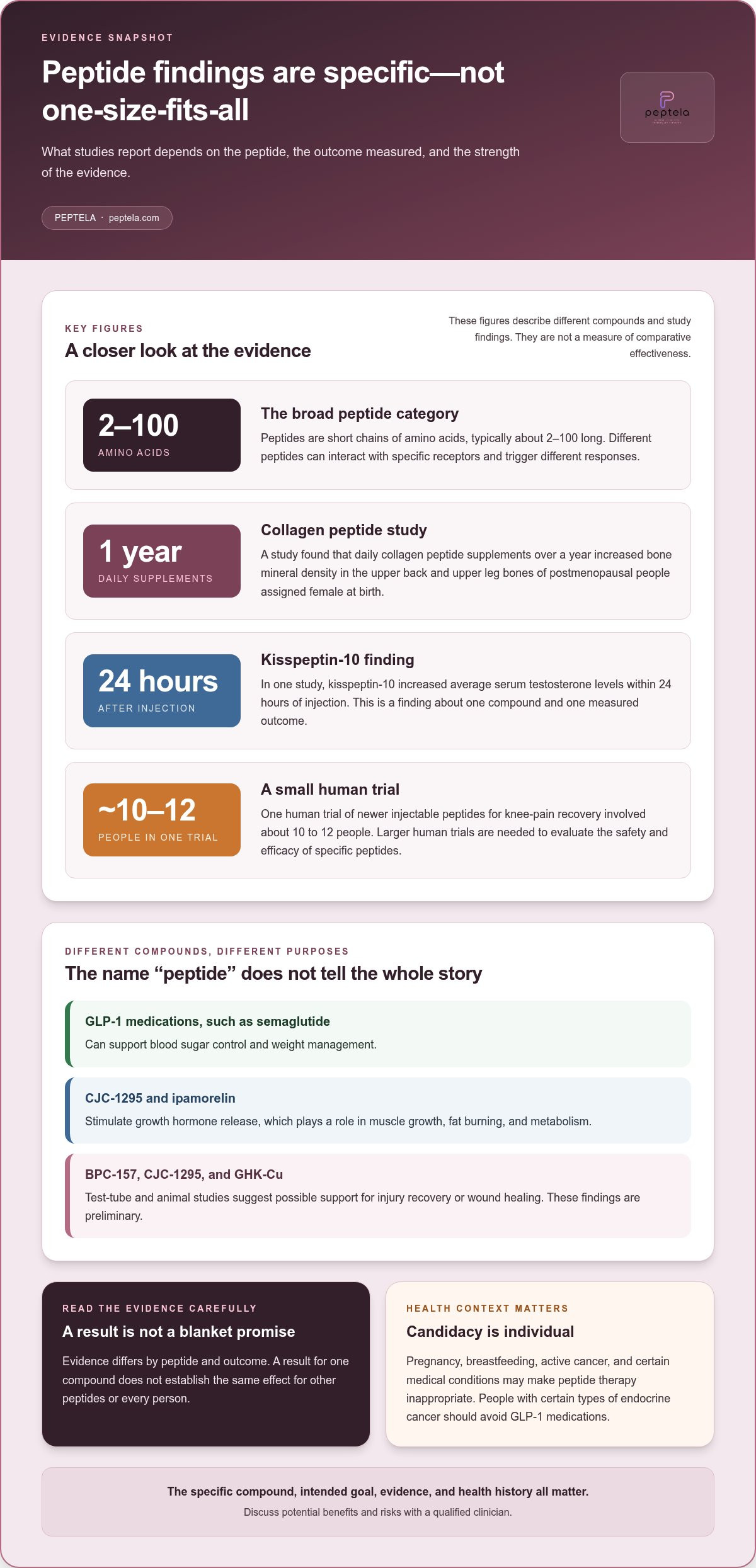
Peptides can influence different body functions by binding to specific receptors. For example, GLP-1 medications such as semaglutide can support blood sugar control and weight management. CJC-1295 and ipamorelin stimulate growth hormone release, which plays a role in muscle growth, fat burning, and metabolism. These are distinct actions, not a single all-purpose wellness effect.
Other potential effects vary by peptide. Some peptides regulate hormone production, cell growth, or inflammation; collagen peptides in some eye creams may help skin appear more youthful. BPC-157 has been studied for possible tissue repair and joint support, while some evidence comes from test-tube and animal studies. The specific compound matters more than the broad label “antiaging.”
Potential Candidates and Contraindications
Interest in these treatments spans adults in their 30s-60s, including people seeking support for metabolic health, recovery, or other specific goals. GLP-1 medications may benefit people with diabetes, obesity, or chronic conditions that contribute to long-term weight gain. That does not mean every peptide suits every goal: a compound intended to affect growth hormone differs from one used for blood sugar or weight management.
Health context can change candidacy. Peptide therapy may be inappropriate during pregnancy or breastfeeding, with active cancer, or with certain medical conditions. People with certain types of endocrine cancer should avoid GLP-1 medications. These considerations make a person’s diagnosis and treatment goal important parts of assessing a potential option.
Evidence for Potential Benefits
Evidence differs by peptide and outcome. A study found that taking collagen peptide supplements daily for a year increased bone mineral density in the upper back and upper leg bones of postmenopausal people assigned female at birth. In one study, kisspeptin-10 increased average serum testosterone levels within 24 hours of injection. These findings concern particular compounds and study outcomes, not every peptide treatment.
For newer compounds, evidence may be more preliminary. Test-tube and animal studies suggest BPC-157, CJC-1295, and GHK-Cu might support injury recovery or wound healing. One human trial of newer injectable peptides for knee-pain recovery involved about 10 to 12 people. Larger human trials are needed to evaluate the safety and efficacy of specific peptides.
Does health insurance cover peptide therapy in the United States? Coverage depends on the medication, its approved use, the diagnosis, and the terms of the insurance plan. FDA approval for a specific condition does not by itself establish coverage for every use.
How much does treatment cost, including consultations and follow-up? The price depends on the case and is given after a quote request; the peptide, formulation, and follow-up needs affect the cost.
Are there any side effects of peptide therapy?
Side effects depend on the compound, dose, route, and individual health context. Reviewing reported reactions and evidence gaps can help you know what to discuss before starting peptide therapy and what changes to share during follow-up.
Potential Side Effects and Supplement Safety
People using injectable peptides have anecdotally reported gastrointestinal problems, headaches, fatigue, and irritation where an injection was given. Subcutaneous or intramuscular injections can also cause local pain, swelling, and redness. These reactions may differ from effects associated with particular medicines: insulin can cause low blood sugar, while GLP-1 medications can cause gastrointestinal issues and carry a risk of pancreatitis.
Some injectable peptides may carry a risk of pancreatic inflammation. Unregulated products raise separate concerns, including contamination, uncertain sourcing, and dosing risks. A supplement label does not establish that a product has been evaluated as a medicine or has established safety data. Product identity, formulation, and route all matter when considering possible effects.
Before starting peptide therapy, make a complete list of prescriptions, over-the-counter medicines, and supplements. This context can help a clinician assess possible interactions and distinguish a new reaction from an existing symptom or another medication’s effects. Note when symptoms begin and whether they change after a dose, then share those details during follow-up.
Immune-Function Effects
Peptides can influence immune activity in different ways, so “immune effects” doesn’t mean one predictable outcome. Thymosin Alpha-1 is associated with improved immune function, while some injectable peptides may trigger abnormal immune responses, including allergic reactions or autoimmune issues.
Possible signs of an allergic reaction include itching, swelling, and difficulty breathing. These symptoms require urgent medical attention. A peptide described as affecting immune function is not automatically protective for everyone, and an intended effect does not rule out an unwanted response. The specific compound and a person’s health history shape the safety discussion.
Reported and Unknown Side Effects
Reported reactions can provide useful signals, but they do not establish every risk for every compound. Gastrointestinal symptoms, headache, fatigue, and injection-site irritation have been reported anecdotally for some injectable peptides. Evidence is insufficient to determine whether unregulated peptides are safe.
This uncertainty matters for newer compounds and claims about tissue repair or healing. BPC-157 is described as promoting tissue healing, reducing inflammation, and protecting against gastrointestinal damage, but those proposed benefits don’t establish a complete safety profile. Ask about the specific peptide, route, and known risks, and share medicines and supplements because interactions can occur. For a discussion of the compound and its risks, explore clinician-guided peptide care.
Peptides vs Supplements vs Injectables: What’s the Difference?
Peptides are molecules, supplements are products, and injections are a delivery method. Knowing which category applies helps you compare a treatment’s purpose, evidence, and how it enters the body.
How does peptide therapy compare with established treatments for common conditions? FDA-approved peptide medicines, including insulin and GLP-1 medications, have specific medical uses. Newer or unapproved peptides aren’t interchangeable with these established treatments because evidence and safety data differ.
Peptides and Supplements Are Different Categories
Peptides are chains of amino acids that bind to receptors and trigger responses. A supplement may contain peptides, but “supplement” describes a product category, not one molecule or action. For example, collagen supplements commonly contain collagen peptides made up of three to four amino acids. Their presence does not make every supplement a prescription medicine or injectable treatment.
Route matters, too. Peptides may be taken as oral tablets, nasal sprays, or injections. Oral peptides can be broken down by stomach acid and enzymes before absorption, which may make this route less effective. Depending on the peptide and intended effect, injections may be given under the skin or into muscle.
Established Injectable Peptides
Some peptide medicines have established medical uses. Insulin is a peptide hormone made by the pancreas, and its 51 amino acids help cells take in sugars. It has been used to treat type 1 diabetes since 1923. Its medical role differs from newer peptides promoted for goals such as fat loss or recovery.
FDA-approved GLP-1 medications include semaglutide, sold as Ozempic and Wegovy, and tirzepatide, sold as Zepbound and Mounjaro. These medicines help treat diabetes and can support weight loss by slowing digestion and helping patients feel fuller. More than 100 peptide drugs are FDA-approved in the United States, but approval applies to specific medicines and conditions.
Injection Frequency Depends on the Peptide
There isn’t one injection schedule for all peptides. The compound, its intended effect, and its administration route shape how it’s used. For example, AOD-9604 is described as available in daily injections or capsule form. That example doesn’t establish a schedule for other peptides.
Some injectable peptides are administered under the skin; others may be given into muscle. Injections are a delivery method, not proof that a peptide is approved or effective. Comparing a product’s intended use, evidence, route, and potential side effects gives you a clearer basis for discussing it as a medical treatment.
Safety, online products, and medical supervision
Safety depends on the specific peptide, its quality, and how treatment is prescribed. Approval status and ongoing clinical oversight help clarify what evidence supports its use.
FDA Approval and Peptide Safety
FDA approval applies to particular peptide medicines and conditions, not to every product marketed as a peptide. More than 100 peptide drugs are FDA-approved in the United States, and approved peptide medications have been studied in large clinical trials that provide safety data.
Many injectable peptides marketed online and by wellness clinics are not FDA-regulated or FDA-approved, according to the U.S. Food and Drug Administration. The FDA has approved certain peptides for specific conditions. A product’s online availability or claims about recovery do not establish that it has been evaluated for that use.
Product quality matters, too. The FDA warns that unregulated peptides may contain impurities. Some injectable peptides may trigger abnormal immune responses, including allergic reactions or autoimmune issues. Itching, swelling, and difficulty breathing can signal an allergic reaction and require urgent medical attention.
Long-Term Safety Concerns
Long-term safety is uncertain when evidence does not show how a product affects people over time. For unregulated peptides, available safety evidence is insufficient to determine whether they are safe. Contamination, uncertain sourcing, and dosing create additional concerns, while hormone-related effects may require careful monitoring.
The route also shapes potential risks. Injections under the skin or into muscle can cause pain, swelling, and redness at the injection site. Peptides that stimulate growth hormone release may cause hormonal imbalances if used improperly. Sharing a complete list of medicines and supplements helps clinicians consider possible interactions before treatment.
What should patients expect during a consultation and treatment process? A licensed medical provider reviews the treatment goal, health conditions, medications, and supplements, then assesses candidacy and discusses expected results. Ongoing monitoring tracks progress and supports dosing adjustments.
Before starting, ask which specific peptide is proposed, its intended use, and whether it is FDA-approved for that use. Clarify the intended route and monitoring plan, too. These details matter for athletes: the World Anti-Doping Agency includes all growth hormone secretagogue supplements on its banned list for athletes competing in athletic competitions.
Clinician guidance gives treatment a defined purpose and a way to respond to changes. It does not make every peptide appropriate, but it keeps decisions connected to the compound, evidence, health history, and observed effects.
Integrating peptide therapy with lifestyle care
A peptide acts on a biological signal, while daily routines shape the context around that signal. Integrating care means connecting a specific treatment goal with nutrition, movement, sleep, and ongoing clinical review.
Start with the goal. A person considering a peptide related to metabolism needs a plan that also accounts for meals, activity, and existing health conditions. GLP-1 medicines, for example, can slow digestion and help patients feel fuller. Eating patterns and hydration still matter to day-to-day well-being, and a medicine doesn’t replace care for a chronic condition.
Nutrition provides building blocks, not a shortcut to a treatment result. Proteins are made from chains of amino acids, and dietary protein supports normal tissue maintenance. A practical discussion can consider whether regular meals include protein sources, as well as any digestive changes during treatment. Do not use supplements as substitutes for prescribed medicines such as insulin.
Movement can be matched to a person’s goals and capacity. For someone focused on muscle, resistance exercise offers a clear activity to discuss and track. For someone prioritizing recovery, the plan can account for training load and rest days. These routines support broader health goals, but they do not prove that a peptide will stimulate muscle growth or speed repair.
Sleep and stress routines also belong in the conversation because they influence how a person feels day to day. A simple record of sleep quality, energy, appetite, and activity can help distinguish routine changes from possible treatment effects. Keep the record consistent and share it during follow-up instead of relying on memory alone.
Clinician guidance connects these details. Before treatment, share diagnoses, medicines, supplements, and lifestyle changes. During follow-up, discuss side effects, changes in weight or appetite, and whether your original goal still fits. A clinician can use this information to assess progress and adjust the treatment plan when appropriate.
- Set one defined goal: identify whether the focus is metabolic health, muscle, or another concern.
- Track daily context: note meals, movement, sleep, and relevant symptoms.
- Review changes together: bring the record and medication list to follow-up.
This approach keeps treatment connected to real life, not isolated from it. To discuss how a clinician-guided plan can fit your health goals and routines, explore a personalized peptide plan.
Peptela: Tirzepatide Injections
Peptela offers Tirzepatide Injections for people exploring clinician-guided support for metabolic health and weight management. Tirzepatide is a GLP-1 medication that can support weight loss and help treat diabetes; treatment decisions should reflect the intended health goal and relevant medical history.
If you’re weighing peptide therapy, consider how it fits alongside everyday habits and your broader care plan. Peptela offers clinician-guided, subscription-based treatments, including Peptides and Hormone Balance, with personalized care from its in-house team. A focused conversation can help clarify which option aligns with the health goal you’re addressing.
Visit peptela.com to learn more about Peptela’s approach and explore whether Tirzepatide Injections fit your goals.
Choose a Next Step That Fits Your Goals
Your next step does not have to be a commitment to treatment. It can be a focused conversation about what you want to improve, what you have already tried, and which questions matter most. That gives a clinician a clearer starting point for discussing whether peptide therapy fits your health priorities and how it may complement your existing care.
Peptela offers Tirzepatide Injections, NAD+ Injections, and Hormone Balance through personalized, clinician-guided care. These options address different goals, so start with what you want to work on rather than a product name. Share relevant health conditions, medicines, and supplements to inform the conversation.
Bring your questions, take time to understand the options, and choose the pace that feels right for you. Contact Peptela to discuss your options and take a thoughtful next step toward care that reflects your priorities.
Frequently Asked Questions
What Are Peptides?
Peptides are short chains of amino acids that signal cells to respond in particular ways. They typically contain 2-100 amino acids; scientists generally classify longer chains as proteins. Insulin is one familiar peptide hormone, while collagen supplements contain small collagen peptides. The name describes a broad group of molecules, not one treatment. Their effects depend on the peptide and the receptors it interacts with.
When Will You See Results?
Timing varies with the peptide and the outcome being tracked. Reported timelines for CJC-1295 and ipamorelin include possible changes within 4-8 weeks; reported improvements in sleep, recovery, mood, and energy may appear within 2-4 weeks. Other reported changes, such as fat loss or muscle tone, may take longer. These timelines are not a reliable forecast for an individual, so track specific changes and discuss them during follow-up.
What is peptide therapy and how is it supposed to work?
Peptide therapy uses a specific peptide to influence a biological signal. Peptides bind to receptors and trigger responses that depend on the peptide and receptor involved. For example, insulin helps regulate blood sugar, while growth hormone-releasing peptides can prompt the pituitary gland to release growth hormone. A treatment’s intended effect therefore depends on the compound, its route, and the health goal it is meant to address.
Which peptide therapies are FDA-approved in the United States, and for what conditions?
More than 100 peptide drugs are FDA-approved in the United States, each for specific uses. Examples include semaglutide, sold as Ozempic and Wegovy, and tirzepatide, sold as Zepbound and Mounjaro. GLP-1 medicines help treat diabetes and can support weight loss. Insulin is another established peptide medicine used for type 1 diabetes. Approval applies to a particular medicine and condition, not every use of a similar peptide.
Which commonly marketed peptides are unapproved or compounded, and what is their legal status?
Some injectable peptides promoted online or by wellness clinics are not FDA-regulated or FDA-approved, according to the U.S. Food and Drug Administration. BPC-157, CJC-1295, and GHK-Cu appear in claims about recovery or repair, but that doesn’t establish approval for those uses. Compounding does not itself mean a product is FDA-approved; don’t assume online availability establishes approval or legality. Actual product packaging may appear differently than shown.
If approved, your treatment is compounded by a US-licensed, LegitScript-certified pharmacy partner, rigorously inspected for quality, and shipped discreetly to your door.
What conditions are peptide clinics claiming to treat, and what evidence supports those claims?
Claims may include metabolic health, weight management, muscle growth, skin changes, or tissue recovery. Evidence varies by peptide and intended use. GLP-1 medicines have established uses for diabetes and can support weight loss, while evidence for newer recovery claims includes animal and test-tube studies. Benefits outlined on Peptela.com are based on 3rd party studies. Ask which specific compound supports a claim and whether studies examine people or laboratory models.
What are the risks, side effects, and interactions of peptide therapy?
Reported effects for injectable peptides include gastrointestinal problems, headache, fatigue, and injection-site irritation. Insulin can cause low blood sugar; GLP-1 medicines can cause gastrointestinal issues and may carry a risk of pancreatitis. Reactions can differ by compound and route. Share all medicines and supplements with the clinician, since interactions can occur. The above statements have not been evaluated by the Food and Drug Administration. These products are not intended to diagnose, treat, cure, or prevent any disease.
How can patients evaluate a peptide therapy clinic and verify product quality?
Ask which peptide is proposed, its intended use, evidence, source, and monitoring plan. Prescription products require an online evaluation with a licensed medical professional who will determine if a prescription is appropriate. No in-person visit required. Medication is offered as a subscription service which you can cancel at any time. Clear answers about sourcing and follow-up help you make an informed decision about your care.


