

Before tirzepatide, the most important step may be asking the right questions, not choosing a dose. If you’re wondering what to ask before tirzepatide, it makes sense to want clear answers about how your health history, goals, and daily life fit into the decision. A thoughtful conversation with a clinician can help you understand potential benefits and trade-offs.
This checklist will help you prepare. It covers questions about your medical history and current medications, what you hope to achieve, possible side effects, alternatives, and follow-up. You’ll also find suggestions for what to bring so the conversation can focus on what matters to you.
There’s no one-size-fits-all answer. Peptela provides personalized, clinician-guided care, supported by an in-house team with 199+ years of combined clinical experience. Use these questions to make the conversation collaborative, set clear expectations, and decide with your clinician whether tirzepatide fits your needs.
Key Takeaways
- Use what to ask before tirzepatide as a starting point for a focused conversation about the goals you want to address.
- Prepare an overview of your health conditions, allergies, treatment history, medicines, and supplements.
- Ask which potential benefits, side effects, serious warnings, and alternatives are relevant to your circumstances.
- Clarify the treatment instructions, follow-up plan, progress reviews, and how to raise questions or concerns.
- Weigh your goals, health context, and care expectations before making a shared decision with your clinician.
Before Tirzepatide: What Do You Want Help With?
Questions are a useful starting point, not a commitment to treatment. Before focusing on a medication, identify the health changes you hope to discuss and why they matter now. You might want to explore weight management, blood sugar, or another concern with a clinician. Your priorities may also be practical, such as feeling more comfortable with everyday movement, supporting your health over time, or finding options that fit your routine.
Keep your goal separate from your assumption about how to reach it. “I want to improve my health” is a starting point; “tirzepatide will definitely achieve this particular result” is a conclusion to examine together. A clinician can consider your circumstances and discuss whether tirzepatide is appropriate. In a pre-treatment consultation, you bring your goals and context, and your clinician helps you weigh options and expectations.
Make your notes more useful by writing down:
- The change you hope to work toward, in your own words.
- Why it matters to you now, including any effect on daily routines or well-being.
- What you’ve tried before and what felt helpful, difficult, or unsustainable.
- What you want to understand before considering a treatment decision.
How can you describe your goals clearly?
Be specific about what you want to discuss, without needing to set a number or deadline. For example, explain how your health affects daily activity or describe a concern you’ve been monitoring. Note how each goal connects to your life and priorities. This gives the clinician a clearer starting point than a medication name alone.
It can also help to distinguish the outcome you want from the measures you might use to discuss progress. Ask which signs of progress make sense for your circumstances and how you and the clinician might review them. Avoid treating a particular amount or pace of weight change as guaranteed, or assuming that another person’s experience predicts yours.
What expectations should you bring to the conversation?
Bring your preferences and concerns, too. Ask what outcomes are realistic for you, what uncertainties remain, and how you might discuss progress over time. Share previous approaches without judgment. What you stopped, what you continued, and what didn’t fit your routine can all help shape a personalized conversation. You don’t need to arrive with a perfect plan.
General information can help you prepare, but it can’t forecast an individual result. For a broad introduction to tirzepatide, review Tirzepatide on Wikipedia, then ask how that information relates to your situation. What to ask before tirzepatide depends in part on your goals, so ask your clinician to connect general evidence and known uncertainties to your health context rather than treating averages as a personal prediction.
What Health History Should You Discuss Before Tirzepatide?
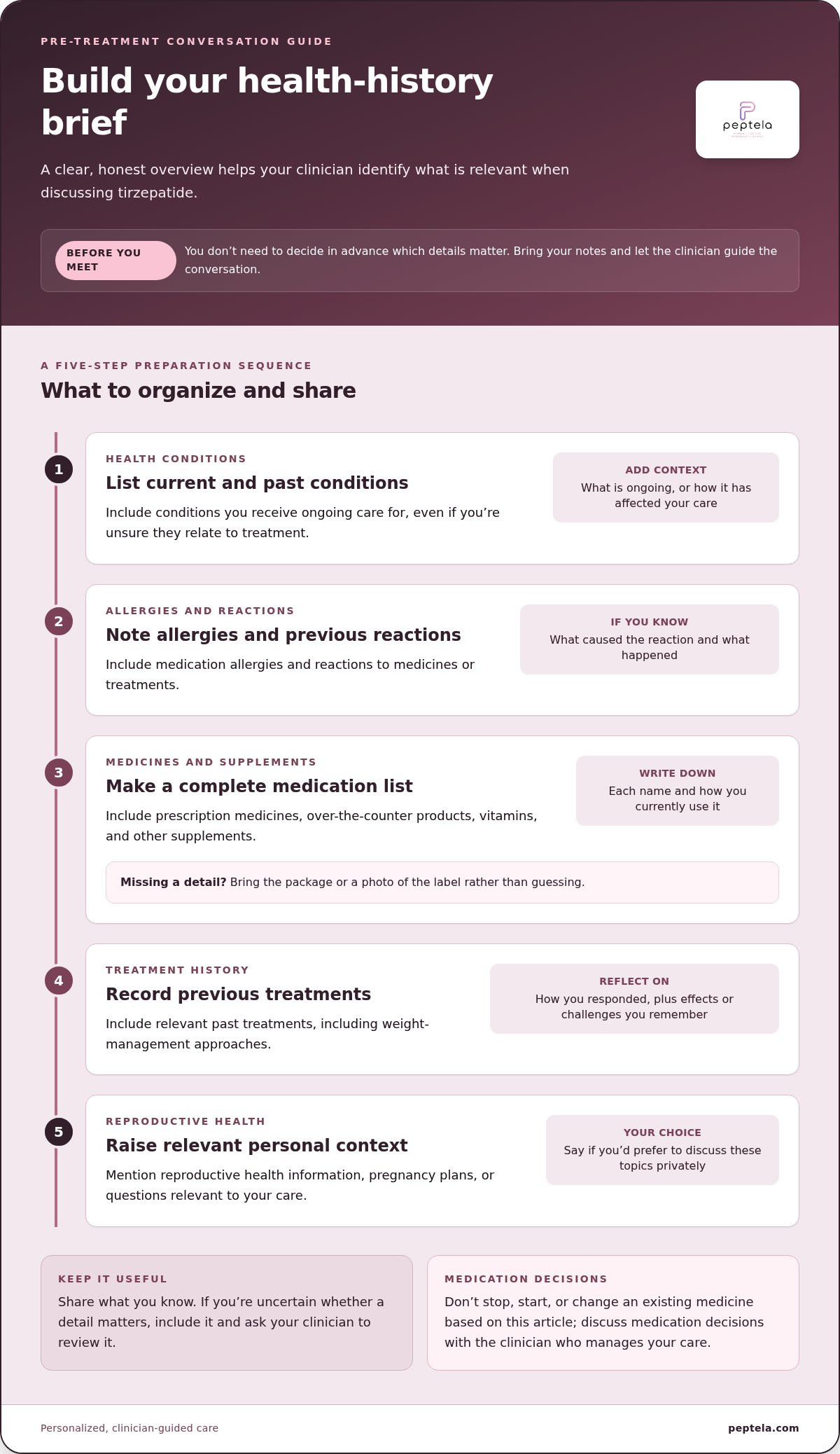
Your health history gives a clinician important context for discussing whether tirzepatide may suit you. You don’t need to decide in advance which details matter. Bring a clear, honest overview and let the clinician identify what’s relevant. A complete health history and medication list can help your clinician assess your individual suitability.
Use this sequence to organize what you want to share:
- Health conditions: Note current and past conditions, including those you receive ongoing care for.
- Allergies and reactions: Include medication allergies and any previous reactions to medicines or treatments.
- Medicines and supplements: List prescription medicines, over-the-counter products, vitamins, and other supplements.
- Treatment history: Record relevant previous treatments, including weight-management approaches and how you responded to them.
- Reproductive health: Mention relevant reproductive health information, pregnancy plans, or questions you’d prefer to discuss privately.
Which medical conditions and allergies should you mention?
Include current and past conditions, even if you’re unsure they relate to treatment. Share what you know about each, such as whether it’s ongoing or how it has affected your care. Tell the clinician about allergies and previous reactions, including what caused the reaction and what happened, if you know. Don’t try to determine on your own whether a condition rules treatment in or out.
For questions about condition-specific risks, ask your clinician to review your circumstances alongside current official prescribing information. The FDA approval of tirzepatide for weight management provides official background on that indication, but an approval announcement isn’t a personalized assessment. Ask which parts of the current prescribing information apply to your history and what needs further discussion.
How should you prepare a medication and treatment list?
Write down each medicine and supplement, including its name and how you currently use it. If you don’t know a detail, bring the package or a photo of the label rather than guessing. Include prescriptions, nonprescription products, and supplements so your clinician can review your full medication picture. Add previous weight-management treatments and any effects or challenges you remember.
Bring up reproductive health information or pregnancy plans that may be relevant to your care. If you’d rather discuss these topics privately, say so. Your clinician can explain which details matter and answer questions in context. Don’t stop, start, or change any existing medicine based on this article; discuss medication decisions with the clinician who manages your care.
Peptela’s clinician-guided tirzepatide care is personalized, so the conversation can focus on your health context rather than a one-size-fits-all checklist. Bring your notes, raise anything you’re unsure about, and work through the information with your clinician.
What Should You Ask About Tirzepatide Benefits, Risks, and Alternatives?
A useful discussion weighs potential benefits against uncertainties, possible side effects, and other ways to work toward your goals. Ask your clinician which parts of the evidence apply to your circumstances and which may not. The aim isn’t to predict a perfect outcome. It’s to understand the options well enough to make a considered choice.
Use these prompts to keep the conversation balanced:
Decision topic: Potential benefits. Ask: “Which of my goals might tirzepatide help address, and how would we assess progress?” Why it matters: This connects the treatment discussion to your priorities instead of assuming one outcome is right for everyone.
Decision topic: Side effects and warnings. Ask: “Which common side effects and serious warnings are most relevant to me, and when should I seek clinical advice?” Why it matters: You’ll know what to watch for and how to raise concerns. Commonly reported side effects include nausea, diarrhea, vomiting, and constipation.
Decision topic: Alternatives. Ask: “What other options could support the same goals, including non-medication approaches, and how do their trade-offs compare?” Why it matters: Comparing options can help you choose an approach that fits your health context and preferences.
Decision topic: Personal uncertainty. Ask: “What can’t we predict about my response?” Why it matters: This separates general evidence from an individual forecast.
How can you discuss possible benefits without assuming a result?
Ask which treatment goals are relevant in your case and what progress would mean to you and your clinician. Progress may involve more than one measure, so clarify what you’ll review and how it relates to your priorities. If you’ve seen trial results or heard about another person’s experience, bring them up as questions, not as benchmarks you expect to match.
Study findings describe groups of participants under particular conditions. Results can depend on the people studied, the dose used, and the length of follow-up. They help clinicians understand potential effects, but can’t guarantee how one person will respond. Ask what the evidence can tell you, what remains uncertain, and how your progress would be considered over time.
What should you ask about risks and other options?
Ask how your health history and current medicines may affect the risks and warnings that matter to you. Request a clear explanation of common side effects, serious warnings relevant to your situation, and when to seek clinical advice. For detailed safety information, review current official prescribing information with your clinician rather than relying on general summaries.
Then compare tirzepatide with relevant alternatives, including non-medication approaches where appropriate. Ask what each option may involve, what trade-offs to consider, and how your preferences shape the decision. If you’re deciding what to ask before tirzepatide, focus on questions that clarify your personal benefits, risks, and choices, not just what the medication may do in general.
What Practical Questions Should You Ask Before Starting Tirzepatide?
Understanding the day-to-day plan can help you decide whether treatment fits your life. Ask about instructions, follow-up, progress reviews, and how to raise concerns. These details turn a treatment discussion into a clearer plan, while leaving room for your clinician to tailor decisions to your needs over time.
What should you understand about instructions and follow-up?
Before starting, make sure you know where to find your individualized administration instructions and how to follow them. Don’t rely on online summaries or someone else’s routine. Use the instructions from your prescriber and current product information, and ask for clarification if anything is unclear.
Discuss how follow-up conversations will be arranged and what a progress review may cover. Ask who to contact with non-emergency treatment questions, how to reach them, and what response process to expect. Clarify who handles each part of your care so you know where to direct questions.
Use these prompts to make the practical conversation specific:
- “Where can I find my current administration instructions, and who can clarify them?”
- “How will we arrange follow-up and review my progress?”
- “Who should I contact with a treatment concern, and what should I expect after I reach out?”
- “Which parts of my care are handled by the clinician, and which steps are my responsibility?”
- “What financial obligations should I understand before deciding?”
The financial question can help you understand your responsibilities without making assumptions about coverage or costs. Ask what information you’ll receive about your specific plan before deciding.
How will you know whether the plan needs reassessment?
Ask which goals and health measures you and your clinician will review, and how those reviews will inform future decisions. Your plan may need to reflect changes in your health, priorities, preferences, or experience. Ask how to raise a concern between planned reviews and what information would be helpful to share.
There isn’t one schedule or treatment duration that fits everyone. Ask how decisions about your plan will be individualized and what factors could lead your clinician to revisit it. This keeps the conversation focused on your progress and circumstances rather than assuming a fixed dose pathway or timeline applies to you.
As you consider what to ask before tirzepatide, look for a care approach that makes instructions and follow-up understandable and personal. Learn more about Peptela’s clinician-guided tirzepatide care and its individualized approach.
How Can You Make a Confident Decision With Clinician-Guided Tirzepatide Care?
A confident decision doesn’t require having every answer before speaking with a clinician. It means understanding how your goals, health context, treatment trade-offs, and follow-up expectations fit together. Review your notes and sort your questions into two groups: what’s clear and what still needs discussion. An unanswered question is a useful next step, not a reason to rush.
How can you turn your answers into a personal decision?
Consider what matters most to you, what you learned about potential benefits and risks, and whether the practical plan feels manageable. Compare your preferences with the clinician’s guidance, then ask for clarification if something doesn’t align or remains uncertain. A consultation is a chance to explore suitability; it doesn’t obligate you to begin treatment. It’s reasonable to take time to reflect before deciding.
Before reaching a decision, check that you can explain these points in your own words:
- Your goals: What change are you hoping to work toward, and why does it matter to you?
- Your health context: What personal history or current treatments may shape the discussion?
- Your trade-offs: What benefits, uncertainties, risks, and alternatives have you considered?
- Your care expectations: What follow-up and progress reviews should you expect, and how will you raise concerns?
If an item feels unclear, bring it back to the clinician rather than filling in the blanks with assumptions. Ask what might prompt a change in the plan and how your preferences will be included in future discussions. The decision should reflect both clinical guidance and what feels right for your circumstances.
What does personalized clinician guidance add?
A checklist helps you prepare, but it can’t interpret your individual situation. A clinician can consider your health context, goals, and questions together, then explain how those factors inform the discussion. That personal exchange can make complex information easier to apply to your decision.
Peptela provides personalized, clinician-guided care, supported by an in-house care team with 199+ years of combined clinical experience. Learn more about Peptela’s clinician-guided tirzepatide care and its individualized approach. Use that information to prepare for a conversation, not as a substitute for guidance about your health.
Take the time you need and make the choice collaboratively with a clinician. If you’re ready to explore a personalized approach, explore Peptela’s clinician-guided care.
Take Your Next Step With Clarity
You don’t need to leave the conversation with every decision made. You can leave with a clearer next step: an answer to seek, a concern to discuss, or time set aside to reflect. If questions remain, write them down while they’re fresh and bring them into your next conversation. That keeps your choice grounded in your priorities, without pressure to decide before you’re ready.
Knowing what to ask before tirzepatide can help you take an active role in a treatment decision, while your clinician helps interpret the medical details. Move at a considered pace. The right next step is one that supports informed choice and ongoing care.
Explore Peptela’s personalized, clinician-guided tirzepatide care to learn how its approach can support your next step. Your questions are a strong place to begin.
Frequently Asked Questions
What happens if I miss a tirzepatide dose?
If you miss a dose, follow the instructions for your specific product or contact your prescriber for guidance. Don’t take an extra dose to make up for one unless your prescriber or product instructions direct you to. Timing instructions can depend on how long it’s been since the missed dose and when your next dose is due. Keep the package instructions handy so you can check them promptly.
Can I take tirzepatide if I am pregnant or planning a pregnancy?
Discuss pregnancy or plans to become pregnant with your clinician before using tirzepatide. Weight-management treatment isn’t intended during pregnancy, and current prescribing information advises stopping tirzepatide if pregnancy occurs. If you discover you’re pregnant while taking it, contact your prescriber for individualized guidance. If you’re planning a pregnancy, ask how that affects treatment timing and which options may suit your situation.
Does tirzepatide affect oral birth control?
Yes, tirzepatide may reduce the effectiveness of oral hormonal contraceptives, especially after starting treatment or increasing the dose. Current prescribing information advises using a non-oral contraceptive method or adding a barrier method for four weeks after starting and for four weeks after each dose increase. Ask your clinician or pharmacist how this guidance applies to your contraceptive and treatment plan.
How should tirzepatide be stored?
Store tirzepatide according to the instructions for the exact product and presentation you receive, since storage limits can differ. Check the package insert for refrigeration, room-temperature limits, light protection, and how long the medication can remain outside refrigeration. Don’t freeze it, and don’t use medication that has been frozen. If storage conditions are uncertain or the product was left out, ask your pharmacist or prescriber before using it.
Can tirzepatide affect anesthesia or a planned procedure?
Tell your surgeon, anesthesiologist, and prescribing clinician that you use tirzepatide before a procedure involving anesthesia or deep sedation. The medicine can slow stomach emptying, which may affect aspiration risk during anesthesia. Don’t stop or adjust treatment on your own. Your care team can consider the procedure, your health, and current guidance to decide whether any change or additional precautions are appropriate.
Is compounded tirzepatide the same as an FDA-approved medication?
No. Compounded tirzepatide is not an FDA-approved drug product, and the FDA doesn’t review compounded medicines for safety, effectiveness, and quality before they’re marketed as it does approved products. Compounded medicines may be prepared for an individual patient when specific conditions are met, but they aren’t interchangeable with an FDA-approved product by default. Ask your prescriber which product is being considered and why it fits your care.


