
A personalized peptide treatment plan depends on the peptide’s intended use, how it’s administered, and what follow-up involves. There is no single schedule for every treatment. Peptide therapy may involve injections, topical applications, or oral supplements, so the plan should match the specific approach.
It’s reasonable to want clear guidance on what happens after a plan begins, especially when recovery or tissue repair is a goal. Research on personalized peptide vaccines for cancer is distinct from research on peptides for general recovery. That difference matters when considering what a treatment may support.
This article explains how clinicians tailor peptide plans, what administration and follow-up can involve, and what research says about muscle recovery and tissue repair. It also distinguishes established findings from areas where evidence is still developing, helping you approach the topic with useful questions and a clearer understanding of personalized care.
Key Takeaways
- Understand how treatment goals, peptide choice, and administration method shape an individualized plan.
- Learn what ongoing monitoring can track and how it helps clinicians assess response and tolerability.
- Separate research on personalized cancer vaccines from evidence about peptides used for muscle recovery and tissue repair.
- The authors of the reported glioblastoma study reported a median overall survival of 27 months for patients with lower or no vaccine-induced T-cell responses.
- Explore what the evidence can, and cannot, tell you about recovery as research continues to develop.
Medical supervision and ongoing monitoring
Clinical supervision connects a treatment goal with an appropriate assessment, administration approach, and follow-up. The details depend on the peptide and the person’s health context.
Suitability testing
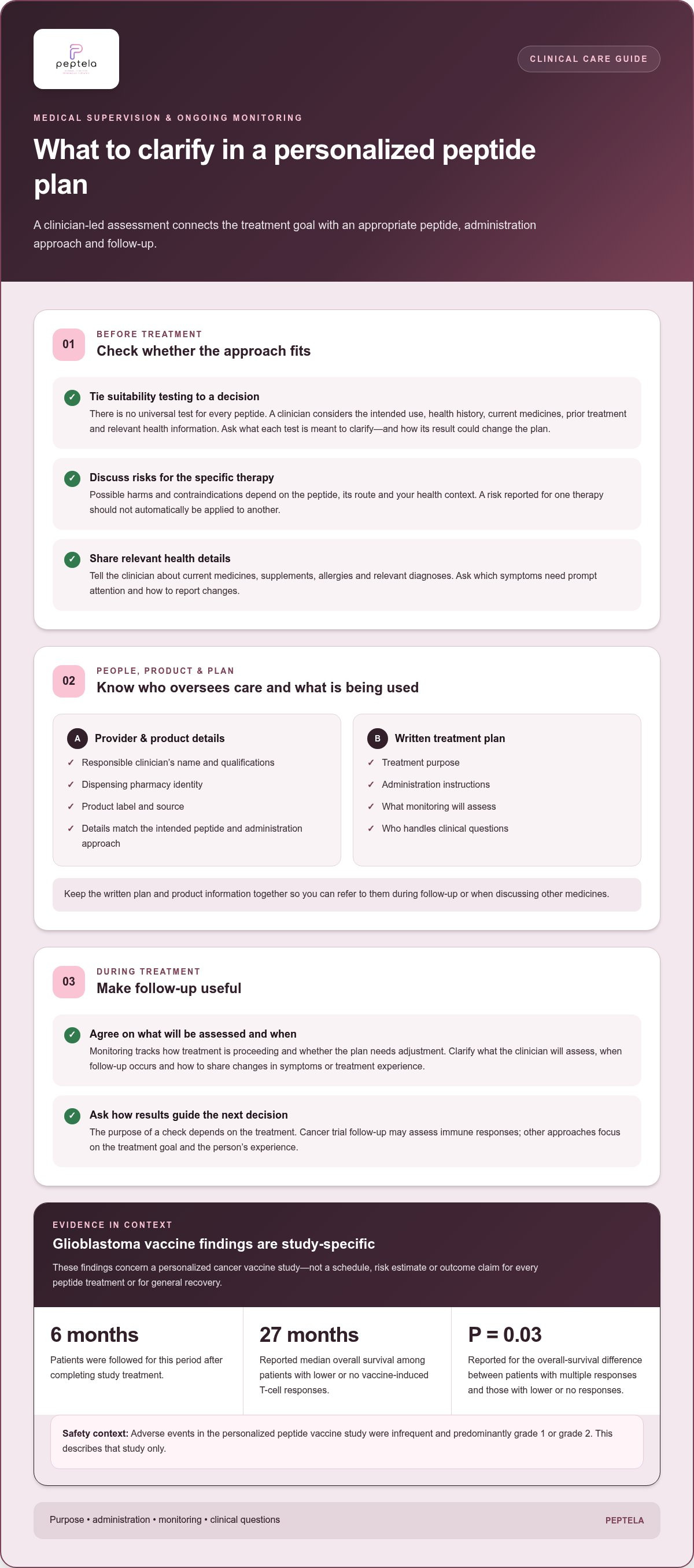
Suitability testing is a clinician-led assessment of whether a specific therapy fits a person’s health history and treatment goal. There is no universal test for every peptide. A clinician considers the intended use, current medicines, prior treatment, and relevant health information. Ask what each proposed test is meant to clarify and how its result could change the plan. This keeps testing tied to a practical decision rather than a generic checklist.
Treatment risks and contraindications
Risks and contraindications are possible harms or health circumstances that may make a particular peptide approach unsuitable. They depend on the specific medicine, its route, and the person’s health context, so a risk reported for one therapy shouldn’t be applied automatically to another. In a personalized peptide vaccine study, adverse events were infrequent and predominantly grade 1 or grade 2. That finding describes that study, not every peptide treatment.
Share your current medicines, supplements, allergies, and relevant diagnoses before treatment begins. Ask which symptoms warrant prompt clinical attention and how to report changes during follow-up. Clear answers help you understand the plan and discuss concerns early.
Provider and product credentials
Credential checks help you understand who oversees treatment and what product is being used. Ask for the responsible clinician’s name and qualifications, the dispensing pharmacy’s identity, and product details such as its label and source. Confirm that the product information matches the intended peptide and administration approach. These practical details can make follow-up questions more specific.
Before starting, request a written plan that covers the treatment purpose, administration instructions, monitoring, and who handles clinical questions. A clinician should be able to explain these elements in plain language. Keep the plan and product information together so you can refer to them during follow-up or when discussing other medicines.
Ongoing medical monitoring
Ongoing monitoring tracks how treatment is proceeding and whether the plan needs adjustment. Agree on what the clinician will assess, when follow-up occurs, and how you’ll share changes in symptoms or treatment experience. In a personalized glioblastoma vaccine study, patients were followed for 6 months after completing study treatment. This describes that study’s follow-up, not a schedule for all peptide therapies.
The authors of the reported glioblastoma study reported median overall survival of 27 months among patients with lower or no vaccine-induced T-cell responses. The difference in overall survival between patients with multiple vaccine-induced T-cell responses and those with lower or no responses was reported with P = 0.03. These findings concern a cancer vaccine study, not general recovery treatment.
Ask how monitoring results will inform the next clinical decision. Cancer trial follow-up may include assessing immune responses; other approaches focus on the treatment goal and the person’s experience. Understanding the purpose of each check makes the process clearer and keeps the care conversation active.
Muscle recovery and tissue repair
Peptides have roles in hormone production, immune function, and tissue repair. If you’re exploring recovery, distinguish these biological roles from proof that a treatment improves a specific injury or outcome.
Peptides are short chains of amino acids that can act as signals between cells. Their signals may influence physiological responses, but the effects depend on the peptide and its intended use. For muscle recovery, that distinction matters: a proposed role in tissue repair does not establish that a particular peptide restores strength, speeds recovery, or replaces rehabilitation.
BPC-157 and TB-500 are associated with tissue repair and accelerated healing. BPC-157 and AOD-9604 are also identified as peptides that may reduce inflammation and promote tissue repair for chronic pain. These descriptions point to areas of interest, not a personalized protocol or a guaranteed result. A clinician discussion can clarify the treatment goal, the evidence relevant to that goal, and how progress would be assessed.
Recovery also depends on the underlying problem. A muscle strain, persistent pain, and healing after surgery involve different needs. Describe the affected area, how symptoms affect movement, and what recovery activities are already part of your routine. This context makes a conversation about therapy more specific than asking whether peptides “help healing” in general.
Peptide research also includes cancer treatment, but that is a separate clinical context. Personalized peptide vaccines for tumors are designed around tumor-associated targets and studied for immune cell responses. Glioblastoma research has examined whether vaccine-induced T-cell responses are associated with survival. Those findings concern cancer therapy and should not be used as evidence that peptides repair exercise-related muscle damage or routine surgical wounds.
Ask the clinician to connect each proposed peptide with a defined purpose and a meaningful way to assess response. For example, discuss whether the goal is pain relief, tissue repair, or another outcome, and how it fits with rehabilitation or other care. This keeps expectations grounded in the specific condition rather than broad claims about recovery.
If you’re exploring peptide options for a recovery goal, clinician-guided peptide care can be a starting point for discussing whether the approach fits your needs.
The tumor-vaccine research described above also involves specific requirements and timing that are distinct from muscle recovery. Cohort C and D patients were expected to have adequate tumor tissue planned for resection, approximately greater than 1cm in cross-sectional size on imaging. The median time from tumor tissue acquisition to personalized vaccine administration was 16 weeks.
These details relate to the design and delivery of a personalized cancer vaccine, not a general tissue-repair treatment. They do not establish how a peptide might affect a strained muscle, persistent pain, or recovery after surgery. Keeping the clinical context clear prevents findings about tumor-targeted immune responses from being treated as evidence for a different goal. When discussing a proposed recovery treatment, ask what outcome it is intended to change and how that outcome will be followed. The key question is whether evidence supports the specific use being considered for your condition, not whether peptides have been studied in other settings.
Need for further research
Evidence for one peptide approach cannot automatically answer questions about another. A personalized peptide vaccine for cancer, for example, is developed around tumor-related targets and studied for immune responses. That differs from peptide use for muscle recovery or general wellness. Before discussing a personalized peptide treatment, identify the condition, the specific peptide, and the outcome researchers measured. Those details determine whether a study relates meaningfully to your question.
A real-world observation in glioblastoma examined patients who received a personalized peptide vaccine. It was retrospective, not a randomized controlled clinical trial. This design can reveal patterns in clinical practice, but it cannot establish cause and effect as directly as a randomized comparison. An association between an immune response and an outcome does not, by itself, prove that the vaccine caused that outcome.
Other research has examined different cancers and treatment questions. A National Cancer Institute-listed phase I trial studied a custom synthetic tumor-associated peptide vaccine for metastatic pancreatic ductal adenocarcinoma or colorectal cancer. Its primary objectives included demonstrating that a custom vaccine could be developed for those patients. The trial is closed to accrual, so its design provides research context, not an open enrollment option.
The trial also illustrates how researchers define a question before measuring efficacy. In Cohorts C and D, investigators planned to measure changes in neoantigen-specific T-cell responses 12 weeks after personalized vaccination began. Those immune measures help assess whether the vaccine engages the immune system. They are not the same as proving longer survival, symptom relief, or tissue repair. Each outcome requires its own measure and study design.
Schedules further show why results need context. In Cohorts A and B, vaccination began only after at least one line of standard chemotherapy. Cohorts A and B scheduled vaccine doses through week 24; Cohorts C and D also included doses through week 24. In Cohorts B, C, and D, pembrolizumab was scheduled every 3 weeks through week 24, unless disease progressed or toxicity became unacceptable. These combined approaches cannot be treated as evidence for a peptide used alone.
When reviewing a study with a clinician, note the condition, peptide, comparison group, treatment combination, and measured outcome. Check whether researchers assessed immune cell responses, symptoms, or survival, because each addresses a different question. A result about neoantigen recognition in tumors does not establish benefit for exercise recovery. Matching a study to your goal is a practical way to judge how relevant its findings are.
Further research can show whether patterns observed in practice hold up in studies with a randomized comparison. Until then, treat an observation as a reason to ask focused questions, not as a basis for assuming a vaccine produces a particular clinical result. Distinguish immune-response findings from outcomes that matter directly to patients, and ask whether the study’s methods support its conclusions. This keeps evidence tied to the specific treatment and question under discussion.
Peptide administration methods
Peptide therapy may be administered through injections, topical applications, or oral supplements. The route affects how treatment fits into daily life and how instructions are followed. A personalized peptide treatment plan should identify the specific peptide, its intended use, and the chosen administration method. This matters because evidence for one route or condition does not automatically establish results for another.
Injections deliver a peptide through an injectable formulation. If a clinician recommends this approach, clarify the written instructions, planned schedule, and how administration fits with other medicines or treatment. Do not assume every injectable peptide follows the same routine. The formulation and purpose determine the instructions, while follow-up helps assess responses and guide care.
Topical applications put a peptide formulation on the skin. Oral supplements are taken by mouth. Because these methods differ, ask which route matches the treatment goal and what the product instructions require. A topical approach and an oral supplement are not interchangeable simply because both involve peptides. The specific product and clinical purpose should guide the discussion.
Personalized cancer vaccines show how administration can depend on disease and treatment context. In one trial, Cohorts A and B received a personalized synthetic tumor-associated peptide vaccine only after at least one line of standard chemotherapy. Its scheduled doses fell at weeks 0, 1, 3, 4, 6, 12, and 24. Cohorts C and D also had vaccine doses scheduled through week 24. These research schedules describe trial protocols, not general instructions for other peptide therapies.
The same trial paired the vaccine with another medicine for some participants. In Cohorts B, C, and D, pembrolizumab was scheduled intravenously every 3 weeks through week 24, unless disease progressed or toxicity became unacceptable. That combination makes it important to interpret responses in context. Evidence from a combined approach doesn’t isolate the effect of the peptide vaccine alone.
Ask what the route means for your plan: how the peptide is administered, how often it is used, and what follow-up will assess. If treatment involves a personalized vaccine, ask how tumor tissue informs its design and what outcome researchers measure. Clear answers help distinguish a clinical trial protocol from a plan for another purpose, such as recovery or tissue repair.
Personalized peptide treatment plans
A tailored plan connects a peptide choice to a defined health goal and clinical context. Its value depends on the evidence for that peptide and intended use, not on the word “personalized” alone.
Treatment plan development
A personalized peptide treatment selects or designs peptide therapy around a particular goal or biological target. In oncology, a personalized peptide vaccine may be developed using tumor-associated targets; this differs from choosing a peptide for another purpose. The National Cancer Institute-listed phase I trial for advanced pancreatic or colorectal cancer illustrates the distinction: researchers aimed to develop a custom vaccine for specific patients and study immune responses.
Personalization should make a plan more specific, not less explainable. Ask what function the peptide is intended to support, what evidence applies to that use, and how the proposed approach compares with standard treatment. A vaccine designed around tumor targets belongs within an oncology plan; it should not be treated as interchangeable with established cancer care. A personalized peptide treatment should have a clearly stated purpose and a rationale you can discuss.
Compounded peptide therapy is a separate issue from personalization. Tailoring treatment to an individual goal does not, by itself, establish that a compounded product has evidence for that goal. Ask what the product contains, why that formulation is being considered, and what clinical evidence supports its intended use.
Steps to receive treatment
Treatment through a licensed provider begins with a clinical discussion of your goal, health history, current medicines, and relevant prior care. Then discuss the proposed peptide, its intended function, administration method, evidence, and monitoring plan. Before proceeding, make sure you understand the treatment choice and how follow-up will assess your response.
Prescribing, compounding, and marketing raise distinct questions that depend on the product and its intended use. Ask the provider to explain those distinctions and what applies to the proposed treatment. A marketing claim is not proof of clinical efficacy.
Approval should be considered for the specific product and intended use, not inferred from the general term “peptide.” The National Cancer Institute-listed phase I vaccine trial is a study; its existence does not establish approval for other peptide treatments.
To compare a proposed approach with standard care, ask what each option is intended to do and what evidence supports it. A trial’s custom vaccine development and immune-response measures answer different questions from treatment outcomes in routine care.
Bring your goals and questions to a clinician-guided peptide care discussion so the proposed plan can be connected to your clinical context.
Peptela: Tirzepatide Injections
Peptela, a longevity platform, offers clinician-guided, subscription-based treatments, including Tirzepatide Injections and Peptides. The right next step depends on your health goals and the treatment you want to discuss. Research on personalized peptide vaccines for cancer does not establish that peptide therapy supports general recovery, so keep these uses distinct when speaking with a clinician.
If you’re considering Tirzepatide Injections, Peptides, or Hormone Balance, focus the conversation on your goal, the proposed treatment, and how care will be guided. These offerings address different needs, so a clear discussion can help you understand which topic fits your priorities. Bring your questions and relevant health context to the conversation.
To explore whether Peptela’s clinician-guided care aligns with your goals, contact Peptela.
Move forward with a clearer conversation
Make your next discussion specific: name the outcome you want to explore, the proposed treatment, and what would count as meaningful progress for you. This gives a clinician a practical starting point and keeps your priorities in view. A personalized peptide treatment should make sense in the context of your goals, not simply sound promising in general.
Before the conversation, write down what you hope to change and which questions would help you feel informed. You might ask how the proposed approach fits your goal, what follow-up involves, and how you can discuss changes along the way. Clear questions help you take an active role in the decision while leaving room to weigh the options together.
Peptela offers Tirzepatide Injections, NAD+, Hormone Balance, Peptides, and GLP-1. If one of these offerings relates to what you’re exploring, bring your questions about fit and clinical guidance to the conversation. Choose a next step that feels grounded in your priorities and supports your confidence moving forward.


