

The most convenient NAD+ option isn’t automatically the right fit for everyone. A nad nasal spray offers a needle-free way to use NAD+, but potential benefits such as supporting energy, focus, or memory are not guaranteed. The right choice depends on your health, goals, and guidance from a qualified clinician.
It makes sense to want a clear picture before choosing a route. Sprays and injections differ in how they’re used, and comparing them can help you understand the practical trade-offs without assuming one is best for everyone.
This guide covers potential benefits of NAD+ nasal spray, how to use it, and what to consider if you take medication or supplements. It also explains how compounded prescriptions fit into the discussion and how nasal sprays compare with injections, helping you prepare informed questions for a clinician.
Key Takeaways
- NAD+ plays a central role in cellular energy metabolism, while proposed benefits for focus or memory should be considered in context.
- Learn the general nasal-spray directions and why the prescribed product’s instructions should guide use.
- Prescription medications and health conditions are important considerations to discuss with a healthcare provider before combining treatments.
- Compare nasal use with injections by considering practical differences, not assuming one route is right for everyone.
- Understand what to discuss about compounded prescriptions and the role of clinical evaluation in a personalized decision.
What Are the Benefits of NAD Nasal Spray?
Nicotinamide adenine dinucleotide, or NAD+, is a coenzyme found in every cell and plays a central role in cellular energy metabolism. A nasal spray is one way to take NAD+, but its potential effects should be distinguished from claims that go beyond established information. It isn’t a substitute for evaluating changes in energy, focus, memory, mood, or metabolic health.
Potential benefits are often discussed in relation to energy production, brain function, and cellular processes. Claims about memory, recall, or staying focused longer do not guarantee improvement. Similarly, claims involving anxiety, depression, or weight loss are not evidence that NAD+ treats those conditions. A clinician can discuss such claims in the context of your health and goals.
Some people may notice effects within 15-30 minutes, but onset alone doesn’t show whether the spray is helping. Noticeable changes can vary, and the timing doesn’t establish a lasting benefit. If you’re tracking a goal such as concentration during a work task, note what changes and when, rather than relying on a single impression.
- Energy: NAD+ participates in cellular energy metabolism; that role doesn’t guarantee a personal increase in energy.
- Focus and memory: These are discussed as potential effects, not assured outcomes.
- Mood and metabolism: Claims about anxiety, depression, or weight loss should not replace appropriate medical evaluation.
There isn’t one United States price for NAD nasal spray. Costs vary with the formulation, prescription, and dispensing arrangements; pricing is provided after a quote request.
Side effects and adverse reactions deserve attention, even when a product is used as directed. Individual responses can vary with the formulation and personal health factors. Track when you use the spray and any new symptoms, including their timing and severity. Seek prompt medical attention for symptoms that feel severe or worsen rapidly. Don’t increase use or change a prescription to pursue a faster effect.
Before starting, review your health conditions, current medicines, and supplements with a healthcare professional. That review helps identify considerations that may affect whether NAD+ fits your situation. A prescription should come with directions for the specific formulation; follow those directions instead of assuming all sprays use the same amount or schedule. Keep expectations measured: a reported onset of 15-30 minutes is not proof of benefit, and potential effects are not a promise of results.
How to administer the nasal spray
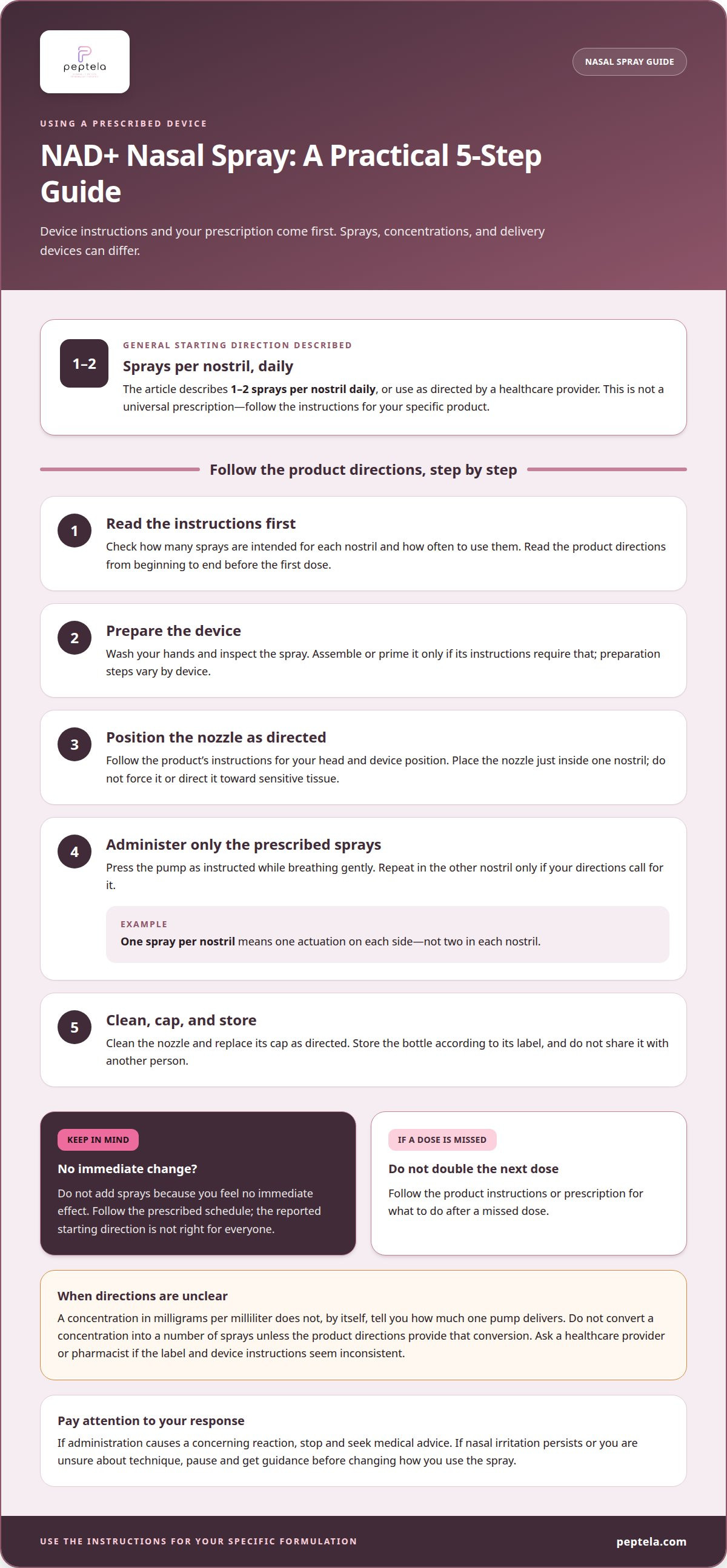
A common starting direction is 1-2 sprays per nostril daily, or use as directed by a healthcare provider. That describes a general schedule, not a universal prescription. The intended amount depends on the specific formulation and its instructions. Follow the label and prescriber’s directions rather than copying another person’s routine.
Before the first dose, read the product instructions from beginning to end. Check how many sprays are intended for each nostril and how often to use them. The active ingredient, nicotinamide adenine dinucleotide, is involved in cellular energy metabolism, but that doesn’t make every spray interchangeable. Concentrations and delivery devices can differ.
- Prepare the device. Wash your hands and inspect the spray. Follow its instructions for assembly or priming, if required. Priming steps vary by device, so don’t guess or use steps from another product.
- Position the nozzle. Keep your head and the device positioned as the product directions describe. Place the nozzle just inside one nostril, without forcing it or directing it toward sensitive tissue.
- Administer the prescribed sprays. Press the pump as instructed while breathing gently. Repeat in the other nostril if your directions call for it. For example, a direction of one spray per nostril means one actuation on each side, not two in each nostril.
- Finish and store it. Clean the nozzle and replace its cap as directed. Store the bottle according to its label, and don’t share it with another person.
Use the prescribed schedule consistently, but don’t add sprays because you feel no immediate change. The reported starting direction of 1-2 sprays per nostril daily doesn’t establish the right dose for every person. If a dose is missed, follow the product instructions or prescription rather than doubling the next dose.
Don’t convert a concentration into a number of sprays unless the product directions provide that conversion. For example, a concentration in milligrams per milliliter describes the amount in a volume of liquid; on its own, it doesn’t tell you how much one pump delivers. A healthcare provider or pharmacist can clarify prescribed directions if the label and device instructions seem inconsistent.
Studies on NAD+ and cellular or metabolic processes don’t replace device-specific instructions. Keep the prescription label available, especially when traveling or switching devices. Stop and seek medical advice if administration causes a concerning reaction. If nasal irritation persists or you’re unsure about technique, pause and get guidance before changing how you use the spray.
Combining NAD+ with medications and supplements
If you take prescription medication or manage a health condition, consult a healthcare provider before combining it with NAD+. Review is important even if your treatment plan feels consistent and familiar. Share the product label, intended dose, and schedule so the clinician can consider the full picture, not NAD+ alone.
Bring a complete list to the conversation. Include prescription medicines, over-the-counter products, vitamins, herbal supplements, and other therapies you use. For each item, note its name, dose, and frequency. A list that includes a daily multivitamin and an occasional pain reliever is more useful than a general statement that you take supplements.
A licensed healthcare professional can review your medical history alongside that list. Mention relevant diagnoses, allergies, recent treatment changes, and any previous reactions to medicines or supplements. These details support an individualized discussion, but don’t establish that a particular combination is appropriate. Don’t stop a prescribed medicine or change its dose to make room for NAD+ without medical direction.
Keep the conversation focused on why you’re considering NAD+. For example, explain whether your goal relates to energy, focus, or a broader interest in longevity. NAD+ has a role in cellular energy production, but that alone doesn’t show how it will interact with your treatment plan or predict a result. A clear goal also helps the clinician weigh whether adding another product makes sense.
Some providers recommend combining daily NAD+ nasal spray with 1-2 injections per week. That schedule isn’t a direction to add injections on your own. Nasal use and injections are different routes, and using both adds another treatment decision. Discuss the proposed schedule, your current medicines, and the reason for combining routes before making a change.
- Before starting: Share your medication and supplement list, health conditions, and product instructions.
- During use: Keep a consistent record of the schedule and any changes you notice.
- If a symptom appears: Record when it began and what you used. For example, note a headache and its timing, rather than assuming its cause.
Keeping a record gives a clinician concrete information if you need advice about a new symptom or treatment adjustment. Seek prompt medical care for a severe or rapidly worsening reaction. For less urgent concerns, contact a healthcare professional before changing the dose or combining NAD+ with another product. A careful review supports an informed decision without assuming supplements are risk-free or compatible with prescriptions.
Nasal spray versus injection comparison
Nasal sprays, oral supplements, and injections differ in how they’re administered. Estimated bioavailability is 40-60% for NAD+ nasal spray and 80-90% for injections. Oral products vary in formulation, so there isn’t a comparable percentage here for ranking them directly. These estimates describe route differences, not which option will best match an individual’s goals.
Bioavailability refers to how much of a substance reaches circulation. A higher estimate doesn’t prove that a route improves energy, focus, or another personal outcome. Nor does it show that the route prevents disease or treats illness. Clinical decisions depend on your medical history, goals, and the specific formulation being considered.
The practical distinction is clear: a nasal spray is used through the nostrils, while an injection involves a needle. The reported onset time for NAD+ injections is 20-45 minutes. That estimate doesn’t establish how long effects last or whether a person will notice them. For someone comparing routines, ease of use and comfort with needles may also matter.
Intravenous NAD+ is another route, delivered into a vein. Its estimated bioavailability is essentially 100%, but that figure alone doesn’t make IV administration the right fit. An IV session requires time for administration in a clinical setting. Consider the route alongside the practical demands and your personal health context.
One suggested approach is to begin with a NAD nasal spray for 4-8 weeks, then discuss with a provider whether injections may be appropriate. This gives time to follow a consistent plan and reflect on your experience before considering a change. It isn’t a requirement for everyone, and it doesn’t guarantee that injections will suit you.
- Oral supplements: Review the ingredient and formulation. Don’t assume an oral product is equivalent to a spray or injection.
- Nasal spray: Consider the prescribed instructions and whether nasal administration fits your routine.
- Injection: Weigh the needle-based route, estimated bioavailability, and clinical guidance.
- IV administration: Consider the infusion setting as well as the estimated route availability.
NAD+ levels can decline with age, but comparisons between routes don’t establish that supplementation reverses this change. The same applies to longevity goals: a biological rationale isn’t proof of a specific health effect. If you have an illness or take prescription medication, discuss that context with a clinician before choosing or combining routes.
Compare the route, product instructions, schedule, and medical context together. A NAD nasal spray may suit someone who prefers nasal administration, while another person may consider a different route after clinical discussion. Don’t choose based on bioavailability alone; focus on what fits your circumstances and can be used as directed.
What is NAD nasal spray and what is it used for?
The term describes a product intended to deliver NAD+ through the nasal route. Its formulation, concentration, and prescription directions are product-specific, so the name alone doesn’t tell you how much each spray delivers or how to use it.
People may consider this option as part of a wellness plan focused on goals such as energy or focus. Those goals explain why someone might ask about NAD+, but they don’t prove that a nasal product will achieve a particular result. Start by identifying the personal goal you want to discuss with a healthcare professional.
Use the product only according to its own label and prescription instructions. Details such as concentration and the amount dispensed with each actuation matter when interpreting directions. Don’t assume another person’s schedule applies to your product, even if both labels describe NAD+ and nasal administration.
If a prescription is involved, its directions should match the preparation provided. Ask the prescribing professional or dispensing pharmacist to clarify any inconsistent instructions before using the product. Keep the container and label available so the discussion refers to the exact preparation, not a general product description.
Compounded NAD+ preparations are not FDA-reviewed or approved for safety, effectiveness, or quality. This distinction matters when considering what a product description can establish. A prescription doesn’t mean the preparation has FDA approval, and claims about a general wellness goal aren’t proof of an individual outcome.
Your medical context also shapes whether this option is appropriate to consider. Share relevant health conditions and current medicines during an evaluation, especially if you’re considering a new product alongside an existing treatment plan. The aim is to make a decision with the specific preparation and your circumstances in view.
Think of the product description as a starting point for a focused discussion, not a complete guide to personal use. Bring the label, prescription directions, and your goal to that conversation. This keeps the decision specific to the formulation and the questions that matter for your care.
Peptela
Peptela provides personalized, clinician-guided care for people considering wellness goals alongside their individual needs. If you’re weighing NAD+ or considering how it fits with other priorities, its care model offers a clinical setting for discussing those questions.
Peptela’s offerings include NAD+, Hormone Balance, Peptides, and Tirzepatide Injections. A personalized plan takes your goals and health context into account rather than assuming one option suits everyone.
Peptela’s clinician-guided care can help you frame next steps around your priorities and health context.
Make your next step an informed one
Choosing whether a NAD nasal spray fits your goals is a personal health decision, not a shortcut to a promised result. Consider what you hope to achieve and which questions remain. A focused conversation with a qualified clinician can help you decide whether to explore this option further.
As you weigh your next steps, keep your priorities at the center. Begin with the questions that matter most to you, then move forward at a pace that feels right.
Frequently Asked Questions
Can NAD+ help with fatigue and brain fog?
NAD+ is involved in cellular energy metabolism, but that role doesn’t establish that it relieves fatigue or brain fog. These symptoms can have different causes, so note when they occur and what affects them. For example, record whether brain fog appears after a medication change or alongside disrupted sleep, then discuss the pattern with a healthcare professional before adding a supplement.
What can I expect?
Expect instructions specific to the product and a response that may differ from person to person. Some people may notice effects within 15-30 minutes, but timing alone doesn’t show whether the product is helping. Keep a brief record of use and any changes, such as whether your concentration during a familiar task feels different, and share it with your clinician.
What is NAD+ and why does the delivery method matter so much?
NAD+ is nicotinamide adenine dinucleotide, a coenzyme found in cells. Delivery matters because oral products, nasal sprays, injections, and intravenous administration use different routes. Routes can differ in administration and estimated bioavailability, but a higher estimate alone doesn’t establish a better outcome. Compare the actual product directions and your clinical circumstances rather than treating routes as interchangeable.
Which NAD+ option should you choose?
Choose only after discussing your goal, health history, medication list, and the route’s practical demands with a healthcare professional. For example, someone who prefers to avoid needles may want to discuss nasal administration, while another person may have a prescription for a different route. Don’t switch, combine, or change doses based only on another person’s experience or a bioavailability figure.
Is NAD nasal spray FDA-approved in the United States?
A compounded NAD nasal spray is not FDA-approved. Compounded products aren’t FDA-reviewed or approved for safety, effectiveness, or quality. Prescription products require an online evaluation with a licensed medical professional, who determines whether a prescription is appropriate. Approval status depends on the specific product, so don’t assume that a prescription or a pharmacy’s role means a preparation has FDA approval.
What evidence supports NAD nasal spray for energy, cognition, or anti-aging?
NAD+ has a biological role in cellular energy metabolism, but that fact alone doesn’t demonstrate that a nasal spray improves energy, cognition, or aging outcomes. Claims about focus or memory should be considered separately from evidence about a specific preparation and route. Ask a clinician what outcome is being considered and how you would assess a meaningful change in daily life.
What are the side effects and risks of NAD nasal spray?
Side effects and adverse reactions are possible, and responses can vary. Follow the directions for your specific prescription, and don’t increase the amount to pursue a faster effect. If you notice a new or concerning symptom, record when it began and discuss it with a healthcare professional. Seek prompt medical care for a severe or rapidly worsening reaction.
Who should avoid NAD nasal spray, including people who are pregnant or taking medications?
People who are pregnant, planning pregnancy, or breastfeeding should discuss use with a healthcare professional before starting, as individual circumstances need review. Anyone taking prescription medication or managing a health condition should consult a provider before combining NAD+ with other treatments. Share your medicines, supplements, and relevant health history so the clinician can assess the proposed product and plan.


