

The same diagnosis doesn’t automatically call for the same care. Personalized care versus one-size-fits-all care comes down to whether decisions account for an individual’s health history, symptoms, test results, lifestyle, and response to treatment, rather than relying on a standard approach alone.
It makes sense to want care that fits your circumstances, especially when managing a chronic condition. Personalization doesn’t mean ordering every possible test or creating a different treatment for every person. It means using relevant information to guide decisions and reviewing care when your needs or response call for it.
This article explains personalized medicine, how it compares with a one-size-fits-all approach, and how clinicians may tailor care for chronic disease. You’ll learn why testing should have a clear clinical purpose, which factors can shape treatment decisions, and how clinician-guided care can support a more individual approach.
Key Takeaways
- Distinguish personalized medicine from precision medicine and see how relevant patient information can guide care.
- Recognize how access, cost, communication, and early identification can shape personalized healthcare.
- Understand why continuity, trust, and attention to emotional well-being matter in the care relationship.
- Explore how chronic disease plans can account for biomarkers, treatment response, and everyday routines.
- Use the comparison to identify what questions and priorities matter when considering a more individualized approach.
What Is One-Size-Fits-All Medicine?
Personalized care uses relevant differences between patients to guide decisions instead of applying one standard plan to everyone. Evidence includes genomic research and pharmacogenomic guidance that can inform care for specific diseases or medications. These approaches can help tailor decisions, but they don’t prove personalized medicine is always better.
One-size-fits-all medicine relies more heavily on standard pathways designed for groups of patients. Shared guidelines can support consistent decisions, but a person’s symptoms, health history, environment, and genetic makeup may affect which choices fit. Personalized medicine brings those factors into the decision. Precision medicine often uses data to identify patient subgroups likely to share disease risks or treatment responses.
The difference between personalized care and a one-size-fits-all approach is not “custom treatment for everyone” versus “no individual consideration.” Clinicians can use relevant information to select a suitable option from the approaches available. The National Research Council describes precision medicine as identifying subgroups with differing risks or responses, not creating a unique treatment for each person.
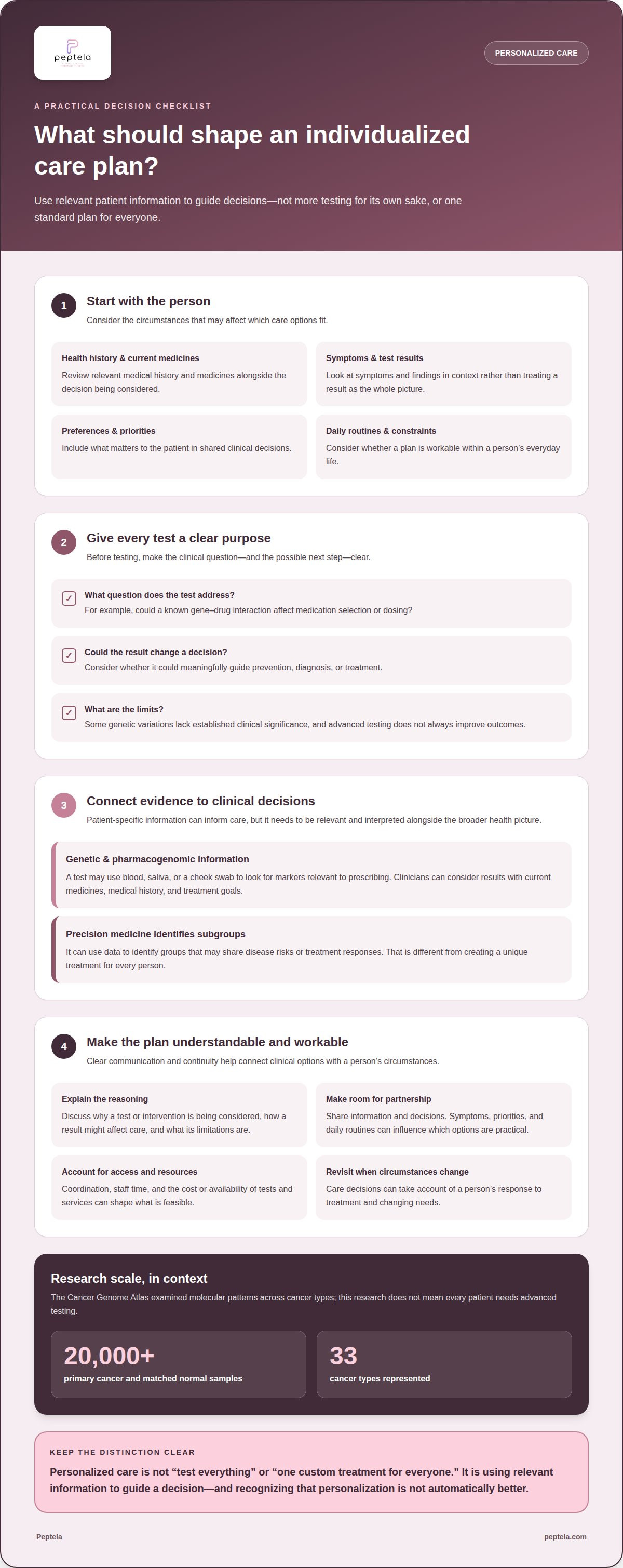
Cancer genomics offers a clear example of precision research. According to the National Cancer Institute, The Cancer Genome Atlas (TCGA) molecularly characterized over 20,000 primary cancer and matched normal samples spanning 33 cancer types. This large-scale work helps researchers examine molecular patterns across cancers, rather than treating every tumor as biologically identical.
Genetic testing can also inform medication selection. Pharmacogenomic tests may analyze DNA from blood, saliva, or a cheek swab for markers relevant to prescribing. Gene-drug relationships can help explain how genetic variations affect medication metabolism and the risk of adverse events. Clinicians can consider relevant results alongside a person’s current medicines, medical history, and treatment goals when selecting or dosing medication.
For health systems, integrating these tools means connecting test results to clinical decisions and care workflows. A genetic result is useful only when it relates to the question at hand, such as whether a known gene-drug interaction could affect prescribing. Personalized medicine doesn’t require every available test. Testing should be clinically relevant, and results need to be interpreted within the patient’s broader health picture.
Limits matter, too. Some genetic variations lack established clinical significance, and advanced testing does not always improve outcomes. Start with the clinical question, then consider whether validated testing or other patient-specific information could meaningfully guide a decision.
Patient expectations for personalized healthcare
Patients often want care that reflects their priorities, not only a diagnosis or test result. An Accenture survey reported that 88 percent of healthcare consumers expected personalized care comparable to online shopping or vacation planning. That expectation points to clear communication and attention to individual circumstances, not simply more testing or technology.
Delivering individualized care can require coordination. Clinicians may need to consider a patient’s health history, symptoms, test results, genetic makeup, and preferences together. Health systems also face practical questions about access, staff time, and the cost of tests or services. A useful approach starts with a specific clinical question, then weighs whether the information could change prevention, diagnosis, or treatment decisions.
Early identification can support prevention when a relevant marker indicates disease risk or presence before symptoms appear. That information may help guide follow-up or preventive steps suited to the person’s health profile. It doesn’t mean every possible condition should be screened for. A clinician considers the patient’s history, current concerns, and whether a finding would lead to a meaningful next step.
Individualized prevention also considers daily life. For example, a plan may need to account for a person’s routines, existing conditions, and priorities alongside clinical findings. A patient who struggles to maintain a recommended routine may need a different plan from someone with the same risk factors but different constraints. Discussing these realities helps make care more practical and supports shared decisions.
Fatigue illustrates why context matters. Mitochondria help cells produce usable energy, but fatigue alone doesn’t identify a mitochondrial problem. Sleep changes, medications, stress, and other health concerns may also be relevant. A thoughtful assessment starts with when the fatigue began, how it affects daily life, and what else changed, rather than assuming a cause.
Patients also need to know why a test or intervention is being considered. Before testing, the clinician can explain what question it addresses, how a result might affect the care plan, and what limitations apply. This keeps personalized healthcare focused on useful decisions instead of collecting data without a clear purpose. The aim is to consider the whole person while keeping each step clinically relevant.
What is personalized medicine?
Personalized medicine uses relevant health information and a patient’s preferences to guide clinical decisions. Continuity, clear communication, and patient participation help connect a diagnosis or therapy with the person’s circumstances.
Communication, Trust, and Partnership
A patient-provider partnership means sharing information and decisions rather than treating care as a one-way exchange. It matters because symptoms, priorities, and daily routines can influence which clinical options are workable. For example, discussing a medication schedule can reveal a practical barrier and help shape a plan the patient can follow.
Seeing a provider who knows a patient’s history can add context to new symptoms or test results. The provider can consider how health concerns and previous therapies have changed over time, rather than viewing each appointment in isolation. Continuity also gives patients a familiar place to raise questions, describe concerns, and explain what matters to them.
Patient engagement includes understanding how health information will inform care. A clinician can explain what a marker or test result may indicate, what it cannot establish, and how it could influence decisions. Patients can then share which outcomes they value and take part in choices about next steps. Emotional well-being belongs in that conversation, too. A CVS Health survey found that 81 percent of U.S. consumers considered it very important for their primary care provider to understand their happiness, life satisfaction, and responses to stress.
Outcomes and Patient Satisfaction
Personalized care doesn’t guarantee better outcomes than conventional care. Clear explanations of a diagnosis, therapy, and available options help patients understand the basis for decisions and take part in discussions about their care. Good communication also gives patients a chance to share concerns or ask how a proposed plan relates to their priorities.
Time helps make that partnership practical. A 13-minute primary care visit may leave limited room for a detailed discussion of health history, goals, and emotional well-being. Longer visits and continuity with the same provider can create more opportunity to clarify questions and review relevant information. Patients can support a focused conversation by sharing symptom changes, treatment experiences, and personal priorities. The clinician can then explain how those details shape the care plan and what to revisit over time.
Individualized chronic disease treatment
Chronic disease care can account for symptoms, health history, test findings, and daily routines. Providers use these details to shape and review a plan instead of assuming everyone will respond alike.
Personalized Plans for Chronic Disease
An individualized plan connects a person’s health information with practical treatment decisions. To create one, a provider considers the disease, current symptoms, medical history, existing medications, and the patient’s goals. The plan may include a treatment choice and a way to monitor the person’s response. This matters because the same diagnosis can affect people differently, and care needs may change over time.
For chronic conditions, regular follow-up helps clinicians assess whether the plan still fits. A change in symptoms or daily function can prompt a review.
Understanding Treatment Response
Treatment response means assessing how a therapy affects a patient’s symptoms, function, and relevant clinical measures. Providers can compare a person’s experience before and after a treatment change, then consider whether the response matches the goal. For example, a symptom record may help distinguish a steady change from occasional variation. This review supports decisions about continuing, adjusting, or reconsidering care with clinical oversight.
One result rarely tells the whole story. The condition, other treatments, and timing of symptoms all provide context.
Treatment Plans That Fit Lifestyle
A lifestyle-fit plan takes daily routines and personal constraints into account. A provider might discuss when medication is taken, how appointments fit around work or caregiving, and which changes feel manageable. These details can affect whether a plan works for that patient. Sharing difficulties early gives the care team useful information, rather than framing every obstacle as a lack of effort.
Plans can also account for food, activity, sleep, and changing responsibilities when these relate to a person’s care. Practical fit matters.
Personalized Care Across Health Areas
Personalized approaches appear in areas such as cancer treatment and mental healthcare. In cancer care, tumor characteristics can help inform treatment choices for particular cases. In mental healthcare, a clinician may consider symptoms, history, preferences, and response to therapy when discussing next steps. The relevant information differs by condition, so the assessment and treatment decisions differ, too.
Asthma care can also consider biomarkers alongside symptoms and clinical history. A biomarker may provide information, but it doesn’t replace a complete assessment. Providers weigh the overall picture before deciding whether a finding should influence treatment. The principle remains the same: match the decision to the actual health context, then review the person’s response.
Personalized versus one-size-fits-all care
The difference lies in how a care decision uses information about the person in front of the clinician. A standard pathway can offer a consistent starting point, while personalized care weighs relevant details such as symptoms, health history, and treatment response. Neither approach means every decision is automatically right for every patient. The goal is to tailor care to the extent that it informs the clinical question.
Consider two people with the same blood pressure reading. Their care could differ because one has other health concerns, takes medication, or experiences symptoms the other doesn’t. The reading matters, but so does its context. A one-size-fits-all approach risks overlooking those distinctions; a personalized assessment brings them into the conversation without assuming every difference requires different treatment.
Precision medicine adds another layer when evidence links particular biological features with disease risks or treatment responses. Genomics can help identify relevant patterns in some settings, including certain cancer decisions. But a genetic result is useful only when it has established clinical relevance to the choice at hand. More data alone doesn’t make care more precise, and advanced testing doesn’t always improve outcomes.
Medication response shows why individual differences matter. On average, a prescription drug on the market works for half of the people who take it. That figure doesn’t predict whether a specific medication will work for an individual. It illustrates why clinicians consider symptoms, other medicines, health history, and response when reviewing treatment. Mental health care also involves individual context, including a person’s symptoms, goals, and experience with therapy.
In practice, personalized care starts with a clear question, then uses relevant information to guide a decision. A review might begin with regular laboratory testing, followed by additional validated tests selected according to symptoms, history, and health goals. The useful comparison is not “standard care or every possible test.” It is whether a decision reflects the person’s clinical needs and relevant evidence. The clearest takeaway is to use a standard approach where it fits, and tailor it when meaningful differences call for a closer look.
Peptela
Peptela offers clinician-guided care for people exploring options that reflect their individual health needs and goals. This may suit you if you want to discuss women’s health or longevity concerns and understand which available options warrant clinical consideration. The focus is a thoughtful conversation about your circumstances, not a promise that one approach fits everyone.
Its offerings include Tirzepatide Injections, Hormone Balance, and Peptides. Each is a distinct option, not a universal solution or a substitute for considering your health as a whole. A clinician-guided discussion can put your priorities, history, and current care in context before considering whether an offering relates to your goals.
Medical evaluation matters before any treatment decision. A clinician needs to consider your health history, current medications, symptoms, and relevant contraindications, then discuss potential risks and whether an option is appropriate. Ask how a proposed approach relates to your goals and what follow-up or monitoring involves. Clear answers help you make an informed choice.
Peptela’s personalized plans are guided by a fully in-house care team with 199+ years of combined clinical experience. That clinical guidance can help translate a broad health goal into a discussion of relevant options and considerations. It does not mean every offering suits every person; individual history and medical needs remain central to the evaluation.
Consider this next step if you want clinician-guided support exploring the listed offerings in relation to your personal health priorities. It isn’t a replacement for urgent or emergency care, and it shouldn’t be treated as a guaranteed response to a chronic condition. If symptoms are urgent, seek appropriate emergency medical care.
Personalized care starts with your questions and a careful look at what matters to you. You can ask how your history, goals, and treatment considerations shape the discussion, then decide whether to proceed based on the clinical guidance you receive. To begin that conversation, contact Peptela.
Make your next care decision with intention
Choosing personalized care versus a one-size-fits-all approach isn’t about pursuing every test or changing treatment for its own sake. It’s about asking whether a decision reflects your health priorities and the clinical information relevant to them. Take an active role by sharing what you want care to address, what concerns you, and which practical limits affect your choices.
Before starting or changing treatment, discuss potential risks, contraindications, and required medical evaluation with a qualified clinician. Ask how the option relates to your situation, what follow-up may involve, and how your response will inform future decisions. These questions make the discussion clearer and keep the decision grounded in your needs.
If you’re ready to explore whether Peptela’s clinician-guided care fits your priorities, contact Peptela to discuss your care. Your questions are a useful starting point for a thoughtful next step.
Frequently Asked Questions
How Does This Play Out With Metabolic Wellbeing?
A metabolic health discussion can start with the specific concern you want to understand, such as a change in appetite, energy, or a recent test result. Share when you noticed it and any relevant medication changes. This gives the clinician a clearer starting point for deciding what information to review and which questions need follow-up.
So What Does All That Mean For You?
Make the conversation more useful by arriving with a short list of priorities. Note what you want help deciding, what you have already tried, and any practical constraints, such as work hours or caregiving. Ask what the next step involves and how you’ll discuss the result or response afterward.
What Is Personalized Care and Why Is It Different?
Personalized care is a way of making health decisions that accounts for relevant information about an individual patient. In practice, a clinician can clarify which concern is being addressed, what information supports a recommendation, and what alternatives are available. This helps the patient understand the decision and identify questions before agreeing to a plan.
What are the benefits of precision medicine?
Precision medicine can make a decision more targeted when a clinically relevant finding helps distinguish between care options. Its practical value depends on whether the result answers a specific question and informs a next step. Patients can ask what a test is intended to clarify and how different results would affect the discussion.
What is Personalized Healthcare?
Personalized healthcare applies an individual’s relevant information to discussions about prevention, diagnosis, or treatment. It can involve coordinating recommendations across a person’s health concerns and clarifying which issue needs attention first. For example, someone managing several conditions can ask how a proposed change fits with existing care and medications.
Why Does Individualization Matter?
Individualization brings a patient’s priorities into decisions that might otherwise focus only on a diagnosis or measurement. For example, someone concerned about a treatment’s effect on work or sleep can raise that concern before choosing among options. Naming it gives the clinician a concrete point to address.
What is personalized care versus one-size-fits-all care?
The difference is whether a care decision accounts for relevant details about the individual or follows a standard pathway without considering them. A standard pathway can provide a starting point; a clinician can then discuss whether it fits the patient’s circumstances. The useful question is which parts of the plan need individual review.
What are the benefits of personalized care compared with standardized care?
Personalized care creates space to discuss how a recommendation fits a patient’s priorities and circumstances. Standardized care can offer a consistent framework, while an individualized discussion can identify questions about timing, follow-up, or competing health needs. Patients can ask how the plan will be reviewed and what information will guide later changes.


