

A starting dose is a reference point, not a personal prescription. A commonly cited starting reference for subcutaneous NAD+ is about 20 mg per injection, but the right at-home NAD+ injection protocol and frequency depends on clinical assessment and the specific formulation. There isn’t one schedule that fits everyone.
It makes sense to want a clear number and a predictable routine. But the same injection volume can contain different amounts of NAD+, depending on the vial’s concentration. Milligrams and milliliters aren’t interchangeable.
This guide explains what shapes a starting dose and schedule, why vial concentration matters, and which side effects and safety checks belong in the conversation. You’ll also see how health history, treatment goals, and response to injections can inform ongoing care. The aim is practical clarity, with a clinician guiding the plan so you can make informed decisions without guessing.
Key Takeaways
- Understand why a subcutaneous and an intramuscular plan can use different doses and schedules, and why gradual adjustment matters.
- Use the vial’s concentration to understand how medication volume relates to the prescribed dose; the two measures aren’t interchangeable.
- Learn which injection-site reactions and broader side effects to discuss, and what safety monitoring may involve.
- See how health history, treatment response, and clinical assessment can shape a weekly schedule and later maintenance.
- Explore when personalized, clinician-guided NAD+ care may be a useful next step.
What is the starting dose for NAD+ injections?
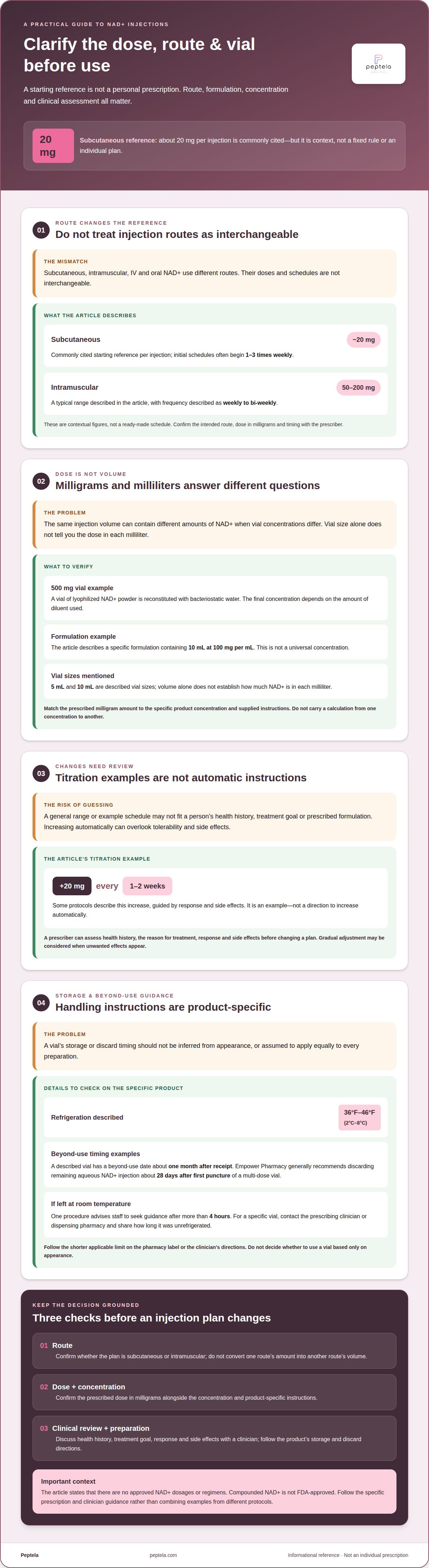
There isn’t one established dose for every NAD+ injection plan; no approved dosages or regimens exist. A commonly cited subcutaneous starting reference is about 20 mg per injection, with schedules often beginning one to three times weekly. These figures are context, not a personal prescription.
Subcutaneous and intramuscular injections use different routes, while IV NAD+ is infused and oral supplements are taken by mouth. Their doses and schedules aren’t interchangeable. A clinician selects the route and plan based on the person and formulation, so an at home NAD+ injection protocol and frequency should reflect those differences.
- Use a subcutaneous starting reference, not a fixed rule. A typical initial amount is about 20 mg per injection. Initial schedules commonly range from one to three injections weekly. The right starting point depends on clinical assessment, including health history and the prescribed formulation. A longevity-focused plan may use different timing from another treatment goal, so avoid treating a general range as a ready-made schedule.
- Adjust gradually and assess effects. Some protocols describe increasing the dose by 20 mg every one to two weeks, guided by response and side effects. That is a titration example, not an instruction to increase automatically. A prescriber can weigh tolerability, the reason for treatment, and the interval since the last adjustment before changing the plan. A slower increase may be considered when unwanted effects appear.
- Keep intramuscular dosing distinct. A typical intramuscular dose range is 50 to 200 mg, with frequency described as weekly to bi-weekly. These figures differ from commonly cited subcutaneous schedules. The route, concentration, and clinical plan all matter; don’t convert an intramuscular amount into a subcutaneous volume or assume that a weekly schedule applies to both.
- Confirm the prescription and preparation context. According to the U.S. Food and Drug Administration, compounded NAD+ injection is prepared under section 503A of the U.S. Federal Food, Drug, and Cosmetic Act. This does not mean compounded NAD+ is FDA-approved. For an at home NAD+ injection protocol and frequency, confirm the intended route, dose in milligrams, and schedule together with the prescriber. Follow the specific prescription rather than combining examples from different protocols.
Injection solution concentration and vial sizes
- Read the prescribed amount in milligrams and the vial concentration. A vial’s total contents and its concentration describe different things. For example, a 500 mg vial of lyophilized NAD+ powder is reconstituted with bacteriostatic water before use. The final concentration depends on the amount of diluent used. Since NAD+ is a cellular coenzyme involved in cell function, the label still needs to be translated into the exact prescribed amount, not guessed from the vial size.
- Match milligrams to volume using the supplied instructions. Vials may be supplied in 5 mL or 10 mL sizes, but volume alone doesn’t tell you how much NAD+ each milliliter contains. A described formulation contains 10 mL of solution at 100 mg per mL; that concentration is specific to that formulation, not a universal standard. Have the prescribing clinician explain how the product label, concentration, and prescribed dose relate before using it. Do not apply one vial’s calculation to another concentration.
- Follow the beyond-use date and storage directions. Reconstituted NAD+ vials should be refrigerated at 36°F to 46°F (2°C to 8°C), and a described vial has a beyond-use date about one month after the patient receives it. Empower Pharmacy generally recommends discarding remaining aqueous NAD+ injection about 28 days after first puncturing a multi-dose vial. Use the shorter applicable limit on the pharmacy label or clinician’s directions. A licensed prescriber or pharmacist can clarify the specific product’s instructions.
- Act promptly if a reconstituted vial is left out. One procedure advises contacting a supervisor if the vial has been left at room temperature for more than four hours. For patient care, contact the prescribing clinician or dispensing pharmacy for instructions about that vial; don’t decide its use based only on appearance or a changed response. Record how long it was unrefrigerated, and follow the product-specific storage and discard guidance. That keeps the next dose tied to the actual preparation rather than an assumption.
A syringe marking is a volume measure, so it should be interpreted alongside the product concentration and the prescribed amount. Alan's syringe-measurement example equates 2.5 mg of NAD+ in 1.0 mL with 100 insulin units. Treat that as an example tied to those stated quantities, not as a conversion to carry over to a vial with a different concentration. Confirm the product label and instructions with the prescriber or pharmacist whenever the amount, concentration, or syringe marking is unclear. Do not estimate a dose from the vial size or use a measurement example as a substitute for product-specific directions.
For storage concerns, the SOP instructs staff to contact a supervisor if a reconstituted NAD+ vial has been left out for more than 4 hours. The time threshold gives staff a point at which to seek guidance; it does not establish that every vial can be used before then or must be discarded after then. Patients should contact the prescribing clinician or dispensing pharmacy with the details of the specific vial and follow their instructions. Keep the vial’s preparation and time out of refrigeration in mind when asking, rather than relying on appearance or attempting to infer whether it remains suitable. This keeps measurement and handling decisions connected to the actual product and its directions.
Potential side effects and safety monitoring
Track changes after each administration, including injection-site reactions and broader symptoms. Share any patterns with your clinician before changing the schedule.
-
Recognize Injection-Site and Systemic Effects
After administration, check the injection site and note irritation, tenderness, or a developing nodule. Rotating sites can help reduce irritation and nodule formation. Record broader changes, such as fatigue or feeling worse, without assuming NAD+ caused them. Note when symptoms begin, how long they last, and whether they ease or worsen, so your clinician can assess your response.
-
Monitor and Report Side Effects
Keep a brief record after each dose: date, prescribed amount, injection site, and any local or broader changes. Note when a symptom began and whether it continued. Share the record during follow-up, especially before a planned dose adjustment. Don’t increase or repeat a dose after a missed or changed schedule without clinical direction.
- Include relevant health history in safety reviews. Pregnancy and breastfeeding are situations where NAD+ injections are advised against because safety data are insufficient. Discuss these circumstances with the prescribing clinician before treatment. Also mention new health changes, other medications, and any prior reaction to an injection or formulation ingredient. These details can affect whether the plan should continue unchanged or needs reassessment.
- Follow a monitoring plan suited to your care. Suggested monitoring includes tracking weight and symptoms monthly during NAD+ therapy. A complete blood count may be rechecked every six months or as clinically indicated, while C-reactive protein or hs-CRP may be rechecked every three to six months. These checks provide structured information for clinical review; they don’t replace reporting a new or worsening symptom.
- Report concerning changes promptly. Contact the prescribing clinician about a reaction that persists, worsens, or affects daily activities, and describe its timing in relation to administration. For a severe or rapidly developing reaction, seek urgent medical care. Don’t rely on the next routine monitoring interval to address an acute concern, and don’t self-adjust the dose while waiting for guidance.
The SOP discusses a dose of 100 mg (1 mL) once weekly. Any dose changes should be made only by the prescriber after reviewing the specific product and your response. Avoid an injection site used for another injection that day. Alan's instructions say to clean the site with an alcohol swab and let it dry completely before injecting.
Risks and considerations for NAD+ injections
No FDA-approved NAD+ dosage or regimen is established here, so the appropriate plan depends on the formulation, route, health history, and clinical oversight. Treat loading schedules as examples, not universal instructions.
- Review personal risk factors before starting. Avoid NAD+ therapy during pregnancy or breastfeeding, and discuss severe liver, kidney, or cardiovascular disease with a clinician. Active cancer and a known allergy to NAD+ or a formulation ingredient are also reasons treatment may not be appropriate. Share relevant diagnoses, medications, and prior injection reactions before a plan is set.
- Keep loading schedules tied to their route and purpose. Some first-time subcutaneous protocols use injections one to two times weekly during an initial loading phase lasting four to six weeks. Other practitioners use a higher-frequency subcutaneous schedule for two to four weeks, then reduce frequency for maintenance. These differing examples show why a schedule should not be copied without clinical assessment.
- Distinguish intensive treatment from routine injections. One described intensive protocol uses 500-1,000 mg daily for four consecutive days, followed by twice-weekly injections for one month. Initial IV protocols also describe three to five daily infusions, followed by weekly or monthly maintenance infusions. These are distinct protocol examples, not a general at-home injection plan or a recommendation for self-directed dosing.
- Reassess before moving to maintenance. After a loading phase, a described maintenance schedule is one injection every one to four weeks; some long-term plans reduce to one injection every two months. The clinician can consider side effects, treatment response, and health changes before adjusting frequency. Do not increase dosing to pursue metabolism, repair, or recovery claims, or to address a disease without appropriate medical evaluation.
- Use clinical follow-up to guide decisions. Track the prescribed amount, route, timing, and any effects after each administration. Report new symptoms before changing the schedule. Compounded NAD+ injections are not FDA-approved drugs, and a general protocol cannot establish whether a specific preparation is appropriate for you. A clinician’s assessment should account for the product and your individual risk factors.
Factors affecting injection frequency
NAD+ injection protocols can differ because the clinical goal, health assessment, and treatment response shape the plan. A wellness discussion and care involving a diagnosed condition, for example, call for different clinical considerations.
- Clarify the goal and clinical context. A clinician considers why NAD+ is being discussed, your health history, and relevant assessment results. Nicotinamide adenine dinucleotide is a cellular coenzyme, but that role alone doesn’t determine injection timing or establish an energy benefit. A personalized at-home NAD+ injection protocol and frequency should reflect the clinical purpose, health context, and specific formulation rather than a general example.
- Review response before changing the weekly schedule. Track the administration day, prescribed dose, symptoms, and side effects. For example, note whether an energy change appears on injection day or later in the week. That timing gives the clinician useful context, but it doesn’t prove NAD+ caused the change. Consider the full pattern before adjusting frequency.
- Separate dose changes from frequency changes. A described protocol increases a dose by 20 mg every one to two weeks, guided by effectiveness and side effects. This example concerns dose titration, not an automatic increase in weekly injections. The clinician should identify whether the dose, interval, or both are being changed, then review the response before another adjustment.
- Use follow-up to make adjustments deliberate. One suggested approach evaluates progress every four weeks. At that review, discuss symptoms, side effects, and how the current schedule fits your routine. For example, fatigue appearing after a dose adjustment gives the clinician a specific pattern to assess. A tailored at-home NAD+ injection protocol and frequency can then be reconsidered using that information and the broader health assessment.
- Interpret mitochondrial language carefully. NAD+ is discussed in relation to cellular and mitochondrial processes, but those terms don’t establish an individual dosing calendar. Record observations such as energy changes across the week and whether they coincide with injection days. A pattern can inform the clinical discussion; it doesn’t prove improved mitochondrial function or justify more frequent dosing.
Peptela: Tirzepatide Injections
Peptela offers NAD+ injections as part of personalized, clinician-guided care. Its other offerings include Tirzepatide Injections, Hormone Support, and Peptides. Each is a separate option, and one offering shouldn’t be assumed to belong with another. Your health history and goals help guide which options are relevant to discuss.
For a conversation about NAD+, bring questions about the intended purpose, formulation, administration route, and how a clinician would assess your individual circumstances. Prescription products require an online evaluation with a licensed medical professional, who determines whether a prescription is appropriate. The service is 100% online, and no in-person visit is required.
Peptela products have not been evaluated by the FDA and are not intended to diagnose, treat, cure, or prevent any disease. Some products are compounded by a licensed pharmacy; compounded products are not FDA-reviewed or approved for safety, efficacy, or quality. Keep these limitations in mind when considering what a treatment can and cannot establish.
If you’re considering another offering, discuss it on its own terms. Tirzepatide Injections, Hormone Support, and Peptides raise different questions from NAD+ care. During an online evaluation, a licensed medical professional considers your health information and goals and determines whether a prescription is appropriate. This keeps decisions focused on your circumstances rather than a general protocol.
All treatments are shipped fast and discreetly through a US-licensed, LegitScript-certified pharmacy partner. Prescription products are subject to an online evaluation by a licensed medical professional. Peptela uses a subscription model, and customers can cancel anytime. These service details don’t replace a clinical discussion about the suitability, risks, or limitations of an individual treatment.
You can consider contacting Peptela if you’d like to discuss its offerings and your questions.
Frequently Asked Questions
Do I need a prescription for NAD+ injection, and is it FDA-approved?
Prescription NAD+ injections require an online evaluation with a licensed medical professional, who determines whether a prescription is appropriate. The clinician considers your health history, medications, and the specific preparation. A prescription does not mean a compounded product has been FDA-reviewed or approved for safety, efficacy, or quality.
Can NAD+ be given intramuscularly?
Yes. NAD+ injections may be administered intramuscularly or subcutaneously, but the routes aren’t interchangeable. The prescribed route affects how a clinician sets the dose and schedule. Don’t apply subcutaneous dosing instructions to an intramuscular injection. Confirm the route on your prescription and follow the technique taught for it.
Does NAD+ need to be refrigerated?
Reconstituted NAD+ vials should be refrigerated at 36°F to 46°F (2°C to 8°C), unless the product’s specific instructions say otherwise. Keep the pharmacy label and beyond-use date with the vial, since storage and discard directions can vary by preparation. If a vial is accidentally left unrefrigerated, contact the dispensing pharmacy or prescribing clinician before using it.
How does it work?
NAD+ is a coenzyme involved in cellular metabolic processes. Its role in these processes doesn’t establish that an injection will improve energy, reverse aging, or treat a disease. The effect of a specific injection schedule also depends on the formulation and the individual. A clinician can explain the intended purpose, evidence limitations, and how response will be assessed.
How is NAD+ injection given to patients?
NAD+ injections may be given under the skin or into a muscle, according to the prescription. At-home subcutaneous administration may be appropriate after a prescriber teaches you the technique. Before starting, make sure you understand the prescribed route and injection-site instructions. Don’t change the route, dose, or timing based on directions for another formulation.
How is NAD+ reconstituted by a clinician?
A clinician or pharmacist follows the preparation instructions for the specific NAD+ product, including the designated diluent and amount. The final concentration depends on those instructions, so don’t estimate it from vial size alone. Don’t improvise reconstitution or substitute diluents. Ask the prescribing clinician to explain the concentration and prescribed volume before your first administration.
Is at-home NAD+ injection appropriate, and is it FDA-approved?
At-home administration doesn’t make a compounded NAD+ injection FDA-approved, and an injection plan shouldn’t be assumed appropriate for everyone. Before prescribing, a licensed clinician should assess your health history, medications, allergies, and pregnancy or breastfeeding status. Ask how to recognize and report reactions, and seek urgent medical care for a severe or rapidly developing reaction.
What is the typical NAD+ injection dose and frequency?
There’s no approved standard dose or schedule. One commonly cited subcutaneous starting reference is about 20 mg per injection, often scheduled one to three times weekly initially; protocols vary, and intramuscular schedules differ. These figures aren’t a personal dosing recommendation. The amount in a given volume depends on vial concentration, so follow the prescription rather than converting a general example yourself.


