

The diluent matters: ordinary sterile water is not automatically interchangeable with bacteriostatic water. Use only the diluent specified for the peptide, and follow its preparation instructions rather than substituting based on assumption.
If you’re learning how to reconstitute peptide vials with bacteriostatic water, it’s reasonable to want clear steps and accurate calculations. This guide explains how to add the water gradually, help the lyophilised powder dissolve, calculate the resulting concentration, and store the prepared vial according to its instructions.
You’ll also learn what to do if material remains undissolved, including why gentle swirling is preferred to shaking. Preparation and storage depend on the specific peptide and its product directions, so keep those instructions close as you follow each step. Clear guidance makes the process easier to understand and can help you approach it with more confidence.
Key Takeaways
- Use the diluent and preparation instructions specified for the particular peptide rather than assuming another water type is interchangeable.
- Calculate concentration by converting the vial’s peptide amount to micrograms and dividing by the solvent volume in milliliters.
- Add solvent slowly along the vial’s inside wall, then gently swirl the vial instead of shaking it.
- Follow the storage directions for the specific peptide and prepared solution, and keep handling consistent.
- If the solution remains cloudy or contains visible particles, pause and review the product’s instructions before using it.
Calculating solution concentration from vial content and solvent volume
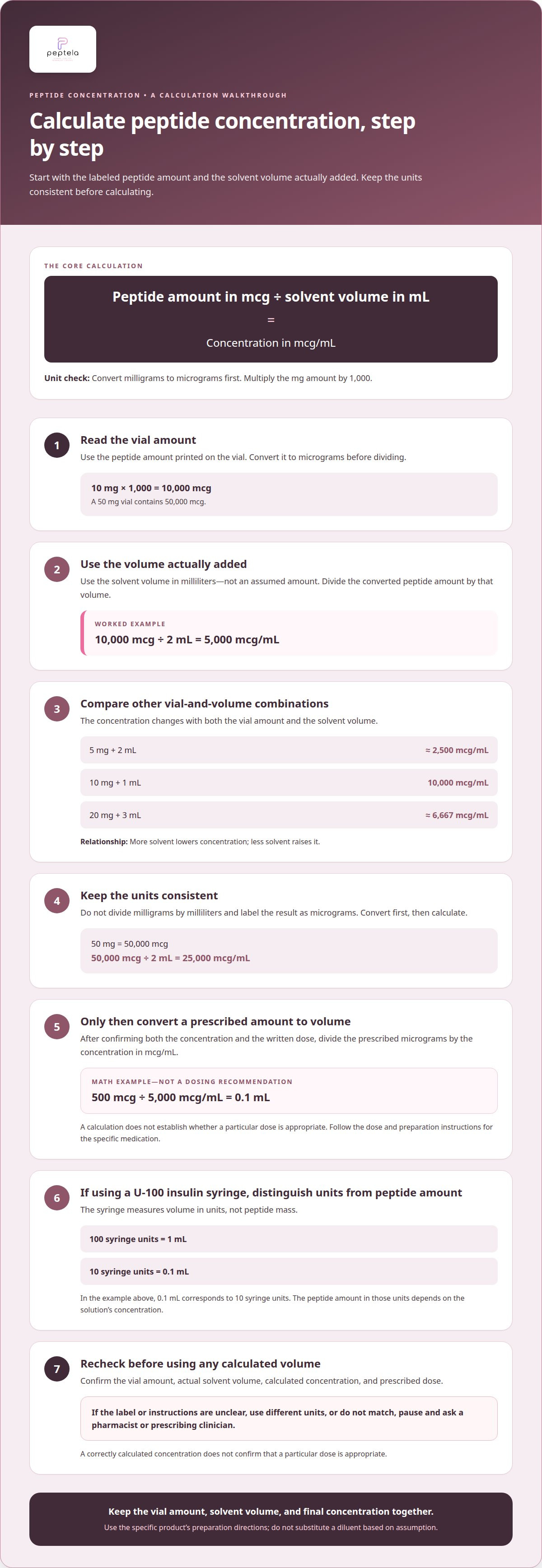
- Start with the peptide amount printed on the vial and the solvent volume actually added. Convert milligrams to micrograms by multiplying by 1,000, then divide by milliliters. For example, 10 mg equals 10,000 mcg; mixed with 2 mL, that gives 5,000 mcg/mL. The result describes concentration, not the amount prescribed for an individual dose.
- Use the same calculation for other vial sizes. A 5 mg vial with 2 mL contains about 2,500 mcg/mL. A 10 mg vial with 1 mL contains 10,000 mcg/mL. A 20 mg vial with 3 mL contains about 6,667 mcg/mL. More solvent lowers concentration; less solvent raises it.
- Keep units consistent before calculating. A vial labeled 50 mg contains 50,000 mcg. With 2 mL added, the concentration is 25,000 mcg/mL. Don’t divide milligrams by milliliters and then label the result as micrograms. Record the vial amount, solvent volume, and final concentration together to reduce mix-ups.
- Convert a prescribed amount to volume only after confirming the concentration and written dose. Divide the prescribed micrograms by the concentration in mcg/mL. For example, 500 mcg divided by 5,000 mcg/mL equals 0.1 mL. This is a math example, not a dosing recommendation. Use the dose and preparation instructions provided for your specific medication.
- A U-100 insulin syringe measures volume in units, not peptide mass. On this syringe, 100 units equals 1 mL, and 10 units equals 0.1 mL. Therefore, the example volume of 0.1 mL corresponds to 10 syringe units. The peptide amount in those units depends on the solution’s concentration.
- Vial pressure can change as liquid is withdrawn. Pressure balancing adjusts the air in the vial to make withdrawal easier, but the correct method depends on the product’s instructions. Don’t force the plunger or improvise. Before drawing, inspect the vial and stopper for damage or leaks. If you encounter unusual resistance, stop and get guidance from the prescribing clinician or pharmacist.
- Recheck the arithmetic before using any calculated volume. Confirm the peptide amount on the label, the actual solvent volume, the concentration, and the prescribed dose. If the label or instructions use different units, pause and ask for clarification. A correctly calculated concentration does not establish whether a particular dose is appropriate.
A nominal 5 mg peptide vial with 3 mL of solvent has an approximate concentration of 1,667 mcg/mL; a nominal 10 mg peptide vial with 3 mL of solvent has an approximate concentration of 3,333 mcg/mL.
Refrigerated storage of powdered and reconstituted peptides
- Ask a pharmacist or clinician for reconstitution instructions before preparing a vial if its product directions are missing, unclear, or inconsistent. Provide the peptide name and the vial’s storage instructions so they can clarify the specific diluent, preparation steps, and storage conditions.
- Follow the specific peptide’s storage directions before mixing it. Powdered peptides may have a shelf life of up to two years when stored cold, but that does not replace the product label. Check whether the directions specify refrigeration or another condition, and keep the vial in its original packaging.
- After reconstitution, store the prepared solution consistently in the refrigerator unless the specific product instructions say otherwise. Keep the vial in its labeled container so its identity and directions remain available. Don’t apply another peptide’s storage instructions: conditions depend on the specific peptide and prepared solution.
- Use the stated storage period for the specific prepared solution. Properly handled reconstituted peptides typically have a shelf life of 3-6 months, but that broad range is not a substitute for product-specific instructions. Record the preparation date on the vial if the directions permit, and follow any shorter use period provided with the product.
- Keep storage conditions consistent between uses. Return the vial to the refrigerator after handling, and avoid leaving it at room temperature for extended periods. Don’t assume a solution remains usable just because it looks unchanged; appearance alone does not establish its storage life.
- If a vial has been stored outside its stated conditions, pause before using it. Note how it was stored and for how long, then ask a pharmacist or clinician whether the product instructions address that situation. Don’t estimate a new storage period or reset the preparation date without product-specific guidance.
- Keep storage facts separate from dose calculations. A longer stated shelf life does not change the peptide concentration, and refrigeration does not correct a preparation error. Keep the product label, preparation date, and storage directions together so they’re easy to review before use.
Consistent refrigeration gives a reconstituted peptide a clear, steady storage routine. Use refrigeration as its regular storage condition rather than alternating between locations or conditions. Maintain that routine throughout the period of use, not just after preparation. After handling the vial, return it to refrigerated storage to maintain the same conditions between uses. Don’t treat a change in location as a reason to establish a different storage practice. The key is consistent refrigeration, not occasional or irregular refrigeration. Follow the product’s own directions if they specify a different condition for that peptide. Don’t assume another product’s storage practice applies or create a new condition without product-specific guidance. Keeping the vial in its usual refrigerated place supports a simple, repeatable routine.
Troubleshooting undissolved material
- Gather the prescribed peptide vial, its specified diluent, a suitable syringe, alcohol swabs, and a sharps container. Set them on a clean, uncluttered surface before you begin. Keep the product label and preparation instructions beside the vial so you can check each step rather than rely on memory.
- Check the vial label and instructions before adding anything. Confirm the peptide name, specified diluent, and amount to use. Don’t substitute another liquid or add extra solvent to clear visible material. Changing the solvent volume alters the concentration and can make later dose calculations inaccurate.
- After preparation, inspect the solution under good lighting and compare its appearance with the product-specific instructions. If it remains cloudy or contains specks, strings, or other visible material that the instructions do not describe, pause. Don’t draw a dose if its appearance differs from what the product instructions specify.
- Review the preparation steps for a missed instruction, such as using the wrong diluent or amount. Compare the vial label with the written directions, not with instructions for another peptide. If you spot a discrepancy, don’t try to correct it by adding liquid or changing the mixture yourself.
- Handle the vial only as gently as its instructions specify. Forceful shaking or vigorous agitation can create foam and make visual inspection harder. If gentle handling doesn’t clear the material, stop rather than applying heat, filtering the solution, or using tools to break up particles.
- Contact the dispensing pharmacist or prescribing clinician if particles remain, the solution looks unusual, or the directions conflict. Provide the peptide name, the diluent used, and a clear description of what you see. These details help them assess the specific product and advise you on the next step.
- Keep the vial separate from prepared solutions that look clear. Mark it or set it aside according to the product instructions, and don’t draw from it while awaiting guidance. Don’t rely on appearance alone to decide whether an unusual solution can be used or stored.
- Dispose of used syringes and needles in an appropriate sharps container, following its instructions. Keep the vial, label, and preparation details available in case a pharmacist or clinician needs them. A concise record of the product and steps taken can help clarify what happened without further altering the solution.
Adding solvent and dissolving lyophilised peptide
- Read the peptide’s preparation instructions before opening the vial. Confirm that bacteriostatic water is the specified diluent and note the exact volume directed. Products can have different instructions, so don’t apply one vial’s preparation method to another. Keep the label within reach as you work.
- Draw only the instructed volume of bacteriostatic water into the syringe. Don’t estimate the amount or change it to make mixing easier. The solvent volume affects the resulting concentration, so an unplanned adjustment can change the amount of peptide in each measured volume.
- Position the needle so the solvent runs slowly down the inside wall of the peptide vial. Don’t direct the stream onto the lyophilised powder. A slower flow helps limit bubbling and reduces force on the powder as the liquid enters.
- Add the bacteriostatic water gradually. If liquid enters too quickly or creates noticeable bubbles, pause and continue more slowly. Don’t push the plunger abruptly. Controlled flow keeps the process measured and makes it easier to observe the vial as you add the solvent.
- Once the instructed volume has entered, handle the vial gently. Swirl it slowly to move liquid across the powder and help it dissolve. Don’t shake the vial. Vigorous agitation can create foam.
- Continue gentle swirling rather than stirring with the needle or another object. Keep the vial closed during this step and follow the product’s specific directions for any additional handling. Don’t add extra solvent just because the powder takes time to dissolve.
- After gentle swirling, inspect the mixture under good lighting and compare its appearance with the product’s instructions. If the product is expected to be clear and particle-free but material remains, don’t try to dissolve it with shaking, heat, or extra liquid. Pause and follow the product instructions for unresolved material.
- Keep the vial’s label and preparation directions with it after mixing. Use the specified storage conditions, not instructions for another peptide. If the directions conflict or leave you unsure about the diluent or volume, ask a pharmacist or clinician before proceeding.
Use bacteriostatic water only if the peptide’s preparation instructions specify it as the diluent. Follow the product directions for the exact volume and handling. If they’re unclear, ask a pharmacist or clinician before proceeding.
Step-by-step bacteriostatic water reconstitution
Compounded drugs are not FDA-approved. The FDA does not review their safety, effectiveness, or quality before marketing. “Research peptide” labeling does not establish that a peptide is approved for human use. Bacteriostatic Water for Injection, USP labeling describes formulations containing benzyl alcohol, but that does not establish that it is suitable for mixing with a particular peptide.
Bacteriostatic water is appropriate only when the specific peptide’s instructions call for it. If you’re learning how to reconstitute peptide vials with bacteriostatic water, follow the product’s stated diluent, volume, preparation method, and storage directions. Ask a pharmacist or clinician if those instructions are unclear or unavailable.
Benzyl alcohol may be unsuitable for someone sensitive to it, and improper handling or vial access can lead to contamination. Review product warnings and discuss personal risks with a pharmacist or clinician before proceeding.
- Read the peptide vial and supplied instructions before opening anything. Confirm the peptide name, specified diluent, required volume, and storage directions. Don’t assume bacteriostatic water is suitable for every peptide.
- Gather the materials named in the instructions, including the specified diluent, a suitable syringe, and the peptide vial. Work on a clean, uncluttered surface. Keep the label and directions in view as you follow each step.
- Inspect the vial, stopper, and diluent container before use. Don’t proceed if a container is damaged, leaking, or visibly compromised. Follow the product’s handling directions, and avoid touching the needle or vial access point.
- Draw the exact solvent volume specified for that peptide. Check the syringe markings at eye level rather than estimating between marks. The amount of diluent affects concentration, so adding more or less changes later calculations.
- Introduce the solvent slowly along the vial’s inside wall, not directly onto the powder. Let it enter gradually to limit bubbling. Avoid forceful pressure on the plunger, which can make liquid strike the lyophilised material.
- After adding the instructed volume, gently swirl the vial until the powder dissolves. Don’t shake it. Check the solution under good lighting. Its expected appearance depends on the product instructions; follow them to determine whether it should be clear and free of visible particles.
- Stop if the solution’s appearance differs from the product instructions. Don’t add extra solvent, apply heat, or use the mixture while you’re uncertain. Contact the dispensing pharmacist or prescribing clinician and provide the preparation details.
- Follow the product’s storage directions after preparation, and record the preparation date if instructed. If you’re learning how to reconstitute peptide vials with bacteriostatic water, use the product label as your guide to handling and storage. Ask a pharmacist or clinician about any unclear warning before using the solution.
Peptela: Peptides
Peptela offers peptides as part of personalized, clinician-guided care. If you’re considering peptide treatment and want to understand whether it fits your health goals, a clinical conversation can help you consider relevant factors, including your medical history, current medications, and potential risks. Reconstitution instructions are product-specific, so this guidance doesn’t replace the directions supplied with a particular peptide or advice from its pharmacist.
For questions about care or to discuss your options as part of an individualized plan, contact Peptela.
Make Your Next Step Clinician-Guided
Knowing how to reconstitute peptide vials with bacteriostatic water is only one part of an informed treatment decision. Consider whether a particular peptide is appropriate for your needs and how it fits with your medical history and current medications. Preparation instructions explain handling, but they can’t determine whether a treatment is right for you.
Peptela offers Peptides, Tirzepatide Injections, NAD+, and Hormone Balance. A clinician-guided discussion can help you explore relevant considerations and identify questions to ask before proceeding. Individual needs and potential risks deserve careful consideration.
Contact Peptela with your questions to discuss your next step. A thoughtful conversation can help you move forward with clarity and confidence.
Frequently Asked Questions
Can I use ordinary sterile water instead of bacteriostatic water?
Use ordinary sterile water only if the specific peptide’s instructions name it as the diluent. Bacteriostatic water contains benzyl alcohol; sterile water is a different preparation. Don’t substitute one for the other based on assumption. If the product directions don’t identify the diluent, ask a pharmacist or clinician before preparing the vial.
How much solvent should you add?
Add the volume specified in the instructions for that peptide. There’s no single amount for every vial. The vial’s contents and required concentration determine the instructed volume, so don’t choose an amount based on another product or adjust it to make mixing easier.
What is bacteriostatic water and what is it used for with peptide vials?
Bacteriostatic Water for Injection, USP is a diluent used when a peptide’s instructions specify it. Labeled formulations contain benzyl alcohol, with concentrations varying by formulation. It isn’t automatically appropriate for every peptide. Check the specific product directions, especially if you have a known sensitivity to benzyl alcohol.
What supplies and sterile technique are needed to reconstitute a peptide vial?
Use the peptide vial, its specified diluent, a suitable syringe and needle, and any additional supplies named in the product instructions. Work on a clean surface, keep the instructions nearby, and avoid touching the needle or vial access point. Dispose of used sharps according to the container’s instructions.
How do you calculate the amount of diluent and the resulting peptide concentration?
Use the diluent volume specified for the product. To calculate concentration, convert the peptide amount to micrograms, then divide by the solvent volume in milliliters. The result is expressed in mcg/mL. This is the concentration, not a prescribed dose; confirm dose instructions separately.
What are the general steps for reconstituting a peptide vial without contaminating it?
Follow the product’s instructions, gather the named supplies on a clean surface, and avoid touching the needle or vial access point. Add only the specified diluent, then mix as directed. Don’t reuse supplies or improvise if a step is unclear; ask the dispensing pharmacist for product-specific guidance.
How should bacteriostatic water and reconstituted peptide vials be stored, and for how long?
Follow each product’s label because the diluent and prepared peptide may have different storage directions. Powdered peptides may have a shelf life of up to two years when stored cold; properly handled reconstituted peptides typically have a shelf life of 3-6 months. Use the specific product’s directions for its storage conditions and period.
How does bacteriostatic water compare with sterile water for injection or saline for peptide reconstitution?
These are different preparations, not interchangeable defaults. Labeled formulations of Bacteriostatic Water for Injection, USP contain benzyl alcohol; sterile water and saline have different formulations. The correct diluent depends on the specific peptide’s instructions. Don’t substitute or combine diluents unless those directions call for it.


