

What if a plateau doesn’t mean tirzepatide has stopped working? Weight loss often slows after the first 3-6 months as your body changes, and a steady number on the scale can feel discouraging even when your progress hasn’t simply stopped. A plateau alone isn’t proof that your medication is no longer effective.
It’s reasonable to want a clear next step rather than guess or change your dose on your own. Useful tirzepatide weight loss plateau solutions begin with understanding what may be affecting your progress, then making practical adjustments that support your health and treatment plan.
This guide explains why plateaus can happen and how energy use, protein intake, and strength training may relate to weight trends. You’ll learn what to review before changing your routine and why medication adjustments should be discussed with a licensed medical professional. The goal is to assess progress thoughtfully, using more than the scale alone.
Key Takeaways
- A plateau can reflect changes in your body’s energy needs and doesn’t automatically mean tirzepatide has stopped working.
- Weight loss often slows after the first 3-6 months, so assess progress over time rather than relying on a single weigh-in.
- Protein, everyday movement, and resistance training can support muscle as your weight changes.
- Don’t change your tirzepatide dose on your own; review your progress and options with your clinician.
- Severe abdominal pain or persistent vomiting while taking tirzepatide needs prompt medical attention.
Protein and strength training to support muscle
Protein, regular activity, resistance training, sleep, and hydration can support your overall plan. Protein and strength training are particularly relevant to supporting muscle during weight loss.
- Build meals around protein. A general guideline is 0.8-1.2 grams per kilogram of body weight daily. For people trying to move past a GLP-1 plateau, another recommendation is at least 0.6 to 0.75 grams per pound of goal body weight. These are different ways to estimate intake, so ask your clinician what fits your health needs.
- Spread protein across your meals. For example, include eggs at breakfast, beans or fish at lunch, and tofu, chicken, or lentils at dinner. If appetite changes make meals difficult while taking tirzepatide, discuss practical options with your clinician instead of forcing large portions.
- Add resistance training regularly. The Centers for Disease Control and Prevention recommends muscle-strengthening activity on at least two days weekly for adults. Start with movements you can perform with good form, such as chair squats, wall push-ups, or resistance-band rows. Increase the challenge gradually.
- Choose a repeatable routine. Two or three weekly sessions can include exercises for major muscle groups, with rest between harder sessions. A trainer or physical therapist can help adapt movements for joint discomfort, mobility limits, or experience with obesity-related health concerns.
- Build activity into ordinary days. Take a short walk after a meal, use stairs when comfortable, or stand and move during a work break. Gradually increasing daily steps can raise activity without requiring every session to feel like a workout. Track a realistic starting point, then add movement at a manageable pace.
- Support training with recovery. Aim for 7-9 hours of sleep per night, and drink fluids regularly throughout the day. On strength-training days, notice your energy, soreness, and ability to complete familiar exercises. Persistent fatigue or difficulty eating and drinking deserves a conversation with your clinician.
Your body composition can change while the number on the scale stays steady. If your clothes fit differently or your measurements shift, those observations can provide useful context. Treat protein, daily movement, and resistance training as connected habits, not quick fixes for a stalled number.
When do people plateau on tirzepatide?
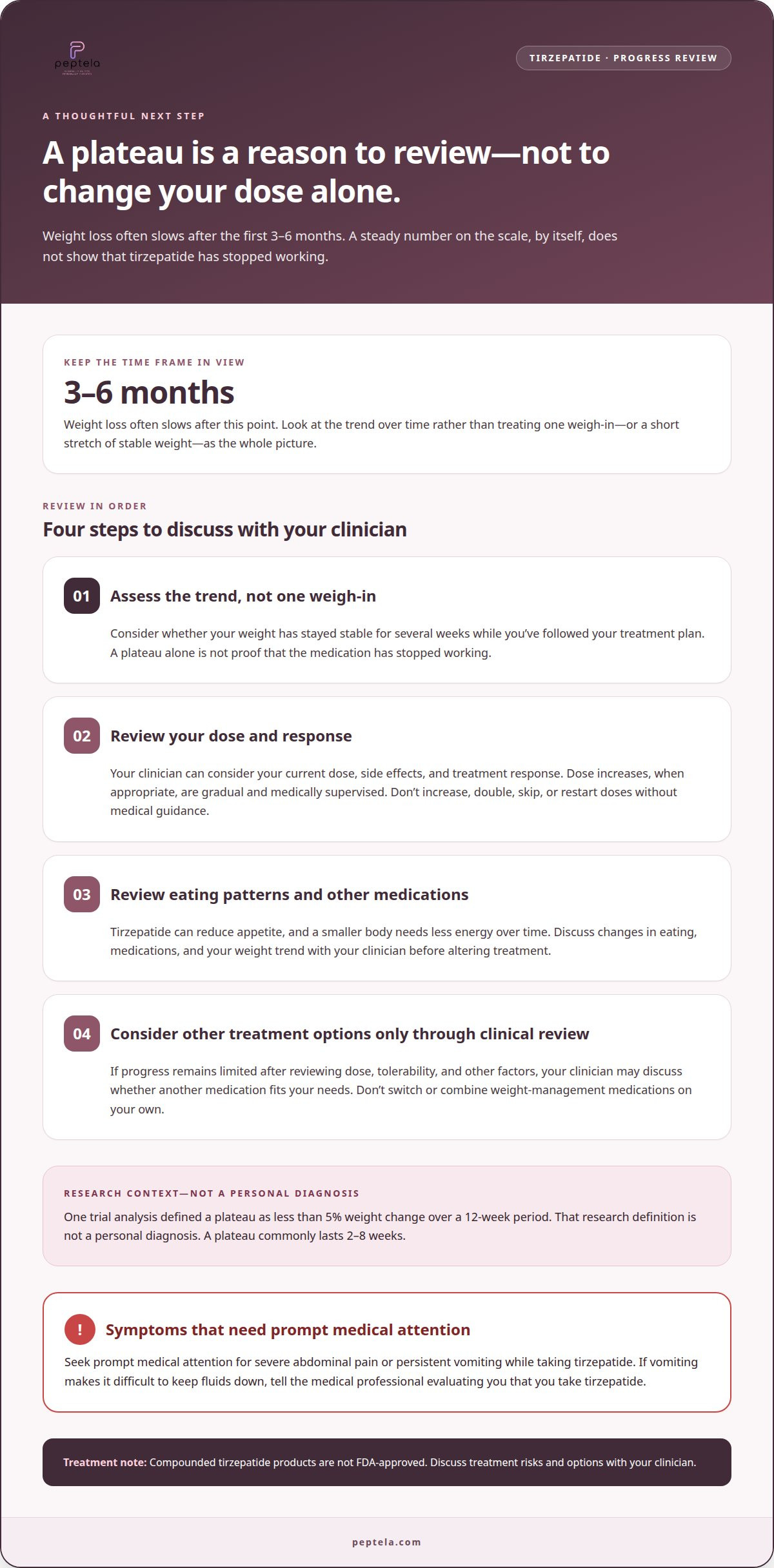
Weight loss often slows after the first 3-6 months. A plateau alone doesn’t mean tirzepatide has stopped working.
Compounded tirzepatide products are not FDA-approved. Don’t assume they’re appropriate for managing a plateau; discuss treatment risks and options with your clinician.
Don’t increase tirzepatide or combine it with another weight-management medication on your own. Changes or combinations can affect treatment risks, so discuss them with a licensed medical professional first.
- Assess the trend, not one weigh-in. Consider whether your weight has stayed stable for several weeks despite following your treatment plan. In a trial analysis, researchers defined a plateau as less than 5% weight change over a 12-week period. That research definition isn’t a personal diagnosis.
- Review your dose with your clinician. Tirzepatide doses may be increased gradually under medical supervision when a person hasn’t reached an effective, tolerated dose. Don’t increase, double, skip, or restart doses without medical guidance. Your clinician can consider your current dose, side effects, and treatment response.
- Seek prompt medical attention for severe abdominal pain or persistent vomiting. These symptoms need timely assessment while taking tirzepatide. If vomiting makes it difficult to keep fluids down, tell the medical professional evaluating you that you take tirzepatide.
- Discuss other medications and changes in eating. Tirzepatide can reduce appetite, so eating fewer calories may contribute to weight loss. Over time, a smaller body also needs less energy. Review medication changes, eating patterns, and your weight trend with your clinician before altering treatment.
- Consider switching only through a clinical review. If progress remains limited after reviewing dose, tolerability, and other factors, your clinician may discuss whether another medication fits your needs. Don’t combine or switch weight-loss medications independently. The next step depends on your current treatment and health history.
A plateau should be interpreted alongside the overall response: while taking tirzepatide or another GLP-1 medication, a plateau alone does not show that the medicine has stopped working. A plateau after losing approximately 15-21% of starting weight may be consistent with clinical trial outcomes, but this comparison does not predict an individual’s response.
If considering a change, review the timing or dose of GLP-1 medication with a clinician. When a patient has not yet reached a maximally tolerated, effective dose, gradual dose escalation under medical supervision is recommended. Do not adjust tirzepatide dose without medical supervision, or increase a GLP-1 dose during a plateau without clinician guidance. Decisions about timing or dose should remain part of that clinical review.
Expected weight-loss curve and plateau timing
Weight loss on tirzepatide often slows after the first four to six months. Look at the longer-term pattern, not a single weigh-in, before deciding treatment has stopped working.
Review the Expected Weight-Loss Curve
Compare several weeks of measurements with your earlier trend. Weight loss may continue gradually for 72 weeks or longer, while a plateau commonly lasts two to eight weeks. In one analysis, researchers began measuring plateau periods at week 24. Don’t treat a short stretch of stable weight as proof that progress has ended.
Set Long-Term Treatment Expectations
Plan to assess treatment over months, not days. Studies of semaglutide and tirzepatide found average maximum weight loss around 9-18 months, after which weight tended to stabilize. That pattern helps set expectations, but it doesn’t predict an individual result. Track the trend and discuss major changes with your clinician.
- Use consistent weigh-in conditions. Record weight at a similar time and under similar conditions, then compare weekly trends across several weeks. Daily numbers can shift, so avoid changing your plan because of one reading. A stable trend over two to eight weeks may fit a common plateau window.
- Put trial results in context. The SURMOUNT-1 plateau analysis included 1,438 adults with overweight or obesity and no diabetes. About 88% to 90% of selected participants across BMI groups met the plateau definition by week 72. Trial patterns describe groups, not a deadline for your own progress.
- Expect a slower later phase. During later weight loss, ongoing loss may average about 1-2 lb per month. Progress at that pace can be harder to notice week by week. Compare monthly trends rather than expecting the faster changes often seen during the first four to six months.
- Review long-term goals with your clinician. In SURMOUNT-5, estimated average weight loss with tirzepatide was 20.2% at 72 weeks. Study results can help frame expectations, but they don’t set a required target. Discuss how your weight trend, treatment experience, and health goals fit together.
Adaptive thermogenesis and energy expenditure
After weight loss, your body may use less energy than before. This change can mean that the same daily intake has a smaller effect on your weight.
- Reassess energy needs after weight changes. Losing weight means carrying less body mass during daily activities. A 10% reduction in weight is associated with a 15% decrease in 24-hour energy expenditure. So an intake that once supported steady loss may eventually maintain your lower weight instead.
- Account for changes in everyday movement. Non-resting energy expenditure includes activity outside structured exercise. A 10% reduction in weight is associated with a 30% decrease in non-resting energy expenditure. Notice whether walking, standing, or household movement has gradually declined. Add manageable movement back into your routine, such as a short walk.
- Review food intake briefly, not indefinitely. Track meals and drinks for 1-2 weeks to spot changes in portions, snacks, or eating patterns. Use the record to identify practical adjustments rather than imposing extreme restriction. As body weight falls, calorie needs may also fall, so modest changes can be more appropriate.
- Keep activity realistic as your body adapts. A 10% reduction in weight is associated with a 20% increase in skeletal muscle work efficiency. In practical terms, familiar movement may require less energy than before. A steady walking routine or regular resistance sessions can help maintain activity as your weight changes.
- Discuss persistent changes with a clinician. Resting metabolic rate can decrease as weight falls, and adaptive thermogenesis may add to that change. One research estimate states that a 10% decrease in weight produces more than a 10% decrease in basal metabolism. These estimates describe energy use, not a reason to cut intake sharply or change medication without guidance.
The practical takeaway is to reassess your intake and daily activity after weight loss. A plateau may reflect lower energy needs, not a lack of effort. Keep a brief food record, note changes in movement, and discuss those details with a licensed medical professional before making major adjustments.
Why weight loss plateaus on tirzepatide
Weight loss can plateau as a smaller body needs fewer calories, daily energy use shifts, or body composition changes. A plateau commonly lasts two to eight weeks, but its duration varies. Useful tirzepatide weight loss plateau solutions begin with understanding which factors may apply to you.
- Reassess your weight trend. Compare measurements over several weeks rather than reacting to one weigh-in. Water shifts and normal day-to-day variation can obscure the broader pattern. If your weight stays stable for several weeks, record the trend alongside your medication routine and eating habits.
- Consider changing energy needs. After weight loss, your body uses less energy to maintain itself and support daily activities. The intake that once supported weight loss may now be closer to what your body needs. Review portions and activity before making a drastic cut.
- Account for body composition. The scale can stay steady while fat decreases and some muscle is gained. For example, note whether your clothes fit differently or measurements change while your weight remains stable. These observations add context, though they can’t show exactly how your body composition has changed.
- Remember how tirzepatide works. Tirzepatide activates GLP-1 and GIP gut hormone receptors. Reduced appetite may change how much you eat, but medication response and weight trends can vary over time. A plateau by itself doesn’t show that treatment has stopped working or that your dose needs an increase.
- Review practical factors before adjusting treatment. Consider changes in meals, activity, sleep, and medication use. A brief food record may help you notice changes in portions or missed meals. One practical tirzepatide weight loss plateau solution is to bring these observations to a clinical review before considering a treatment adjustment.
The takeaway: a plateau can reflect lower energy needs, changing activity, or changes in body composition. It may not have a single cause. If your weight trend has stayed stable for several weeks, discuss it and your treatment questions with a licensed medical professional before changing your dose.
Peptela: Tirzepatide Injections
Peptela offers Tirzepatide Injections for people considering clinician-guided support with weight management. If your weight has plateaued, a dose increase isn’t automatically the next step. A clinical review can put your progress, treatment experience, and health needs in context before you decide what to do next.
Peptela’s personalized plans are guided by a fully in-house care team with 199+ years of combined clinical experience. A useful review can cover how long your weight has been stable, how you take your medication, changes in eating or activity, and any side effects. These details help frame an individualized discussion instead of treating one scale reading as the whole picture.
Tirzepatide may not be appropriate for everyone. Before starting or changing treatment, a licensed medical professional should consider your health history, current medications, prior response, and possible contraindications. Share relevant diagnoses and medications, including supplements, for the review. Don’t increase, skip, or restart doses without medical guidance.
A clear summary of your progress can make a clinical discussion more useful. Note when the plateau began, whether your weight has stayed steady, and whether your routine or medication use has changed. A brief food or activity record may also help reveal patterns. The goal is a thoughtful review, not pressure to lose weight at a particular pace.
Peptela also offers NAD+, Hormone Balance, and Peptides. These are distinct from Tirzepatide Injections, and their relevance depends on individual health needs and clinical assessment. A plateau alone doesn’t show that another therapy is needed or that combining treatments is appropriate. Discuss any additional medication or therapy with a licensed medical professional before making a change.
Severe abdominal pain or persistent vomiting while taking tirzepatide requires prompt medical attention. These symptoms need timely evaluation, not a routine weight-management discussion. For other concerns, a licensed medical professional can review your plan, response, tolerability, and health history to assess whether treatment remains appropriate.
Choose a Clear Next Step
A pause in progress can be an opportunity to clarify what matters most to you. Before making a change, decide what you want to address in your next clinical conversation: your treatment goals, the effort involved in maintaining your routine, or concerns affecting your day-to-day well-being. A focused discussion can help turn uncertainty into a practical decision.
The most useful tirzepatide weight loss plateau solutions take your health, priorities, and treatment experience into account. You don’t need to address every factor at once. Choose one question to raise, keep to your plan until you receive guidance, and give yourself time to make an informed choice.
Your progress is more than a number, and your next step can be thoughtful rather than rushed. Keep advocating for the care and clarity you need as you move forward.
Frequently Asked Questions
Does a plateau mean my GLP-1 stopped working?
No. A plateau by itself doesn’t show that a GLP-1 medication has stopped working. Weight trends can flatten as your body’s energy needs change, and a few steady weigh-ins may not represent a lasting shift. For a clearer picture, compare consistent measurements over several weeks and note changes in appetite, activity, or routine. Discuss a persistent change with your clinician before altering medication.
What should I do if I hit a weight loss plateau while taking tirzepatide?
Start by recording your weight trend and routine, rather than sharply cutting calories or changing your dose. For example, briefly track meals, activity, and medication use, then note when your weight began to level off. This can help identify changes to discuss with a licensed medical professional. Don’t double or skip doses, or stop and restart tirzepatide, without medical guidance.
How long should I stay at each tirzepatide dose, and when can it be increased?
Tirzepatide is taken once weekly, but the time spent at each dose depends on your prescribed plan and how you tolerate treatment. Any dose escalation should happen gradually under medical supervision, not in response to a single weigh-in. Talk with a licensed medical professional before an increase, especially if side effects affect eating or drinking. Don’t change your schedule or dose on your own.
What is the maximum FDA-approved tirzepatide dose for weight loss, and how does dose affect results?
The trial information discussed here includes weekly tirzepatide doses of 10 or 15 mg, but trial doses alone don’t establish the FDA-approved maximum. Higher dosing shouldn’t be assumed to produce a better individual result. Follow the prescribing information for your medication and have a clinician determine whether a dose change is appropriate, considering treatment response, tolerability, and health history.
How much weight loss is typical with tirzepatide over 3, 6, and 12 months?
Weight loss varies, and a specific result at 3, 6, or 12 months can’t be predicted for every person. In SURMOUNT-5, estimated average weight loss with tirzepatide was 20.2% at 72 weeks. That study result is not a month-by-month forecast or personal target. Your trend depends on factors such as treatment response, dose tolerance, and consistency over time.
When should a tirzepatide plateau prompt a medical evaluation or treatment change?
Arrange a routine clinical review if your weight stays stable for several weeks despite following your plan, or if side effects interfere with treatment. A review can assess your progress and whether a change is appropriate. Seek prompt medical attention for severe abdominal pain or persistent vomiting while taking tirzepatide. Don’t increase, stop, or switch medication without medical guidance.
What medications or health conditions can slow weight loss while taking tirzepatide?
Changes in other medications or your health can affect your weight-management plan, depending on the specific medicine and your circumstances. Bring an up-to-date medication list, including supplements, to your licensed medical professional, and mention recent changes in appetite, movement, or health. Don’t stop psychiatric medication or another prescribed treatment on your own; discuss concerns with the prescribing professional.


