

NAD+ injections aren’t a proven shortcut to lasting energy or sharper focus. NAD+ supports cellular energy production, but human evidence that injections improve energy is limited. The science behind NAD+ for energy and focus is promising, but it doesn’t establish injections as a reliable fix.
If low energy or difficulty concentrating is affecting your day, it makes sense to look for an approach grounded in how the body works. NAD+ helps cells convert nutrients into usable energy, which is why it has drawn attention as a potential part of wellness care.
Here, you’ll learn how NAD+ supports cellular energy, what research can and can’t tell us about injections, and how food, exercise, and sleep fit into the picture. You’ll also learn how to think about NAD+ therapy alongside sustainable habits, helping you make a more informed choice about your next step.
Key Takeaways
- Understand how NAD+ and NADH help move energy through cellular processes, and why that role doesn’t guarantee a noticeable boost in focus.
- Compare oral precursors, injections, and IV therapy with a clearer view of what current human evidence can and can’t establish.
- Learn how foods that provide vitamin B3 and tryptophan can support the body’s own NAD+ production.
- Build a practical foundation with regular movement and healthy sleep alongside nutrition.
- Explore how to think about persistent fatigue thoughtfully, rather than assuming NAD+ is the only factor affecting your energy.
NAD+ and cellular energy production
NAD+ is a coenzyme found in every cell of the human body. It helps cells convert nutrients into usable energy and supports DNA repair and mitochondrial function. Think of it as a helper molecule in cellular processes, not as fuel itself. Its role links energy production with other work that keeps cells functioning.
NAD+ and NADH are two forms of the same coenzyme. NAD+ is the oxidized form, while NADH is the reduced form that carries electrons. As cells break down nutrients, NAD+ accepts electrons and becomes NADH. NADH then delivers those electrons to chemical reactions that help produce energy. The body continually recycles both forms as these reactions proceed.
In mitochondria, electron transfer supports oxidative phosphorylation, a process that produces adenosine triphosphate, or ATP. Cells use ATP to power everyday tasks, from muscle contraction to maintaining cellular structure. NAD+ contributes by helping move electrons through energy-producing reactions. It doesn’t make ATP alone: the process depends on coordinated reactions and the nutrients cells use. This role helps explain interest in NAD+ for energy and focus, but doesn’t prove a personal benefit.
NAD+ also supports cellular functions beyond ATP production. Enzymes called PARPs use NAD+ in DNA repair, helping address damage to genetic material. Sirtuins, a family of seven proteins, also depend on NAD+ to function. These proteins take part in processes involved in cellular stress responses. This makes NAD+ relevant to cellular recovery and maintenance, as well as converting food into energy.
NAD+ levels can decline by roughly 50% between a person’s 20s and 50s, though the rate varies by tissue type and health. That change doesn’t describe everyone’s energy or focus in the same way. Cells can create NAD+ from scratch or recycle it from smaller molecules, so its availability reflects ongoing production and use. Age is one part of that picture, not a complete measure of cellular function.
For example, after a meal, cells break down nutrients and use NAD-related reactions to transfer electrons toward ATP production. During DNA repair, PARPs also use NAD+ for a different cellular task. The molecule therefore serves several roles rather than acting as a single-purpose energy switch. Understanding these roles helps frame questions about NAD+ for energy and focus while separating cellular functions from claims about how a person will feel.
Do NAD+ injections really work?
NAD+ injections can raise circulating NAD+ levels, but evidence that they improve energy is limited. Oral forms and vial contents offer useful context, though they don’t establish a standard dose or prove that one route works better.
Oral Precursors Compared With Injections and IVs
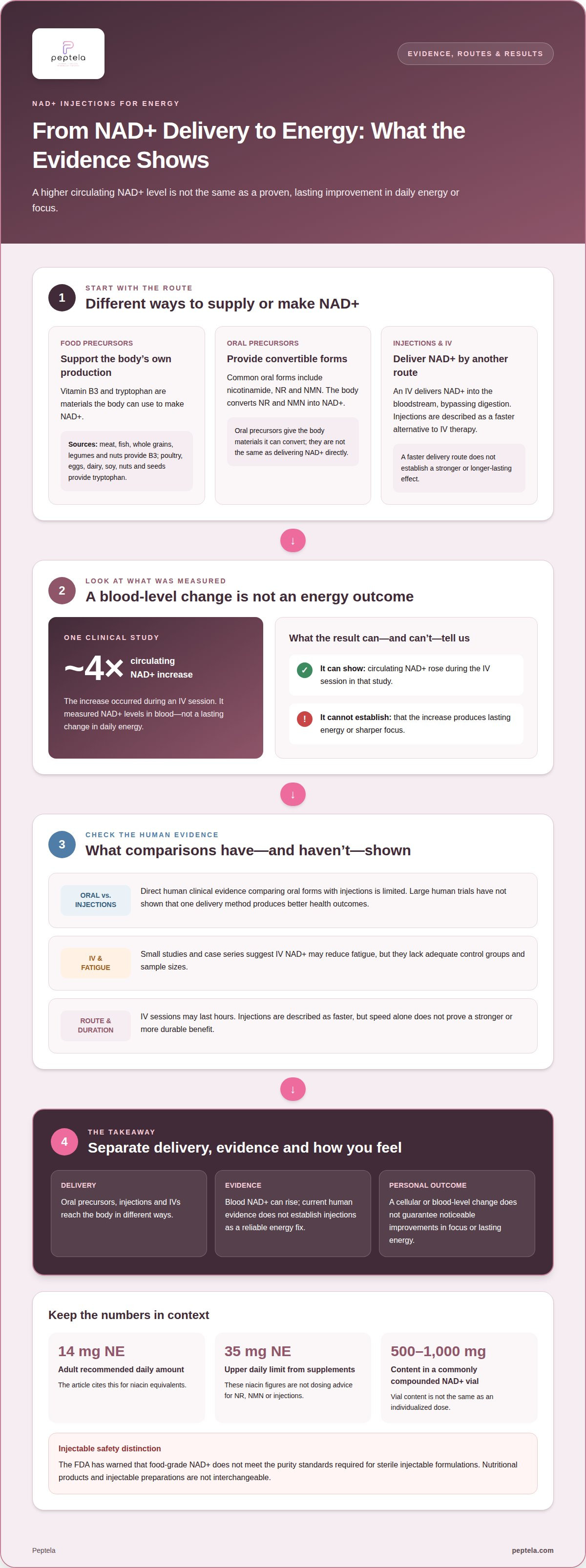
Oral precursors give the body materials it can convert into NAD+, while injections and IVs deliver NAD+ through different routes. This distinction matters because changes in circulating levels don’t automatically translate into improved energy or focus.
Human clinical evidence directly comparing oral forms with injections is limited, and large human trials haven’t shown that one delivery method produces better health outcomes. Small studies and case series suggest IV NAD+ may reduce fatigue, but they lack adequate control groups and sample sizes. One clinical study found that circulating NAD+ levels increased nearly fourfold during an IV session. That finding measures blood levels, not a lasting change in daily energy.
An IV delivers NAD+ into the bloodstream, bypassing digestion, and may involve sessions lasting hours. Injections are described as a faster alternative to IV therapy. But a faster route doesn’t establish a stronger or longer-lasting effect. The practical comparison is between delivery method, evidence, and the outcome being assessed.
Vitamin B3, Tryptophan, NMN, and NR
Vitamin B3 forms, tryptophan, NMN, and NR are precursors the body can use to make NAD+. Knowing the distinction helps separate dietary support from a specific supplement or injection.
The body makes NAD from precursors that include vitamin B3 and the amino acid tryptophan. Nicotinamide, NR, and NMN are common oral supplement forms; the body converts NR and NMN into NAD+. Food doesn’t contain meaningful amounts of NAD directly. Instead, meat, fish, whole grains, legumes, and nuts provide vitamin B3, while poultry, eggs, dairy, soy products, nuts, and seeds provide tryptophan.
Common oral forms include nicotinamide, NR, and NMN. The National Institutes of Health Office of Dietary Supplements lists an adult recommended daily amount of 14 mg niacin equivalents (NE), with an upper daily limit of 35 mg NE from supplements. These figures apply to niacin, not dosing advice for NR, NMN, or injections. A commonly compounded NAD+ vial contains 500 to 1,000 mg, but vial content isn’t the same as an individualized dose.
Food-grade NAD+ is a separate safety consideration for injections: the FDA has warned that it doesn’t meet the purity standards required for sterile injectable formulations. Nutritional products and injectable preparations aren’t interchangeable, even when both relate to NAD+ production.
Can I boost NAD+ naturally without injections?
Yes. Your body makes NAD+ from nutrients, including vitamin B3 and tryptophan, and recycles it during cellular activity. Food, movement, and sleep can support this natural process. However, increasing NAD+ production is not the same as proving better focus, mood, or cognitive performance.
FDA approval depends on the intended use. The FDA has not approved NAD+ for any specific medical indication. It has warned that food-grade NAD+ poses a safety concern in injectable products because it doesn’t meet sterile injectable purity standards. That warning concerns injectable NAD+, not NMN supplements.
In the United States, NAD+ supplement and IV treatment costs depend on formulation, amount, route, and treatment setting. Service pricing is case-specific and provided after a quote request.
Does supplementation improve energy, focus, or cognitive performance in humans? Current evidence doesn’t establish a reliable cognitive benefit. Research on NAD+ supplements is ongoing, and more studies are needed. NAD+ supports cellular processes relevant to brain health, but that role alone doesn’t show that taking a supplement improves memory, attention, or mental clarity.
That distinction matters because a change in NAD+ levels isn’t the same as a noticeable change in daily function. For example, feeling more alert after taking nicotinamide or another supplement doesn’t show that NAD+ caused the change. Sleep, stress, meals, and other factors can also affect concentration and mood. Tracking those patterns can help you describe what changes and when.
For natural support, focus on the inputs your body uses to make NAD+. Meals that provide vitamin B3 and tryptophan supply relevant nutrients, while regular physical activity can stimulate NAD production. Healthy sleep supports the body’s ongoing cellular processes. These habits support overall function, but they shouldn’t be framed as a proven treatment for chronic fatigue or a guaranteed way to sharpen cognition.
Consider what outcome you want to assess before trying a supplement. If your goal is mental clarity, note practical examples, such as completing a focused task, staying attentive during a meeting, or feeling less mentally drained at day’s end. If chronic fatigue or changes in mood persist, discuss them as broader health concerns rather than assuming NAD+ is the cause. A clear record of sleep, activity, and concentration can provide useful context for that conversation.
Combining NAD+ therapy with healthy habits
Nicotinamide adenine dinucleotide, or NAD+, is one part of a broader wellness picture. Food, regular physical activity, and healthy sleep support the body’s natural NAD+ production. Pairing those habits with therapy keeps the focus on daily routines as well as treatment, rather than treating one approach as a replacement for the others.
NAD+ supplements, caffeine, and sleep work differently. Caffeine is a stimulant, sleep supports recovery, and NAD+ supplements aim to supply precursors the body can convert. Research on NAD+ supplements is ongoing, and more studies are needed. For a practical comparison, track a specific outcome, such as afternoon fatigue or focus during a work task, alongside your sleep and caffeine habits.
Brain health is an area of interest because NAD+ supports the normal function of brain cells. That role doesn’t establish a treatment for memory concerns, low mood, or other mental health symptoms. It’s useful to distinguish between supporting a cellular process and demonstrating a change in cognitive function. For example, feeling mentally clearer after a better night’s sleep doesn’t show that NAD+ levels caused the change.
Metabolism is another part of the picture. A randomized, double-blind, placebo-controlled trial found that oral NMN improved muscle insulin sensitivity in prediabetic women over 10 weeks. That finding concerns a specific metabolic outcome, not proof that NMN improves focus, treats inflammation, or resolves fatigue. It illustrates why the measured result and the population matter when interpreting research.
Healthy routines also create useful context for evaluating therapy. Regular physical activity has been shown to stimulate NAD production, while vitamin B3-rich foods provide nutrients the body uses in this process. Sleep matters too. If fatigue persists, noting changes in sleep, movement, and concentration can help separate a broader wellness pattern from an assumed supplement effect.
Keep the approach manageable. Choose a repeatable activity, such as a walk, and pair it with a consistent sleep routine and meals containing vitamin B3. Then observe practical markers, such as energy during a usual afternoon task. This won’t prove cause and effect, but it can make patterns easier to discuss and support informed decisions about therapy.
NAD+ research spans cellular energy, neurological health, and metabolism, but these topics involve different outcomes. Treating mental clarity, mood, inflammation, and physical energy as interchangeable can obscure what a study actually measured. A focused wellness plan combines sustainable habits with a clear goal, such as improving sleep consistency or understanding ongoing fatigue.
NAD+ injections for energy and fatigue
NAD+ injections are promoted for energy, but human evidence that they relieve fatigue is limited. Small studies and case series suggest IV NAD+ may reduce fatigue, yet they lack adequate control groups and sample sizes. That distinction matters: a biological change during treatment doesn’t automatically mean a lasting change in how you feel.
Lower NAD+ levels have been linked to muscle weakness and fatigue, as well as metabolic and cognitive concerns. A link doesn’t prove that a decline in this molecule causes an individual’s symptoms. Fatigue can have different contributors, so an important question is what outcome treatment aims to address and how that outcome will be assessed.
Some clinical data describe changes in circulating NAD+ during an IV session. One study reported levels rising nearly fourfold during treatment. That result concerns blood levels, not proof of better daily stamina or focus. Reports of physical energy, mood, and focus after IV therapy are typically more pronounced 24-48 hours after infusion, but those reports don’t establish a predictable response for every person.
The route also shapes the experience. IV NAD+ enters the bloodstream directly and may involve infusion sessions lasting hours; injections are described as a faster alternative. Faster administration doesn’t itself show greater effectiveness. The key comparison is whether evidence supports the intended result, such as reduced fatigue, rather than simply showing that NAD+ levels changed.
Clinical oversight matters for injectable treatment. The FDA has warned that food-grade NAD+ is a safety concern in injectable products because it doesn’t meet purity standards for sterile formulations. Possible temporary side effects reported with NAD+ therapy include nausea and brain fog. The product’s formulation and the person’s symptoms are relevant considerations, not details to overlook when discussing treatment.
Before considering an intervention, define a practical measure of progress. For example, note whether afternoon fatigue disrupts a usual task or whether your focus changes during a workday. This gives the conversation a specific outcome beyond a general wish for more energy. It also helps distinguish a short-lived feeling from a pattern that affects daily functioning.
Explore clinician-guided NAD+ care as part of a thoughtful discussion about energy, fatigue, and your goals. The clearest takeaway is that NAD+ injections may change circulating levels, while evidence for lasting improvements in energy remains limited.
Peptela: Tirzepatide Injections
Peptela’s longevity platform offers Tirzepatide Injections as a distinct option within personalized, clinician-guided care. NAD+ research focuses on cellular energy and fatigue; tirzepatide is a separate offering, not a proven way to improve focus or energy. Peptela’s in-house clinical team can help you explore your health goals and whether this option is relevant to them.
If your priorities also involve Hormone Balance or Peptides, Peptela offers those as other options within personalized care. A useful conversation starts with your goals, health context, and the outcomes you want to understand, not an assumption that one treatment addresses everything.
Contact Peptela to explore whether Tirzepatide Injections align with your health goals.
Choose a Next Step That Fits Your Goals
Your next step can start with a clearer definition of what better energy or focus would look like in daily life. Is it staying attentive through a workday, feeling less drained in the afternoon, or building routines that support long-term wellness? A specific goal can make conversations about NAD+ for energy and focus more personal and useful.
NAD+ may be one consideration, but it isn’t a guaranteed fix for fatigue or concentration concerns. Peptela offers NAD+, Hormone Balance, and Tirzepatide Injections as distinct options through personalized, clinician-guided care. The most relevant discussion depends on your health priorities and the outcomes you want to explore.
If you’re ready to discuss whether NAD+ fits your goals, contact Peptela about NAD+ care. Keep your next step simple: bring a clear goal and stay open to an approach tailored to you.
Frequently Asked Questions
What Is NAD+ and Why Does It Matter?
NAD+ is a coenzyme that helps cells carry out essential processes, including converting nutrients into usable energy. It also supports DNA repair and other cellular functions. Its presence matters because cells rely on coordinated chemical reactions, not a single molecule working alone. For example, muscle and brain cells use energy continuously while also maintaining and repairing their structures.
Who may benefit from NAD+ therapy?
People exploring support for energy, focus, or healthy aging may want to discuss NAD+ with a licensed medical professional. Those goals alone don’t establish that NAD+ is appropriate. Prescription products require an online evaluation with a licensed medical professional who will determine if a prescription is appropriate. Peptela is a longevity platform with clinician-guided, subscription-based treatments. Benefits outlined on Peptela.com are based on 3rd party studies.
Are NAD+ injections safe?
Safety depends on the preparation and administration, so injectable products need appropriate sterile standards and professional oversight. The FDA has warned that food-grade NAD+ is a safety concern in injectable products because it doesn’t meet sterile injectable purity standards. If approved, your treatment is compounded by a US-licensed, LegitScript-certified pharmacy partner, rigorously inspected for quality, and shipped discreetly to your door. The above statements have not been evaluated by the Food and Drug Administration. These products are not intended to diagnose, treat, cure, or prevent any disease.
Can You Increase NAD+ Naturally?
Your body can make NAD+ from nutrients and recycle it during cellular activity. Regular physical activity can stimulate NAD production, while healthy sleep and meals containing vitamin B3 support the body’s natural processes. For example, a routine that includes movement and consistent sleep can support general wellness without relying on injections. These habits support health broadly; they don’t establish a specific cognitive effect from increased NAD+.
Can you raise your NAD levels naturally without supplements?
Yes. You can support the body’s NAD+ production through food, physical activity, and healthy sleep, without taking supplements. Vitamin B3 sources include fish, whole grains, legumes, and nuts; tryptophan is found in poultry, eggs, soy products, and seeds. Choose a sustainable mix of these foods and regular movement. This supports the body’s natural processes, though it doesn’t promise a particular change in energy or focus.
How Can I Expect To Feel After NAD+ Therapy?
People’s experiences can differ. Reports after IV NAD+ describe changes in physical energy, mood, and focus that are typically more pronounced 24-48 hours after infusion. Temporary nausea and brain fog have also been reported. A useful way to understand your own experience is to note specific changes, such as whether afternoon fatigue affects a usual task, rather than relying only on a general impression of feeling better.
How Is NAD+ Administered?
NAD+ may be taken through oral precursor supplements, given by injection, or delivered through an IV infusion. Peptela’s care is 100% online. No in-person visit required. Medication is offered as a subscription service which you can cancel at any time. Actual product packaging may appear differently than shown. Prescription products require an online evaluation with a licensed medical professional who will determine if a prescription is appropriate.
What is NAD+ and how does it relate to energy and focus?
NAD+ supports cellular energy processes, while focus depends on many factors beyond one molecule. Its role in brain-cell function explains scientific interest, but doesn’t prove that NAD+ therapy improves concentration for everyone. For a practical discussion, identify when focus feels difficult, such as during afternoon tasks, and consider how sleep and daily routines relate to those experiences. This gives your health conversation a specific starting point.


