

Choosing NAD+ care starts with your goals and health context, not simply the delivery method. NAD+ is a coenzyme involved in cellular energy processes. Personalized NAD+ care considers your circumstances alongside the options available and the clinical review that guides them.
It’s natural to wonder whether one option works better or whether testing can help guide the choice. NR and NMN are oral precursors used to support NAD+ levels, while IV delivery provides NAD+ through an infusion. Each route has different practical considerations, and no single option is automatically right for everyone.
This article explains what NAD+ does, how NR, NMN, and IV options differ, and how health assessment, baseline testing, and reported outcomes fit into care. You’ll also learn what a thoughtful process can consider before a protocol begins, so you can take part in decisions with more clarity and confidence.
Key Takeaways
- Understand how NAD+ supports cellular energy processes and why its role matters when considering a care approach.
- Compare NR, NMN, and IV delivery by how each is used and what practical differences may shape your decision.
- See how reviewing health history, medications, supplement use, and baseline tests can help inform an individualized plan.
- Learn how to interpret self-reported outcomes thoughtfully and distinguish personal experiences from broader evidence.
- Explore the steps involved in clinician-guided NAD+ care and how assessment can help align an approach with your goals.
NAD+ and its role in cellular energy and repair
NAD+ is a coenzyme involved in cellular energy metabolism and processes linked to cellular repair. Understanding those roles helps put supplement and infusion options in context.
Cellular Energy Metabolism
Cells use NAD+ in chemical reactions that transfer electrons as nutrients are broken down. The coenzyme shifts between forms and helps connect steps in cellular energy production.
In mitochondria, these reactions contribute to processes that make energy available for cellular work. NAD+ is part of a wider metabolic system, not energy itself.
When considering an approach, focus on your goal and the option being discussed. A conversation about daytime energy, for example, is different from a claim that an intervention improves exercise performance.
Cellular Repair Role
NAD+ also supports enzymes involved in cellular processes, including responses to DNA damage. It provides a resource those enzymes use, rather than repairing cells on its own.
This distinction matters: a biological role does not prove that supplementation will produce a specific health outcome. Consider what evidence relates to the exact form, dose, and outcome being discussed.
A placebo-controlled study involving 24 elderly individuals reported that one dose of an NAD+ booster before exercise improved fatigue index, physical recovery, and muscle function. That finding describes a specific study and outcome, not a guaranteed result for every person.
Study context matters. The participants were elderly individuals, the intervention was a single dose before exercise, and the reported outcomes applied to that setting. Those details help put results in perspective when considering personal goals.
Before starting an NAD+ plan, discuss the product and its use with a licensed medical professional. Peptela’s NAD+ Injections are offered through clinician-guided, subscription-based treatment, following an online evaluation to determine whether a prescription is appropriate.
Regular laboratory rechecks every 3-6 months are recommended for people following a personalized NAD+ protocol. Results can help inform an ongoing discussion about the plan, alongside how you feel and what you want to address.
Risks, side effects, and contraindications depend on the delivery route and individual health context. Before starting or changing an NAD+ protocol, have a qualified healthcare professional review your medical history, medications, and supplement use.
NAD+ delivery forms, including NR, NMN, and IV
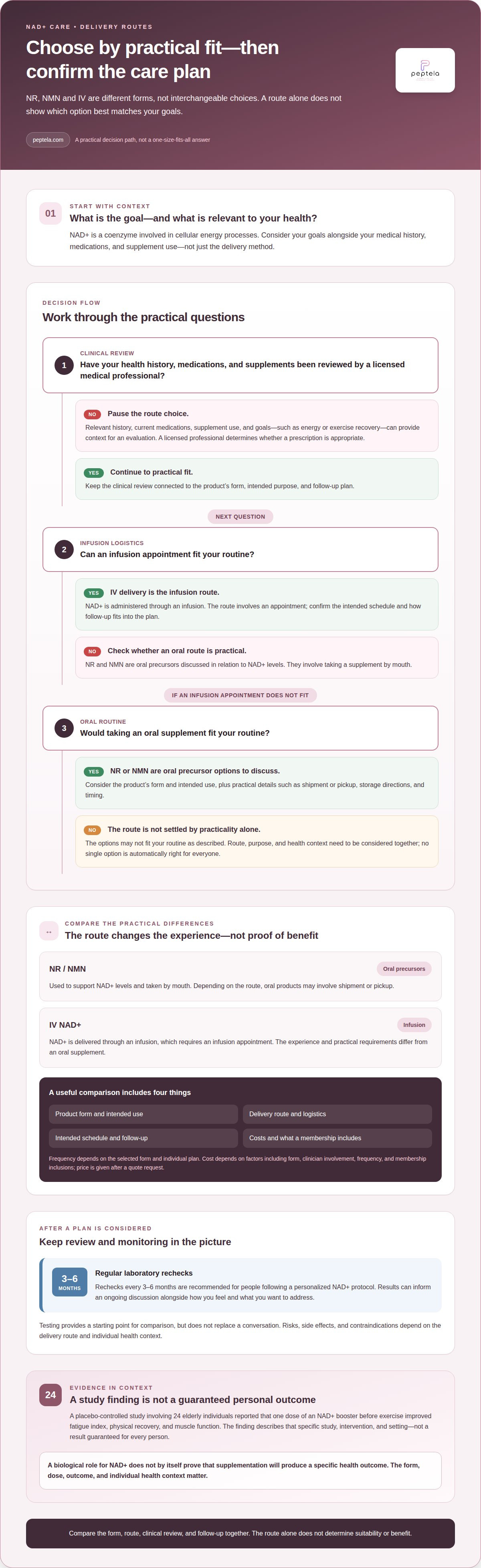
NR, NMN, and NAD+ injections are different forms, not interchangeable choices. Comparing them means considering what is taken or administered, how it is delivered, and what clinical oversight accompanies the plan.
Regulatory considerations depend on whether a product is a supplement, a compounded preparation, or an injection. These categories are not interchangeable, so the product’s form and intended use matter when understanding its regulatory context.
A thoughtful NAD+ care process begins with a review of your medical history, medications, and supplement use. Look for a clear explanation of the proposed product, its purpose, and how follow-up fits into care.
How the delivery options differ
NR and NMN are oral precursors discussed in relation to NAD+ levels. Their use involves taking a supplement, while IV delivery administers NAD+ through an infusion. The route changes the experience and practical requirements, but it doesn’t establish which option best matches a person’s goals.
Consider the difference in routine: an oral supplement is taken by mouth, while an injection is administered. A clinician-guided discussion should connect the product to your health context and explain the plan’s purpose, rather than treating the form alone as proof of benefit.
Frequency, costs, and delivery logistics
Frequency depends on the selected form and individual plan. A useful discussion sets out the intended schedule, how progress will be reviewed, and what could lead to an adjustment. For a personalized protocol, regular laboratory rechecks every 3-6 months are recommended.
Cost depends on factors such as the form, clinician involvement, frequency, and what a membership includes. Price depends on the case and is given after a quote request. Membership terms may affect how care is organized, so understand what the membership covers and how delivery fits the plan before deciding.
Shipping, delivery, and pickup also depend on the route. Oral products may involve shipment or pickup, while an IV requires an infusion appointment. Confirming the practical steps, storage directions, and timing helps you compare options without assuming every method works the same way.
Use a simple comparison: identify the form, the delivery route, the follow-up plan, and the logistics. That gives you a more grounded conversation about NAD+ options, including what fits your routine and what questions to raise during medical review.
Health assessment and baseline laboratory tests
A baseline assessment provides context for decisions about NAD+ care. Reviewing health history, medications, and supplements helps connect a proposed approach to the person receiving it.
Before an online evaluation, prepare a concise record of your medications and supplements, including how you use them. Add relevant medical history and the goals you want to discuss, such as changes in energy or exercise recovery. A licensed medical professional can use this information to assess your situation before determining whether a prescription is appropriate.
Testing can be part of a wider assessment. Baseline laboratory results provide a starting point for later comparison, while health history and current medication use help shape which information matters. A test result does not replace a conversation: its value depends on how it relates to your circumstances and the plan being considered.
Bring practical questions to the review. Ask what a recommended test is intended to assess, how results may inform the plan, and what might prompt a change. This helps you understand the clinical reasoning behind recommendations and how they relate to your goals.
- Before the review: List medications, supplements, and relevant health history.
- At the review: Share your goals and ask how baseline results relate to the proposed approach.
- During follow-up: Compare new information with the baseline and discuss changes in your experience.
Preparation also means describing your starting point clearly. If daytime energy is your goal, note when you feel most alert or when fatigue affects routine activities. Specific examples make the discussion more useful than a general goal alone.
Follow-up gives the care team a chance to revisit the plan with updated information. Regular laboratory rechecks every 3-6 months are recommended for people following a personalized NAD+ protocol. The comparison helps frame a discussion about results, tolerance, and whether the approach still aligns with the original goals.
Keep the process collaborative. A clinician should review medical history, medications, and supplement use before recommending an NAD+ intervention. Share changes to those details during follow-up, rather than treating the original assessment as a permanent snapshot.
Prepare by organizing your health history, medication list, supplement use, and treatment goals for clinical review. Follow-up includes regular laboratory rechecks every 3-6 months for people following a personalized protocol.
Self-reported customer outcomes
NAD+ is discussed in relation to concerns such as fatigue, low energy, and exercise recovery. Those concerns are not diagnoses or proof that a product will address an individual’s symptoms.
Evidence includes the placebo-controlled study described earlier, but one study cannot establish how everyone will respond. Its specific participants, intervention, and measured outcomes limit how broadly its findings can be applied.
Personal reports offer a different kind of information. Someone might describe feeling more energetic, recovering differently after exercise, or noticing no change. These accounts can help describe an individual’s experience, but they do not establish that NAD+ caused the change.
Daily experience is shaped by many factors. Sleep, activity, stress, and changes in routine can affect how someone feels during a plan. For example, a more energetic week may coincide with improved sleep, making it difficult to attribute the change to one intervention.
A simple tracking process can make personal observations clearer:
- Choose a specific outcome: Record daytime energy or post-exercise recovery, rather than a broad goal such as feeling better.
- Set a consistent routine: Note observations at the same point in the day or after similar activities.
- Record context: Include sleep, exercise, and routine changes that may influence the experience.
- Review the pattern: Bring the notes to follow-up instead of relying on one unusually good or difficult day.
A personal log is not a clinical trial, but it can give you concrete examples to discuss, such as whether fatigue affects mornings or follows physical activity.
Separate three questions when evaluating a reported result: what changed, when it changed, and what else changed at the same time. A report of improved recovery, for instance, is more informative when it describes the activity and the person’s usual baseline.
Look for careful wording in outcome claims. A personal account reflects one person’s experience; a controlled study compares outcomes under defined conditions. Neither should be stretched beyond its context, and testimonials alone cannot show that an intervention works consistently.
For a useful review, share both positive and unwanted experiences with a qualified healthcare professional. Discuss those observations alongside relevant follow-up information, then consider whether the plan still fits your goals and health context.
What is personalized NAD+ care and how does it work?
Personalized NAD+ care connects an individual’s goals and health context with a considered approach to NAD+ options. It is a process for making informed decisions, not a single standard plan or a promise of a particular result.
Start by defining what you want to address. Someone concerned about daytime energy, for example, has a more useful starting point than a broad goal like “feel better.” A clear goal helps focus the clinical conversation and gives follow-up a practical reference.
Next, a licensed medical professional reviews your medical history, current medications, and supplement use during an online evaluation. These details matter because a prescription decision should account for your overall health, not just a product choice. Bring an accurate list and mention relevant changes during follow-up.
Assessment then informs the discussion of possible delivery forms. NR and NMN are oral precursors, while IV delivery administers NAD+ through an infusion. The route affects how the intervention is taken or delivered. The choice should connect to the individual’s goals and clinical context, rather than assuming one form suits everyone.
A practical care process can include these steps:
- Set a clear goal. Describe a specific concern, such as energy during the workday or recovery after exercise.
- Review personal context. Share health history, medications, and supplements with the healthcare professional.
- Discuss the approach. Compare the proposed form and route with the goal and relevant health information.
- Track the experience. Record meaningful changes and factors such as sleep or exercise that may affect how you feel.
- Revisit the plan. Use follow-up to discuss observations and whether the approach still fits.
Laboratory tests may provide baseline information for a plan, and later results can support a review. Their usefulness depends on the question being considered and how results relate to the person’s health context. A result is one part of the picture, alongside personal experience and clinical review.
Personal observations also make follow-up more specific. Rather than recording only “more energy,” note an example, such as whether afternoon tasks felt easier. Include relevant routine changes so the discussion considers context, not just one impression.
This process keeps the individual involved at each stage: goals guide assessment, assessment informs the discussion, and follow-up brings new observations into view. Explore NAD+ care options as a next step in learning about clinician-guided support.
Peptela: Tirzepatide Injections
Peptela’s longevity platform offers NAD+ Injections as part of clinician-guided, subscription-based treatments. Its other offerings include Tirzepatide Injections, Hormone Balance, and Peptides, each suited to different health and wellness goals.
The next step depends on the goal you want to address. Exploring NAD+ care is distinct from discussing Tirzepatide Injections. Share your goals and relevant health context during an online evaluation so a licensed medical professional can determine whether a prescription is appropriate.
Use what you’ve learned about assessment and follow-up to guide that discussion. Clear questions can help you understand how an option fits your broader care decisions.
Contact Peptela to explore whether its offerings align with your goals.
Choose a Clear Next Step
Your next step can be a focused conversation about what you want to change and how you want care to fit your life. Bring the questions that matter most to you, whether they concern daily energy, your preferred approach, or how progress will be reviewed. A clear goal gives the discussion direction while leaving room to make informed choices.
Personalized NAD+ care is most useful as a thoughtful process that connects your priorities with clinical guidance and ongoing reflection. Peptela offers NAD+ Injections, Tirzepatide Injections, and Hormone Balance, so you can explore these options in relation to broader wellness goals without treating them as interchangeable.
If you’re ready to discuss your goals and explore whether NAD+ care fits, contact Peptela about NAD+ care. Take the next step at your own pace, with your questions and priorities leading the conversation.
Frequently Asked Questions
What Is NAD+?
NAD+ is a coenzyme that participates in cellular energy metabolism. The body uses it in processes that support everyday cell function, but this role alone doesn’t establish that a supplement or treatment will improve a particular concern. Keep that distinction in mind when reviewing claims about energy or wellness. The above statements have not been evaluated by the Food and Drug Administration. These products are not intended to diagnose, treat, cure, or prevent any disease.
How is NAD+ care personalized based on health history, labs, or goals?
Personalized NAD+ care connects your goals with your health context and clinical review. If your focus is afternoon energy, for example, describe when it tends to dip and how it affects your routine. That detail gives a clinician a more specific starting point than a general request to feel better. A clinician can consider your history and available test results alongside that goal when discussing next steps.
What forms of NAD+ therapy are available, including IV, injections, and oral supplements?
Options include oral NR or NMN, NAD+ injections, and IV infusion; these are distinct delivery routes. Peptela’s service is 100% online, with no in-person visit required. Prescription products require an online evaluation with a licensed medical professional who will determine if a prescription is appropriate. If approved, your treatment is compounded by a US-licensed, LegitScript-certified pharmacy partner, rigorously inspected for quality, and shipped discreetly to your door.
How much does NAD+ therapy cost in the United States, and is it covered by insurance?
There’s no single price for NAD+ therapy; costs depend on the form, delivery route, and care plan. For Peptela, price depends on the case and is given after a quote request. Medication is offered as a subscription service which you can cancel at any time. Peptela doesn’t offer insurance-covered treatment, so don’t assume a plan will cover it. Benefits outlined on Peptela.com are based on 3rd party studies.
How can I find a reputable NAD+ provider near me in the United States?
Look for care that reviews your medical history, medications, and supplements, explains the proposed product and its purpose, and outlines follow-up. Prescription products require an online evaluation with a licensed medical professional who will determine if a prescription is appropriate.
What are the risks, side effects, and contraindications of NAD+ therapy?
Risks, side effects, and contraindications depend on the delivery route and your health context. A qualified healthcare professional should review your medical history, medications, and supplement use before you start or change a protocol; starting at a low dose and increasing gradually can help assess tolerance.


