

NAD+ treatment online can provide a route to a clinician’s assessment, but injectable NAD+ requires a prescription in the United States. Most insurance plans don’t cover NAD+ therapy, and whether it may help depends on the reason for considering it. The evidence for wellness benefits is still developing, so it’s important to weigh potential effects against risks.
Before deciding, it helps to understand the process, cost, and possible side effects. Online care can make an initial assessment more convenient, but it should still include a clinician’s review of your health history and goals.
This guide explains how online evaluations and prescriptions work, what affects treatment costs, and why insurance coverage may be limited. It also reviews possible side effects and questions to discuss with a clinician, so you can make an informed decision without treating NAD+ as a guaranteed solution.
Key Takeaways
- Injectable NAD+ requires a prescription in the United States, and online treatment still involves clinical evaluation.
- Compare the full cost of care, including the treatment format and any administration or follow-up expenses.
- Most insurance plans don’t cover NAD+ therapy, so understand the likely out-of-pocket commitment before starting.
- Learn which side effects may occur and what health factors to discuss with a clinician before treatment.
- Explore how online providers assess eligibility and guide treatment, while keeping expectations grounded in the available evidence.
Can You Buy NAD+ Injections Online?
Yes. Injectable NAD+ is a prescription product in the United States, so NAD+ treatment online begins with an evaluation, not a retail checkout. A licensed clinician reviews your health history and determines whether a prescription is appropriate. If approved, treatment is compounded by a US-licensed, LegitScript-certified pharmacy partner and shipped discreetly to your door.
Available NAD+ Formats
Injections, nasal sprays, patches, and face creams are different delivery formats, not interchangeable versions of one treatment. Creams and patches are applied to the skin, sprays use the nose, and injections deliver medication through a needle. Compare the route, intended use, ingredients, and clinical oversight. Evidence and instructions for one form should not be assumed to apply to another.
Injection and IV Delivery Options
Subcutaneous injections go under the skin, rather than into a vein or muscle. They can be administered at home following clinical instructions. IV infusions deliver NAD+ into a vein and take place in a clinic; a session typically lasts 2-4 hours, while reported session lengths range from 2 to 8 hours. The setting, time commitment, and administration method differ.
Some injectable products are compounded. Compounded drug products aren’t FDA-approved, and the FDA doesn’t evaluate their safety, effectiveness, or quality. This distinction matters when comparing a prescription injectable with a supplement or topical product. Ask for clear instructions on storage, administration, and what to do if you experience a reaction.
Pricing and Included Services
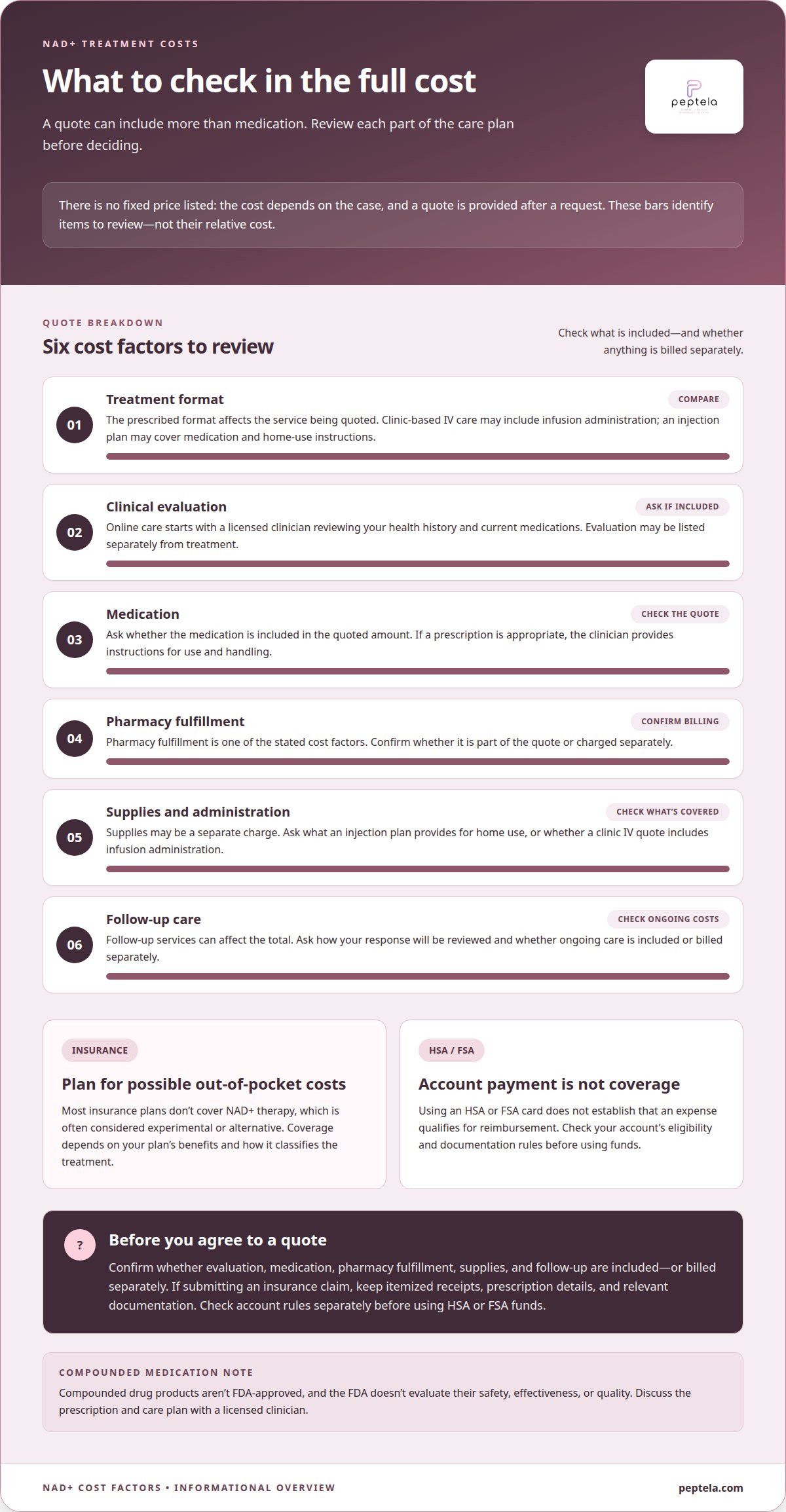
The price depends on the case and is given after a quote request; cost factors include the prescribed format, medication, clinical evaluation, supplies, and follow-up. Review whether the quote includes each item or bills them separately. A clinic-based IV service may also include infusion administration, while an injection plan may cover medication and home-use instructions. Compare the full service, not just the medication line.
NAD+ treatment online starts with an online evaluation by a licensed medical professional, who reviews your health history and current medications. If a prescription is appropriate, follow the clinician’s instructions for administration and handling. Discuss the treatment schedule and how your response will be reviewed before beginning.
Schedules vary by protocol. Some injection protocols begin with daily injections during an initial phase, then move to maintenance injections a few times per week. That pattern isn’t universal. Confirm the prescribed timing and how progress will be reviewed. Reports of changes in energy or clarity don’t establish a predictable timeline for every person, so track your experience against the goals discussed during evaluation.
Is NAD+ therapy covered by insurance?
NAD+ treatment uses a coenzyme involved in cellular energy metabolism. It’s promoted for goals such as energy, mental clarity, and cognitive function; NAD+ therapy is also discussed for substance use disorders, but evidence for that use is limited, and it isn’t FDA-approved for treating those disorders.
In the United States, injectable NAD+ requires a prescription. Compounded drug products aren’t FDA-approved, and the FDA doesn’t evaluate their safety, effectiveness, or quality. A telehealth prescription still requires clinical evaluation; online ordering alone doesn’t replace that step.
Insurance coverage and treatment costs
Most insurance plans don’t cover NAD+ therapy because it’s often considered experimental or alternative. Coverage depends on the plan’s benefits and how it classifies the treatment. A wellness goal, such as supporting energy or clarity, doesn’t by itself establish insurance coverage.
The price depends on the case and is given after a quote request. Cost factors include the treatment format, clinical assessment, medication, pharmacy fulfillment, and follow-up services. Before paying, review which items the quote includes and whether separate charges apply to evaluation, supplies, or ongoing care.
If you plan to submit a claim, keep your itemized receipt, prescription details, and any documentation describing the medical purpose. Check your plan’s coverage criteria and whether it requires a specific diagnosis, prior authorization, or particular billing information. These details can affect whether a claim is considered, even when a licensed clinician prescribed the treatment.
FSA and HSA payment
HSA or FSA payment is separate from insurance coverage. Paying with an account card does not establish that an expense qualifies for reimbursement. Review the account’s eligibility rules and documentation requirements before using funds, and keep your receipt and prescription records together.
For example, check whether your account requires documentation of a medical purpose or a specific form from the clinician. A receipt shows what you paid, while an assessment record may document the clinical context. These records serve different purposes, so retain both when available.
What evidence means for coverage
Insurance decisions and clinical evidence are related, but they are not interchangeable. An insurer’s classification does not prove whether NAD+ improves a particular function, such as mental focus. Likewise, claims about cognitive benefits do not guarantee that a plan will pay.
Before starting, write down the goal you want to address, such as persistent fatigue or difficulty concentrating, and discuss it during your evaluation. Ask how the clinician will assess progress and what might prompt a change in the plan. This gives you a clearer basis for weighing out-of-pocket costs against the care offered.
Possible side effects and medical considerations
NAD+ is a coenzyme involved in cellular energy metabolism, including processes involving mitochondria. That role does not establish that NAD+ therapy will relieve fatigue or improve energy for any particular person.
Potential Side Effects
Reported side effects of injectable NAD+ include injection-site discomfort, flushing, and nausea, particularly at higher doses. NAD+ therapy can also be associated with headache, muscle cramps, chest tightness, and feeling warm or flushed. Reactions may differ by administration route, dose, and protocol, so note what happens and when.
For example, record whether nausea begins during administration or afterward, and whether discomfort stays near the injection site. Share those details with the prescribing clinician before another dose. Don’t increase or repeat a dose to try to address fatigue or seek faster clarity without clinical direction.
Medical Precautions and Safety
A medical evaluation should cover your health history, current medications, allergies, and reason for considering NAD+ therapy. These details help a clinician weigh whether treatment is appropriate and which risks need attention. If you’re pregnant or breastfeeding, discuss NAD+ injections carefully with your provider before starting.
Compounded NAD+ products require particular care. Compounded drugs aren’t FDA-approved, and the FDA doesn’t evaluate their safety, effectiveness, or quality. Ask the clinician to explain the product, dose, administration instructions, and who to contact about a reaction. Clear guidance matters whether injections are prescribed for home use or administered in a clinic.
Follow the prescribed protocol rather than adapting another person’s schedule. If a dose is missed, a symptom appears, or instructions conflict, pause and contact the prescribing clinician for guidance. Keep the medication label and administration instructions available, and report changes in symptoms alongside the timing of each dose.
Chest tightness warrants prompt attention, especially if it begins during an infusion or injection. Stop the administration and seek urgent medical help if symptoms feel severe or rapidly worsen. For less urgent concerns, such as flushing or nausea, record the timing and severity, then contact the clinician before continuing the protocol.
Track your response with specific observations, not assumptions about how a coenzyme should affect mitochondria. A brief log can include dose timing, injection-site discomfort, nausea, sleep, and fatigue. Review that record with the clinician, who can assess side effects and determine whether the plan needs to change.
First-month and promotional pricing
When comparing NAD+ treatment costs, focus on the full subscription price and what it includes, not only an introductory payment.
Provider Pricing and Payment Plans
The price depends on the case and is given after a quote request. Cost factors include the prescribed format, medication, clinical evaluation, supplies, pharmacy fulfillment, and follow-up. Ask for an itemized breakdown so you can distinguish treatment costs from services billed separately.
For a promotional offer, identify its end date, renewal terms, and any eligibility conditions before enrolling. A reduced first payment doesn’t show what later months may cost. Review whether follow-up visits, shipping, or administration supplies are included, and whether a payment plan changes the total amount owed.
Use this simple comparison before deciding:
- Write down the introductory charge and the later recurring charge.
- List the services and supplies included in each payment.
- Note cancellation terms and any payment-plan conditions.
This approach helps you compare offers with different billing structures. For example, one plan may group medication and care together, while another may list them separately.
NAD+ Pricing and Vial Supply
A vial’s price alone does not show how long a supply may last. The prescribed dose, concentration, administration schedule, and quantity all affect how medication is used. Follow the label and clinician’s instructions rather than estimating from another person’s schedule.
Ask how the pharmacy calculates the quantity dispensed and whether the quote includes supplies needed for administration. Clarify how to handle a vial that runs out before a follow-up, and how the clinician addresses a dose change. These practical details can affect both continuity and the amount paid over time.
Promotional pricing also shouldn’t shape expectations about results. Claims that NAD+ may address an age-related decline, support metabolic function, or improve mental clarity don’t establish that a particular person will notice those effects. Likewise, a claim about cellular repair isn’t a substitute for discussing the symptoms or goals behind treatment.
Before choosing treatment, write down your goal and review the subscription terms. Check the monthly price, included services, and cancellation policy. A clear understanding of ongoing costs makes it easier to weigh the full commitment, not just an introductory payment.
Online NAD+ telehealth providers
A telehealth provider should connect an online assessment with clinician review, a prescription decision, and clear product information. Before choosing, look for transparent credentials, pharmacy details, administration instructions, and realistic descriptions of possible effects.
To assess whether an online provider, pharmacy, and product are legitimate, match the clinician’s name and credentials against a relevant licensing directory, then verify the dispensing pharmacy through its state licensing authority. Check that the prescription label identifies the medication, concentration, directions, and dispensing pharmacy; compounded products are not FDA-approved.
What a telehealth assessment should cover
A meaningful assessment asks about your health history, medications, allergies, and reason for considering NAD+. For example, a clinician should distinguish a general wellness goal from a symptom that needs another medical evaluation. The review should lead to an individualized decision, not an automatic prescription after a short form.
Injectable NAD+ requires a prescription in the United States. An online evaluation supports a clinician’s assessment, but checkout alone does not replace clinical review. Ask how follow-up works, who reviews your questions, and how to discuss administration or changes in your health.
Review the product and fulfillment details
Before accepting a shipment, compare the prescription with the pharmacy label and written instructions. Check the medication name, concentration, storage directions, dose, and route. For a subcutaneous injection, the instructions should explain where and how to administer it, along with what to do if a dose is missed.
Compounded NAD+ products are not FDA-approved, and the FDA does not evaluate their safety, effectiveness, or quality. Be cautious of claims that present cellular wellness benefits as established effects. Review product information carefully and discuss questions about the ingredients and intended use with a clinician.
Questions that clarify care
Use the intake or consultation to ask who makes the prescribing decision, which pharmacy dispenses the medication, and how the plan is adjusted. For example, clarify whether follow-up includes review of side effects, injection technique, and changes in your symptoms. These details show how telehealth connects an online service to continuing clinical oversight.
Availability and prescribing processes can vary by location, so confirm that the telehealth service can assess patients where they live. A provider should explain the prescription process and pharmacy fulfillment in plain language, without promising specific cellular or wellness outcomes. Keep copies of your assessment, prescription, and product instructions for reference.
These records help you stay organized and support clear follow-up conversations with your clinician.
Peptela: Tirzepatide Injections
Peptela offers Tirzepatide Injections alongside NAD+ care. These are distinct offerings, so the right discussion depends on your goals and health history, not on assuming one treatment replaces another.
If you’re considering Tirzepatide Injections, Hormone Balance, or Peptides, discuss your goals, health history, and medications during an online evaluation. A clinician can explain the available options and potential risks before you decide whether to proceed.
Make your next step a thoughtful one
Choosing whether to explore NAD+ treatment online is a personal decision guided by your goals, health history, and an honest discussion of potential risks. Before your online evaluation, note what you hope to address, what medications you take, and what questions remain. This preparation can keep the conversation focused on your needs rather than broad promises about energy or wellness.
Peptela offers NAD+ Injections alongside Tirzepatide Injections and Hormone Balance. An online discussion with a clinician can help you consider whether NAD+ fits your goals and what factors should shape your decision. Individual responses may differ, so discuss realistic expectations and your options with care.
Contact Peptela about NAD+ care to take the next step at your own pace.
Frequently Asked Questions
Does NAD+ therapy really work?
Evidence does not establish NAD+ therapy as a reliable way to improve energy, focus, or other wellness outcomes for everyone. Reports of changes do not prove that NAD+ caused them. Before starting, choose a practical outcome to track, such as afternoon fatigue or concentration during work, and discuss how to assess it with a clinician. This makes progress easier to evaluate than relying on broad promises.
What is the best way to get NAD+ therapy online?
Start with an online clinical evaluation, not a checkout page promising automatic approval. Prescription products require an online evaluation with a licensed medical professional who will determine if a prescription is appropriate. No in-person visit required. If approved, your treatment is compounded by a US-licensed, LegitScript-certified pharmacy partner, rigorously inspected for quality, and shipped discreetly to your door. Review the label and instructions when it arrives.
How does NAD+ support energy and cellular health?
NAD+ is a coenzyme found in cells and involved in cellular energy metabolism. That biological role doesn’t establish that taking NAD+ will increase a person’s energy or improve health. Benefits outlined on Peptela.com are based on 3rd party studies. The above statements have not been evaluated by the Food and Drug Administration. These products are not intended to diagnose, treat, cure, or prevent any disease.
How does this compare to an IV drip at a clinic?
Online prescription care and an IV drip differ in delivery and setting. An online evaluation can determine whether prescribed treatment is appropriate, while an IV is administered into a vein. Consider the practical differences, such as traveling to a clinic versus following instructions for a prescribed at-home format. Convenience alone does not show that one route works better.
How is NAD+ therapy priced?
Pricing depends on the prescribed format and what services the provider includes. Ask for an itemized breakdown that separates medication, evaluation, supplies, and follow-up, then compare the ongoing cost with any introductory offer. Medication is offered as a subscription service which you can cancel at any time. Insurance coverage and account reimbursement are separate issues, so review your plan and account rules before budgeting.
How is subcutaneous NAD+ different from IV infusions?
Subcutaneous NAD+ is injected under the skin; an IV infusion delivers it into a vein. The routes also differ in how treatment is administered and where it typically takes place. A clinician’s instructions should specify the prescribed route, dose, and administration steps. Don’t substitute an IV plan for an injection schedule, or change routes, without discussing it with the prescriber.
Is NAD+ treatment supported by clinical evidence, and what do medical studies show?
Evidence for specific wellness outcomes remains limited, and available information does not establish that NAD+ injections outperform oral supplements. Studies may examine different formulations, routes, and goals, so one result does not automatically apply to another product or person. When reviewing a claim, look at the treatment form studied, the outcome measured, and whether the findings relate to your reason for considering therapy.
What types of NAD+ treatment are available online, including IV, injections, and supplements?
Online information may cover injectable NAD+, clinic-based IV infusions, and oral supplements or precursors such as NMN and NR. These forms are not interchangeable: oral precursors pass through metabolic steps, while injections and IVs use different routes. A clinician can assess prescription options, while supplements have their own product labels and directions. Actual product packaging may appear differently than shown.


