
NAD+ injections have not been shown in large human trials to produce better health outcomes than oral NAD+ precursors. NAD+ therapy is being studied for its role in cellular energy and repair, but a biological role is not proof that treatment delivers a noticeable benefit.
It’s reasonable to ask whether an injection can translate into more energy in daily life. NAD+ helps cells process energy and supports functions involved in repair, but the best way to support these processes depends on what research shows.
This article explains NAD+’s role in cells, what studies say about energy and mitochondrial function, and how oral precursors, injections, and IV infusions compare. It also covers safety considerations and everyday habits that support normal cellular function, helping you distinguish established findings from questions still under study.
Key Takeaways
- Understand how NAD+ helps cells turn food into energy and supports processes involved in repair.
- Separate NAD+'s important role in cell function from evidence that treatment improves energy or health outcomes.
- Compare oral precursors, injections, and IV infusions with a clearer view of what research has and hasn’t established.
- Learn which safety considerations matter when weighing treatment routes and products.
- Explore everyday habits, including sleep, physical activity, and nutrition, that may support balanced NAD levels.
NAD+ functions in cellular energy production and repair
NAD+ helps cells process energy and maintain essential functions. It connects food metabolism with DNA repair, cell protection, and normal tissue activity.
Cellular Uptake and Conversion
Cells maintain NAD by making it from smaller molecules or recycling components already present. The body can build NAD using vitamin B3, including niacin, and the amino acid tryptophan. This means cellular NAD availability depends on both production and recycling, not simply on the amount of NAD+ taken in.
NAD+ and NADH shift between chemical states as cells use them. NAD+ is the oxidized form, while NADH is the reduced form. This conversion lets cells transfer electrons during key processes. The distinction helps explain why supporting a molecule’s supply is not the same as showing that a particular delivery method improves cellular function.
Support for Cellular Energy
NAD+ supports cellular energy by accepting and transferring electrons as the body processes food. NADH carries electrons in the other direction, helping maintain this exchange. The cycle links metabolism with the energy cells need for everyday work, rather than acting as energy by itself.
This process matters across tissues because NAD is found in every cell in the human body. Muscle cells need energy for movement, and brain and heart cells also rely on normal energy metabolism. NAD supports the function of muscles, brain cells, heart cells, and bones. Its contribution is part of a larger cellular system, not a switch for immediate energy or focus.
DNA Repair and Cellular Aging
NAD also supports DNA repair, cell protection, and metabolism. Sirtuins, a family of seven proteins, depend on NAD+ to function. These roles link NAD availability with cellular maintenance processes that help preserve normal activity.
NAD levels naturally decline with age, and some cells may use NAD faster than the body replaces it. This balance can vary among cells and tissues. Age-related changes in NAD have attracted scientific interest, but they do not establish that raising NAD through treatment reverses aging or repairs damage in a person.
Think of NAD as a working resource with several cellular roles: electron transfer, metabolism, and repair. Understanding these functions helps put research on energy and treatment options into context. The key distinction is between NAD’s established role in cell processes and evidence that a specific intervention changes meaningful health outcomes.
Research on energy and mitochondrial function
Research examines whether NAD availability relates to energy production and mitochondrial function. But a biological role inside cells does not, by itself, show that treatment improves energy or health outcomes.
What conditions is NAD+ therapy claimed to treat? Claims often focus on fatigue, muscle weakness, eye conditions, metabolic disorders, heart issues, and cognitive decline. Lower NAD levels have been linked with these concerns, but a link does not establish that treatment prevents or treats them.
Does health insurance cover treatment with NAD+? Insurance generally doesn’t cover it in the United States because NAD+ isn’t FDA-approved for a specific medical indication. That distinction matters when weighing treatment alongside established care.
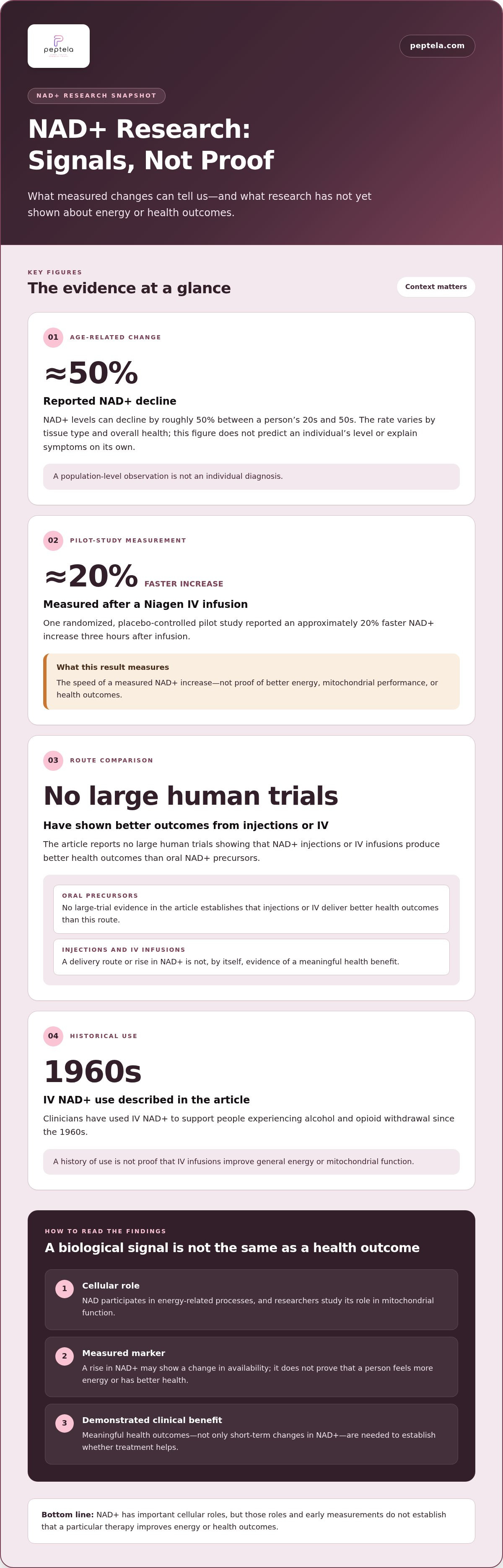
NAD+ levels can decline by roughly 50% between a person’s 20s and 50s. The rate varies by tissue type and overall health, so the figure doesn’t predict an individual’s level or explain symptoms on its own. Researchers study mitochondria because these structures play a central role in cellular energy production, and NAD participates in energy-related processes.
Research on NAD+ supplements is ongoing, and more studies are needed. Researchers distinguish changes in NAD levels from changes a person can feel or measure in health. A rise in a biological marker may show that a supplement affects NAD availability, but it does not prove better energy, mitochondrial performance, or long-term health. This distinction is central to evaluating claims about NAD+ therapy.
Clinicians have used IV NAD+ to support people experiencing alcohol and opioid withdrawal since the 1960s. That history describes a use, not proof that infusions improve general energy or mitochondrial function. For a fair comparison, studies need to measure meaningful health outcomes, not just short-term changes in NAD levels.
One randomized, placebo-controlled pilot study reported an approximately 20% faster NAD+ increase three hours after a Niagen IV infusion. This result concerns the speed of a measured increase after infusion. It doesn’t demonstrate that IV delivery leads to better health outcomes than oral precursors.
No large human trials have shown that NAD+ injections or IV infusions produce better health outcomes than oral NAD+ precursors. This helps frame comparisons: the delivery route and a change in NAD levels are not substitutes for evidence of an outcome that matters to the person receiving treatment.
For now, distinguish cellular mechanisms, early findings, and demonstrated clinical benefits. This helps you assess claims about fatigue or mitochondrial function without treating a promising biological explanation as proof of a treatment effect. It also provides a grounded starting point for discussing NAD+ therapy with a clinician.
Common side effects and safety concerns
Safety depends on more than the label NAD+ therapy. The preparation, sterile handling, route, and clinical oversight all matter. Injections and IV infusions enter the body differently from oral products, so consider the specific method. A broad claim about “NAD+” alone does not describe every product or procedure.
For injectable products, sterile quality is central. NAD+ intended for sterile compounding should use pharmaceutical-grade ingredients, not food-grade material. Food-grade NAD+ does not meet the quality, sterility, and endotoxin specifications required for sterile IV compounding. This distinction concerns how the ingredient is made and prepared, not whether a treatment produces a particular health benefit.
In the United States, the FD&C Act distinguishes 503A compounding pharmacies from 503B outsourcing facilities. A 503A pharmacy prepares medication for an individual patient based on a prescription. A 503B facility is FDA-registered and may manufacture sterile medications in bulk for distribution without patient-specific prescriptions. FDA registration describes the facility’s status; it doesn’t mean every compounded medication has FDA approval for a specific indication.
USP 797 is the safety and quality standard that 503A pharmacies must follow for sterile compounding. It is relevant because contamination control and preparation practices affect products intended for injection or infusion. Also, 503A pharmacies can’t compound large quantities of IV products for office administration. These distinctions help explain why sterile preparation and the intended use matter when reviewing an injectable product.
Before treatment, discuss the exact route and preparation with the clinician overseeing care. An IV infusion, an injection, and an oral precursor are not interchangeable. The clinician’s review should consider the product’s intended use, how it was compounded, and the person’s health circumstances. Clear answers make the safety discussion more specific than relying on a general label.
It’s useful to consider safety and effectiveness separately. A product may meet sterile-compounding standards without evidence that it improves energy or treats a condition. Likewise, research on a biological effect does not establish the quality of a particular preparation. Keeping these questions distinct helps you evaluate both the product and the evidence without assuming one proves the other.
For any injectable or IV option, focus on three connected details: ingredient grade, sterile preparation, and the compounding pathway. These details offer a practical framework for understanding safety. They also help you discuss how the route fits into care, rather than treating “NAD+” as one uniform product.
Lifestyle habits that support NAD levels
Daily routines can support balanced NAD levels alongside the body’s own processes. Physical activity, sleep, nutrition, stress management, social connection, mental activity, and limiting alcohol all matter. These habits are practical foundations, not proof of a specific treatment’s effectiveness. Focus on consistent choices that fit your life, rather than expecting one meal or workout to determine cellular NAD.
Nutrition offers building blocks the body uses to make NAD. Vitamin B3 occurs in meat, fish, whole grains, legumes, and nuts. Tryptophan is found in poultry, eggs, dairy, soy products, nuts, and seeds. Food does not contain meaningful amounts of NAD directly, so eating these foods supports nutrient intake rather than supplying NAD itself. A varied plate can bring several of these food groups into everyday meals.
- Include vitamin B3 sources: Meat, fish, whole grains, legumes, and nuts provide examples to rotate through meals.
- Add tryptophan-containing foods: Poultry, eggs, dairy, soy, nuts, and seeds offer varied options across meals and snacks.
- Move regularly: Choose physical activity that fits your routine, such as a walk or an active daily task.
- Protect sleep: Make enough sleep part of your routine, since sleep is one habit associated with balanced NAD levels.
- Manage stress and stay engaged: Stress management, social connection, and mental activity are also listed as supportive habits.
- Limit alcohol: Reducing alcohol is another practical lifestyle factor linked with maintaining balanced NAD levels.
These habits work best as a pattern, not as isolated fixes. For example, a meal with fish and whole grains can provide vitamin B3 sources, while a walk adds physical activity. Another day might include eggs or soy foods, a social conversation, and a calming stress-management practice. The point is to build a varied routine from realistic choices, not to follow a rigid formula.
Sleep and stress deserve attention alongside food and movement. A late night or stressful stretch can make healthy routines harder to maintain, so simple planning can help: set a regular wind-down routine, schedule a walk, or make time for a conversation. These steps support overall daily wellbeing and align with habits associated with balanced NAD levels.
No single food or lifestyle choice controls cellular NAD on its own. The body’s balance involves multiple processes, and nutrition is one part of the picture. Consistent movement, restorative sleep, stress management, social and mental engagement, and limiting alcohol offer a broader approach than focusing on one supplement or ingredient. These are concrete habits to consider while evaluating treatment options separately.
Oral precursors, injections, and IV infusions
Oral precursors, injections, and IV infusions use different forms or routes to support NAD availability. The choice affects how treatment is given, but a different route does not establish better health outcomes.
Oral precursors provide materials the body can use in making NAD. The body uses vitamin B3 and tryptophan to produce NAD, connecting this approach with normal production pathways. An oral precursor is not the same as taking NAD directly. It supplies a precursor for the body’s own processes, rather than delivering an infusion into a vein.
Injections and IV infusions deliver NAD+ by routes that bypass digestion. An injection is given into tissue, while an IV infusion enters a vein and runs over time. The routes differ in administration, but neither has shown superior health outcomes over oral precursors in large human trials. When comparing options, ask what outcome a study measured, not only whether NAD levels changed.
A randomized, placebo-controlled pilot study reported an approximately 20% faster NAD+ increase three hours after a Niagen IV infusion. That finding describes the timing and size of a measured increase in that study. It doesn’t establish a lasting energy benefit, nor does it show that IV treatment outperforms oral precursors for health outcomes.
Clinicians have used IV NAD+ to support people going through alcohol and opioid withdrawal since the 1960s. This historical use is distinct from evidence for general wellness or everyday energy. The purpose of treatment matters: a use in withdrawal care shouldn’t be presented as proof that an infusion treats unrelated concerns.
What happens during an NAD+ therapy session, and how long does it take? An IV session involves delivering NAD+ through a vein over time. Infusions typically take 2 to 3 hours and may take 4 or more hours.
Time commitment is one practical difference between routes. Oral precursors do not involve an infusion appointment, while IV administration requires time for the infusion itself. An injection is also administered differently from an IV, so identify the route and preparation clearly before comparing options.
Evidence remains central to the comparison. No large human trials have shown that injections or IV infusions produce better health outcomes than oral NAD+ precursors. A faster rise in a measured level, such as the result of a pilot study, answers a different question from whether someone experiences a meaningful health improvement.
Frame a balanced discussion around the route, the goal, and the outcome supporting its use. A biological change can matter without proving a benefit a person can feel. Understanding that difference helps keep decisions grounded in practical demands and the strength of available evidence.
Peptela: Tirzepatide Injections
Peptela offers Tirzepatide Injections as a distinct option from NAD+ approaches. If you’re exploring care beyond cellular energy research, this offering may be relevant to a separate health goal. It isn’t an NAD+ delivery method, so the two shouldn’t be treated as interchangeable.
Peptela provides personalized, clinician-guided care to help you discuss whether Tirzepatide Injections align with your needs and broader wellness priorities. If your main interest is NAD+, focus on the evidence and route-specific considerations above. If you’re considering tirzepatide, discuss it separately in light of your goals.
Explore Peptela’s clinician-guided care and Tirzepatide Injections through its online longevity platform.
Choose a next step that fits your goals
Your next step can be a focused conversation about what you want to address, what matters in daily life, and which options align with those priorities. Consider NAD+ therapy in light of the evidence and your personal health context, rather than as a stand-alone promise of more energy.
Peptela offers NAD+, Hormone Balance, and Tirzepatide Injections as distinct options. A clinician-guided discussion can help you explore which offering relates to your goals and what questions you want answered before deciding how to proceed.
If you’re ready to explore NAD+ care, contact Peptela about your options. Take the next step at your pace, with clear questions and your priorities at the center.
Frequently Asked Questions
Do NAD+ injections really work?
NAD+ injections can affect NAD levels, but evidence has not shown that injections lead to better health outcomes than oral precursors. A change in a measured level is different from a noticeable improvement in daily energy or function. If you’re considering this approach, distinguish the proposed biological effect from the outcome you hope for, such as feeling less fatigued during everyday activities.
How long do NAD+ shots last?
There is no established duration for the effects of NAD+ shots. A measurable change in NAD after administration does not tell you how long someone might feel an effect, or whether they will notice one. Duration cannot be inferred from how quickly a level rises after a dose. This distinction matters when comparing claims about short-term effects with lasting changes in energy or wellbeing.
How much do NAD+ injections cost?
There isn’t one standard cost for NAD+ injections. Price depends on the case and is given after a quote request; factors include the formulation, dose, route, and care setting. Injectable NAD+ is a compounded product, so the specific preparation also affects the quoted cost. Compare the full treatment being discussed, rather than assuming that an injection and an IV infusion have the same cost.
Is NAD+ FDA-approved?
NAD+ is not FDA-approved for any specific medical indication in the United States. That means it does not have FDA approval to treat a particular condition. This is separate from how a compounded preparation is made or handled. When you encounter a claim about a specific health use, distinguish the claim from FDA approval for that use before weighing it.
What is NAD+ and why is it important?
NAD+ is one form of nicotinamide adenine dinucleotide, a molecule involved in cellular processes. It works alongside NADH, its reduced form, as cells transfer electrons during energy metabolism. This role connects NAD+ with how cells use nutrients, rather than making it a direct source of energy. Understanding the distinction helps put claims about supplements and injections into context.
What is NAD+ and why does it matter?
NAD+ matters because cells use it in processes tied to metabolism and maintenance. Its role is not limited to one organ or daily sensation; cellular functions depend on coordinated processes. For example, the body can recycle smaller molecules to maintain NAD, as well as make it through its own pathways. This context helps explain why a single route of supplementation does not define overall cellular function.
What is NAD?
NAD stands for nicotinamide adenine dinucleotide. It exists in two forms, NAD+ and NADH, which shift between states as cells carry out chemical reactions. The plus sign identifies the oxidized form; NADH is the reduced form. These names describe different states of the same molecule, not separate wellness goals. The distinction is useful when reading labels or research that refers to NAD levels.
What are the functions of nicotinamide adenine dinucleotide?
Nicotinamide adenine dinucleotide supports electron transfer during energy metabolism and contributes to processes involved in DNA repair, cell protection, and normal cell function. It also supports sirtuins, a family of seven proteins. These functions describe the molecule’s roles in the body; they do not, by themselves, show that a particular supplement or injection produces a specific health outcome.


