

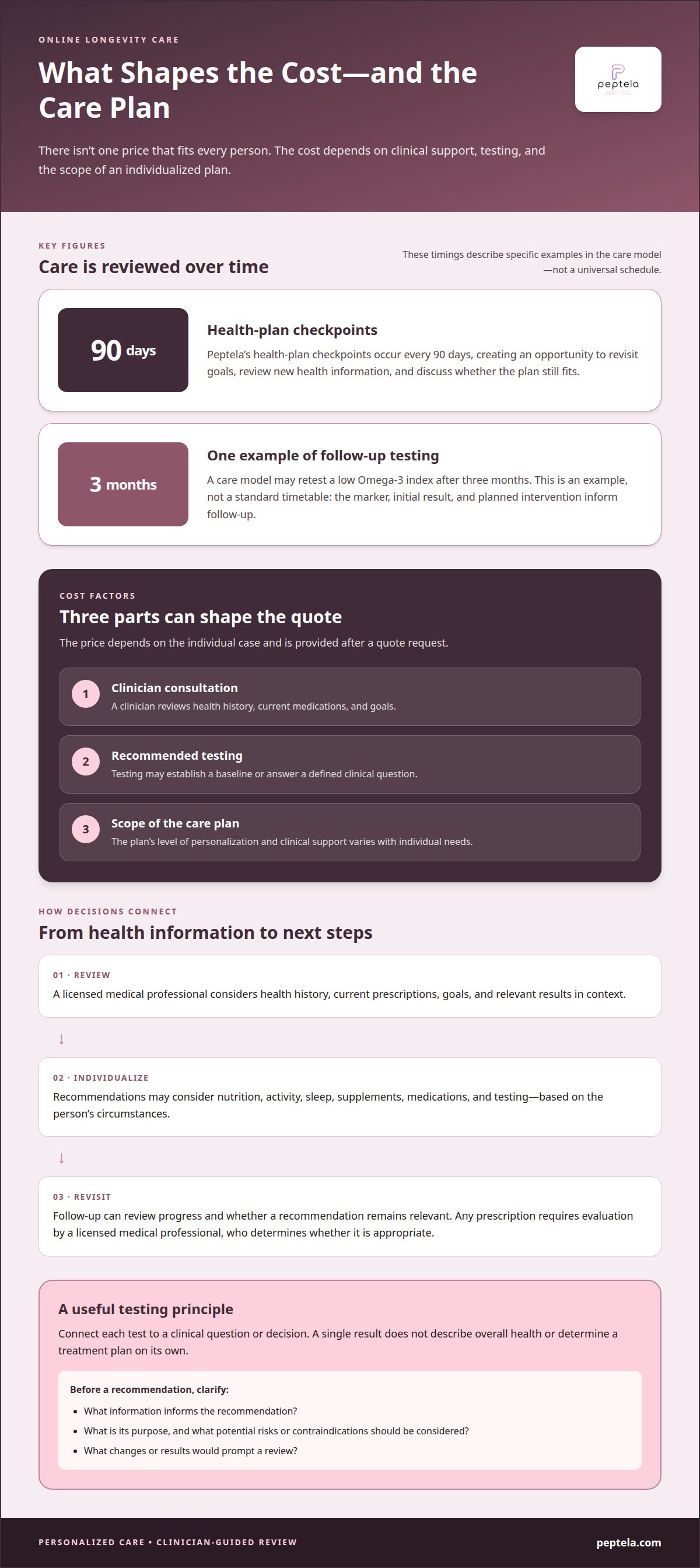
The cost of longevity care online depends on the level of clinical support, testing, and personalization involved. The price depends on the individual case and is given after a quote request; key cost factors include the consultation, any recommended testing, and the scope of the care plan. There isn’t one price that fits every person.
It’s reasonable to want clear pricing and understand what a clinical evaluation involves before choosing care. A clinician reviews your health history, current medications, and goals to determine whether a prescription is appropriate. Personalized care should clarify the next steps, not make them harder to understand.
This guide explains what may shape costs, what to expect from clinician-led consultations, and how a personalized protocol can bring together health information, lifestyle changes, and treatment options where appropriate. You’ll also learn what ongoing follow-up can look like and how to think about healthspan goals with clinical guidance and your own physician’s care in view.
Key Takeaways
- Understand which parts of an online care plan can shape its cost, including clinician support, testing, and the level of personalization.
- Learn how one-on-one consultations can turn health goals, medical history, and relevant results into practical next steps.
- See how supplements, lifestyle changes, medications, and follow-up testing may be considered as part of an individualized plan.
- Use regular checkpoints to review progress and adjust goals or recommendations as your health needs change.
- Keep online longevity care connected with your personal physician and broader healthcare team, especially when managing chronic disease risks.
Supplements, lifestyle changes, medications, and future testing
A personalized plan connects current health information with practical choices, from nutrition adjustments to clinician-guided treatment. Testing can establish a baseline, while follow-up helps determine which steps remain relevant.
Supplements, Lifestyle Changes, and Medications
A clinician can review supplements, nutrition habits, activity, sleep, and medications together. This matters because a supplement may interact with a medication or be inappropriate for a health condition. Before recommending treatment, medical evaluation should consider health history, current prescriptions, and contraindications. The plan should explain each recommendation, its purpose, and how the care team will review it.
For example, a nutrition change may be more practical than adding another supplement when a dietary pattern is the main concern. A medication decision calls for a separate discussion of expected use, potential risks, and alternatives. No supplement or medication should be treated as a universal longevity step; the relevant choice depends on individual medical factors and goals.
Personalized Testing and Health Baselines
Personalized testing starts with a baseline that reflects the person’s health history and clinical goals. A clinician can use that starting point to decide which biomarkers matter, interpret results in context, and identify whether future testing could inform care. The value lies in connecting each test to a decision, rather than collecting advanced laboratory results without a clear purpose.
A clinical evaluation considers the information relevant to your care. A single piece of information does not describe your overall health or determine a treatment plan on its own. The licensed medical professional decides whether a prescription is appropriate after reviewing your information.
Longevity goals also require careful consideration. A general health goal is not a diagnosis or a complete account of your health. A useful conversation connects your priorities to your health history and considers whether an available treatment option is appropriate.
Future testing should answer a defined question, such as whether a prior finding has changed. For example, one care model retests a low Omega-3 index after three months. That timing is an example, not a universal schedule; the marker, initial result, and planned intervention shape follow-up.
Before choosing a treatment, consider its relevance to your goals and how the clinician will evaluate your request. If you are considering a prescription, a licensed medical professional reviews your information and determines whether it is appropriate. This keeps treatment decisions connected to an online clinical evaluation.
One-on-one clinician consultations for healthspan and longevity
An online clinical evaluation connects your health priorities with a review by a licensed medical professional. Peptela’s longevity platform provides personalized, clinician-guided care for goals that include weight management, energy and focus, and healthy aging.
Longevity Membership and Healthspan Planning
Peptela’s longevity platform provides personalized, clinician-guided treatment plans. The in-house care team guides care based on individual goals and health information, rather than applying one fixed plan to everyone. Prescription products require an online evaluation with a licensed medical professional who will determine if a prescription is appropriate.
Health-plan checkpoints every 90 days provide opportunities to revisit goals and discuss relevant changes. At each review, the physician can consider new health information, progress toward the goal, and whether the plan still fits. This makes proactive planning a continuing conversation, not a one-time recommendation.
The First Online Consultation
During a first online consultation, expect to discuss your health history, current concerns, medications, and priorities. To get started, arrange the consultation and prepare a concise account of relevant diagnoses, symptoms, and questions. The clinician can then identify which topics need more discussion and whether available records or laboratory results could inform the conversation.
Bring the concerns that most affect daily life. For brain health, describe the specific change or question you want to address. For weight, explain your goals and relevant treatment history. For diabetes, share known diagnoses, medications, and recent health information. These examples help a doctor understand what you want from the consultation without assuming that one protocol suits everyone.
Laboratory analysis adds context when results are relevant to the clinical question. A physician can review the result alongside health history, medications, and other available data, rather than interpret a number in isolation. If records come from different sources, integrating them can help organize the discussion and identify information that may need clarification.
The consultation should also make the next steps understandable. The clinician can distinguish between a concern that needs medical evaluation, a goal that calls for further discussion, and information that does not change the current plan. A treatment decision requires attention to medical history, potential risks, and contraindications. That review helps keep recommendations tied to the person, not simply to a test result.
Before ending, clarify the plan’s priorities and how future discussions will connect to them. Ask which health data informs the recommendations, what changes would prompt a review, and when the next checkpoint occurs. With checkpoints set every 90 days, members have a defined opportunity to discuss evolving goals with their physician and adjust the conversation as their needs change.
Online longevity care and personalized protocols
Online care can connect clinical conversations with personalized planning, nutrition, screening, and health data. The right protocol depends on each patient’s goals, medical history, and care needs.
In the United States, clinician-led online services offer different approaches to longevity-focused care. Whether a physician can treat you online depends on authorization to provide care where you are located.
Nutrition and Personalized Protocols
A personalized treatment discussion should connect the options available to your goals, health history, and relevant medical information. The licensed medical professional evaluates your request rather than treating one detail as a complete guide to care.
Look for a clear explanation of the evidence behind each recommendation and how the clinician will review it. Nutrition advice should also fit the patient’s medical needs and current treatment. If a recommendation changes, the care team can explain what information prompted that adjustment.
Provider Availability and State Licensure
Provider availability varies across the country, and online services differ in their clinical scope. Consider whether a service provides physician-led care, personalized protocols, and screening relevant to your goals. Clinicians must be authorized to provide care in the location where the patient receives it.
Some care questions may require an in-person assessment, while others can be discussed remotely. The appropriate format depends on the patient’s needs, the clinical concern, and the evaluation required. Location alone doesn’t determine which assessment is appropriate.
Online protocols can support preventive primary care, but they shouldn’t replace an ongoing relationship with a personal physician and healthcare team. Share relevant diagnoses, medication details, and available laboratory results so clinicians can consider the full context. For example, a metabolic screening result can guide discussion, but it doesn’t independently establish a diagnosis or determine treatment.
Before a protocol begins, clarify its purpose, the information used to shape it, and how follow-up works. A clinician can explain which recommendations address nutrition, which involve further medical evaluation, and which require coordination with your existing doctor. That distinction keeps personalized care connected to your broader health plan.
For patients considering online longevity care, the strongest fit is a process that connects evidence, clinical judgment, and individual priorities. A protocol should make its next step understandable, whether that means discussing nutrition, reviewing screening results, or continuing care with the personal physician already involved.
Precision longevity care compared with traditional and wellness medicine
Personalized care connects your health information and priorities with clinician guidance. Its value depends on clear treatment options and an evaluation tailored to your circumstances.
How do you choose a reputable online longevity care provider? Look for physician oversight, state licensure, clear explanations of testing, and discussion of treatment risks and contraindications. A credible care plan links each recommendation to your health history and goals.
Does insurance cover online longevity care, lab testing, or prescribed treatments? Coverage depends on plan terms, the service, and how it is billed. Don’t assume a longevity program, laboratory test, or prescribed treatment qualifies for coverage without reviewing those factors.
Traditional and precision models can differ in visit structure. One practice describes traditional care as typically offering 10-15 minutes with a physician once a year. A concierge-style approach may create more room for ongoing planning, but the label alone doesn’t establish clinical quality. Focus on the actual consultation, follow-up, and decision process.
Coordination matters when cardiovascular health, strength, or performance goals overlap with medical care. A useful plan identifies which clinician handles each concern and how relevant information reaches the rest of the care team. For example, a patient discussing strength training and a medication change needs recommendations that account for both priorities.
For Medicare beneficiaries receiving long-term care, coordination with the facility’s medical team and personal physician can help keep recommendations aligned. Medicare eligibility, clinical eligibility, and insurance coverage are separate considerations. The service, plan terms, and billing determine coverage questions, while the clinician evaluates whether a proposed treatment fits the individual’s health history.
Virtual medical weight-loss care may include discussion of GLP-1 medications when clinically appropriate. A clinician should review medical history, current medications, potential risks, and contraindications before treatment decisions. The conversation should also cover lifestyle factors and how follow-up will address questions or changes in health.
Clinician-guided care is different from general wellness information. Educational material can explain health topics, while an online evaluation considers your individual information before a licensed medical professional decides whether a prescription is appropriate.
Before beginning a protocol, identify its purpose, the evidence behind recommendations, and the role of each clinician. Ask how testing informs decisions, how treatment risks are discussed, and how the provider coordinates with existing doctors. Those details offer a clearer picture than labels such as “advanced” or “personalized.”
Prevention and management of chronic disease risks
Chronic disease risk planning starts with relevant health history, current concerns, and personal goals. A clinician can organize these details into a discussion of prevention and identify when a medical evaluation is appropriate. For example, a patient concerned about cardiovascular risk may discuss existing diagnoses, family history, and current care priorities before considering possible next steps.
An individualized program connects recommendations to specific concerns, rather than applying the same checklist to everyone. The clinician can discuss health information alongside lifestyle factors such as nutrition, activity, and sleep. This can help clarify which topics deserve attention and which questions belong with the patient’s existing medical team. Prevention planning supports informed decisions, but cannot guarantee that disease will be avoided.
Preventive in-home primary care visits are a distinct care format from online consultations. A home visit allows a clinician to meet a patient in their living environment; virtual care relies on the information available during an online appointment. The right format depends on the clinical question and the assessment required. An in-home visit is not a service offered through every online care program.
Individualized prevention also considers how daily routines and medical needs intersect. For example, someone managing a chronic condition may want to discuss how an activity goal fits alongside current treatment. A clinician can help frame questions and identify when changes require coordination with the existing physician. Recommendations should account for medical history, current medications, and relevant contraindications.
Hormone-related symptoms deserve a focused medical assessment, not assumptions about disease prevention. A clinician can consider the symptoms, health history, and potential risks before discussing whether hormone-related care is appropriate. Hormone Balance may be relevant to a conversation about hormone concerns, but it should not be described as preventing or treating chronic disease. Individual evaluation guides whether any care option fits.
Coordination keeps prevention discussions connected to ongoing care. If a recommendation could affect an existing treatment plan, the clinician should consider the patient’s current care and clarify when the personal physician needs to be involved. A practical plan identifies the concern being addressed, the next clinical step, and who should be included in the discussion.
For a clinician-guided conversation about hormone concerns and personalized care, explore Hormone Balance options. A clinician can discuss whether the offering aligns with your needs and review relevant risks and contraindications. Keep your personal physician involved in decisions affecting ongoing medical care.
Peptela
Peptela offers personalized, clinician-guided care for people exploring longevity goals and health concerns. Its offerings include Tirzepatide Injections, NAD+, Hormone Balance, and Peptides. The right next step starts with a clinical conversation about your goals, health history, current medications, and relevant risks.
Consider Peptela when you want clinician guidance to understand whether an available offering aligns with your individual needs. A clinician can assess whether further medical evaluation is appropriate and discuss potential risks and contraindications before treatment decisions. These offerings are not a substitute for your ongoing relationship with your personal physician or healthcare team.
To discuss your goals and care options, start an online evaluation with Peptela.
Choose a Next Step That Fits Your Goals
Make your next conversation useful by identifying the health priority you want to address and the questions you need answered. That focus can help you decide whether longevity care online fits your needs and how to keep decisions connected to your broader medical care.
A thoughtful plan starts with your priorities, not a preset idea of what you should optimize. Consider what you want to discuss, what health information may help, and how treatment options could fit your current care. Your personal physician can remain part of decisions that affect ongoing medical treatment.
You don’t need to solve every health question at once. One clear priority can open a practical conversation and help you decide what to explore next. Move at a pace that supports informed choices and keeps your health goals at the center.
Frequently Asked Questions
How much does it cost?
There isn’t one standard figure for everyone. The amount depends on the specific care arrangement. Before deciding, ask for a clear breakdown of what the quoted amount covers and whether any items are separate. This helps you understand the commitment and avoid assuming that every service or treatment is included.
Can I get care from a specialist?
You can raise a specialist-related concern during an online clinical evaluation. A licensed medical professional reviews your information and determines whether a prescription is appropriate. If the concern requires care outside the platform’s offerings, coordinate with your existing medical team.
Can I keep my primary care physician?
Yes. Continue seeing your primary care physician and let them know about care decisions that may affect your health. For instance, you can share an updated medication list or relevant care summary with your physician. This supports communication between clinicians without asking you to replace established primary care.
Can medications be shipped to me?
Medication can be shipped if prescribed after evaluation. Prescription products require an online evaluation with a licensed medical professional who will determine if a prescription is appropriate. If approved, your treatment is compounded by a US-licensed, LegitScript-certified pharmacy partner, rigorously inspected for quality, and shipped discreetly to your door. Actual product packaging may appear differently than shown.
How can I sign up?
Start by completing the online evaluation and providing accurate information about your health and current medications. A licensed medical professional reviews it and decides whether a prescription is appropriate. No in-person visit required. Medication is offered as a subscription service which you can cancel at any time.
What is online longevity care and what services does it include?
Online longevity care is clinician-guided care delivered remotely, with plans shaped around individual health goals. Peptela’s offerings include NAD+, Hormone Balance, Peptides, GLP-1, and Tirzepatide Injections. Prescription decisions require an online evaluation. The above statements have not been evaluated by the Food and Drug Administration. Discuss these products with a medical professional to understand whether they are appropriate for you.
How much does online longevity care cost, including memberships, tests, and consultations?
Memberships, consultations, tests, and prescribed treatments may not all be part of the same arrangement. For a useful estimate, identify which services you’re considering and request a breakdown showing what the proposed plan includes. Don’t assume a test or consultation is bundled with a treatment unless the terms say so.
What lab tests and health assessments are commonly included in longevity care?
Treatment decisions depend on the online clinical evaluation, rather than a universal plan. Ask how the licensed medical professional evaluates your request and determines whether a prescription is appropriate. Individual goals and health information help guide the discussion.


