

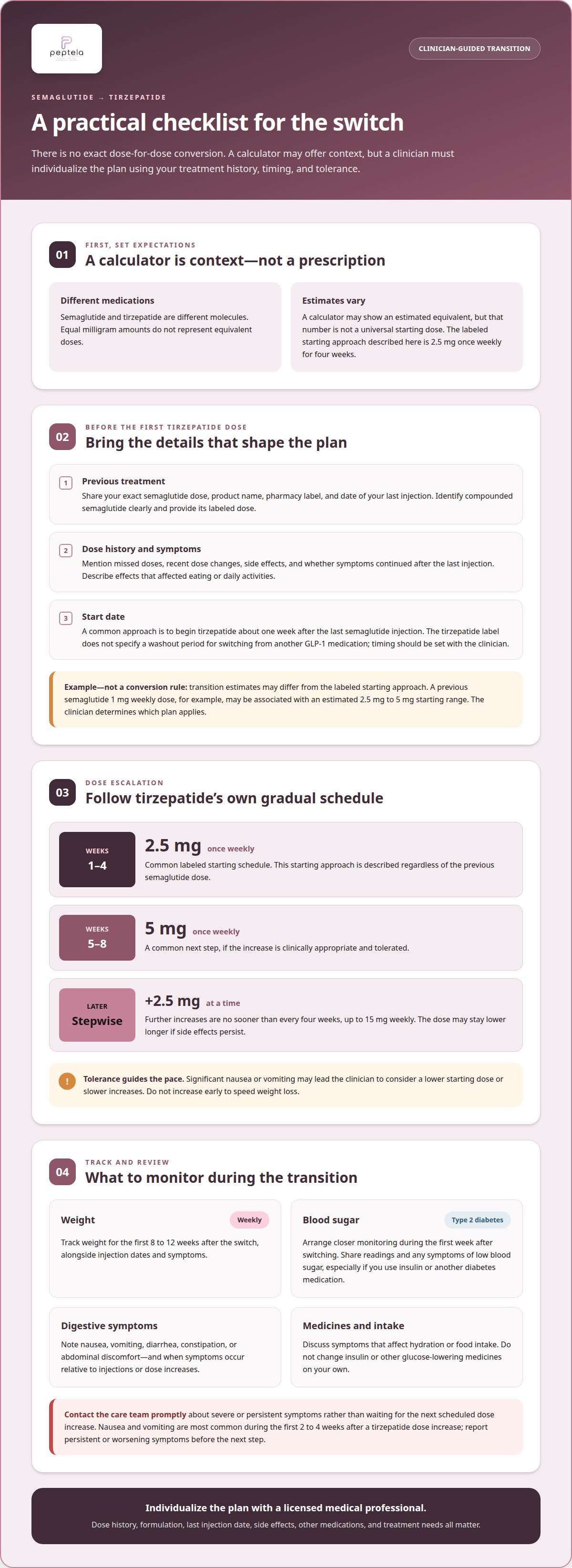
A practical guide to switching from semaglutide to tirzepatide starts with one key point: there’s no exact dose-for-dose conversion. A common starting approach is tirzepatide 2.5 mg once weekly for the first four weeks, often beginning one week after the last semaglutide injection. Your previous dose, side effects, and treatment needs help shape the plan.
If you’re considering a switch, this guide to switching from semaglutide to tirzepatide dosage explains why a calculator’s estimate is not a prescription. These are different medications, so a licensed medical professional must consider your treatment history when planning a transition.
This guide covers how tirzepatide dose increases are generally approached, which side effects may need attention, and how clinicians consider timing. Use these points to prepare for an informed discussion with a licensed medical professional.
Key Takeaways
- A calculator can offer a reference, but semaglutide and tirzepatide don’t have an exact dose-for-dose conversion.
- A common labeled starting approach is tirzepatide 2.5 mg once weekly for the first four weeks, with later adjustments based on tolerability and clinical needs.
- Titration usually proceeds gradually. Gastrointestinal effects and other changes can influence the pace of dose increases.
- Blood sugar monitoring matters during the transition, especially for people who also use insulin or other diabetes medications.
- A clinician can individualize the switch by considering your previous dose, side effects, other medications, and treatment goals.
Can a clinician calculate a tirzepatide starting dose after semaglutide?
A clinician guides the switch by reviewing your semaglutide dose, treatment history, and side effects. A calculator can provide an estimate, but there is no exact dose-for-dose conversion between these different medications.
-
Compare the Dose Equivalency
Use conversion estimates as context, not as a prescription for your first tirzepatide dose. Semaglutide and tirzepatide are different molecules, so equal milligram amounts don’t represent equivalent doses. A calculator may display 7.5 mg of weekly tirzepatide as a clinical equivalent, but that figure isn’t a universal starting dose. The clinician should distinguish an estimated equivalency from an individualized titration plan.
-
Adjust the Dose for Prior Semaglutide Use
Give the clinician your exact previous semaglutide dose and how you tolerated it. A common labeled starting approach is tirzepatide 2.5 mg once weekly for four weeks, regardless of the previous semaglutide dose. Some clinical transition estimates vary: for example, a previous 1 mg weekly dose may correspond to a 2.5 mg to 5 mg starting range. These estimates don’t replace the labeled starting approach.
- Include the full medication and pharmacy details. Share the product name, dose, date of your last injection, and pharmacy label. If you used compounded semaglutide, identify it clearly and provide its labeled dose. This helps the clinician understand what you took instead of relying on a calculator alone. Also discuss missed doses, recent dose changes, and side effects, as each can affect the transition plan.
- Set the transition timing with the prescriber. A common approach begins tirzepatide approximately one week after the last semaglutide injection. The tirzepatide label doesn’t specify a washout period when switching from another GLP-1 medication. That doesn’t establish one timing rule for every person. The clinician considers the last injection date, current symptoms, and treatment circumstances when setting the start date.
- Agree on the titration and review plan. The usual starting schedule is 2.5 mg once weekly during weeks one through four. Dose increases can follow in four-week intervals when clinically appropriate and tolerated. A person moving from semaglutide 2.4 mg may encounter estimates ranging from a higher equivalent dose to a 5 mg starting approach; the labeled recommendation remains 2.5 mg for four weeks. Ask the prescriber to explain which plan applies and how side effects will shape adjustments.
A conversion calculator can organize dose information, but it cannot account for your full clinical history. The prescriber considers your previous dose, formulation, timing, and side effects when guiding the switch.
Do I need to titrate again when switching drugs?
Yes. Tirzepatide has its own dose-escalation schedule, and semaglutide tolerance doesn’t determine the new dose by itself. A common schedule starts at 2.5 mg weekly and increases gradually, with the pace shaped by side effects and clinical needs.
-
Review Prior Side Effects and Tolerance
Tell the clinician which effects you experienced on semaglutide, when they occurred, and whether they affected eating or daily activities. Significant nausea or vomiting may lead the clinician to consider a lower starting dose of tirzepatide rather than increasing it quickly. Include any symptoms that continued after your last injection. This history helps the clinician plan dose increases around your tolerance, rather than assuming your previous dose transfers directly.
-
Work with a clinician on the tirzepatide dose escalation schedule
Follow a clinician-directed schedule, not a conversion calculator alone. A common labeled schedule uses 2.5 mg weekly for weeks 1-4, then 5 mg weekly for weeks 5-8. Further increases are typically 2.5 mg at a time, no sooner than every four weeks, up to 15 mg weekly. The dose may stay lower longer if side effects persist.
- Plan for effects after each increase. Nausea and vomiting are most common during the first 2 to 4 weeks after a tirzepatide dose increase. Report persistent or worsening symptoms to the clinician before the next step. Side effects after switching may improve within a few weeks, but don’t increase the dose early to speed weight loss. The schedule should reflect how you’re tolerating treatment.
-
How clinicians monitor weight, side effects, and blood sugar
Track weight weekly for the first 8 to 12 weeks after the switch, alongside the timing of injections and symptoms. If treatment is for type 2 diabetes, arrange closer blood sugar monitoring during the first week after switching. Share readings and any symptoms of low blood sugar, especially if you use insulin or another diabetes medication.
- Review gastrointestinal symptoms and other medicines. Nausea, vomiting, diarrhea, constipation, and abdominal discomfort can affect hydration, food intake, and dose tolerance. Keep a clear record of when symptoms begin and whether they follow an injection or dose increase. Don’t change insulin or other glucose-lowering medicines on your own. A clinician can review your blood sugar patterns and medicines as tirzepatide is introduced.
- Use follow-up to guide the next dose. Bring your weight record, glucose readings when relevant, and symptom notes to each review. These details can help distinguish a short-lived effect from a pattern that may call for slower dose increases or another clinical assessment. Contact the care team promptly about severe or persistent symptoms instead of waiting for the next scheduled increase.
What to do when the new medication is not tolerable
Persistent nausea or other difficult side effects warrant a clinical review, not an improvised dose change. These steps can help you address symptoms and keep the transition coordinated.
-
Avoiding overlap between semaglutide and tirzepatide during a clinician-guided switch
Tell the prescriber when you took your last semaglutide injection and when symptoms began. Don’t use semaglutide and tirzepatide at the same time. Overlapping doses can complicate assessment of side effects and treatment decisions. If a dose is delayed or the start date changes, get revised timing from the prescriber before taking either medication. Keep both medication names and injection dates handy for the conversation.
-
Consider Switching Back or Another Medication
Contact the prescriber if nausea, vomiting, or another side effect makes it difficult to follow the current plan. The clinician can assess the severity and timing of symptoms, glucose readings when relevant, and your reason for switching. Options may include pausing dose increases, changing the treatment plan, or considering another medication. Don’t restart semaglutide or begin a different drug on your own; the sequence and timing need clinical review.
- Separate clinical decisions from cost decisions. Ask the prescriber or pharmacy to clarify the formulation and expected out-of-pocket cost before choosing a medication. Brand-name and compounded products can differ in cost, but a lower price doesn’t make their doses equivalent. Compounded tirzepatide has not been evaluated by the FDA, and compounded products are not FDA-reviewed or approved for safety, efficacy, or quality. Cost should not replace an assessment of suitability.
-
Recognize Symptoms Requiring Medical Attention
Seek prompt medical attention for severe or persistent vomiting, inability to keep fluids down, or symptoms that may indicate low blood glucose. Tirzepatide may cause low blood sugar, particularly when used with insulin or other diabetes medicines. If you have diabetes, share glucose readings and symptoms with your care team. Don’t wait for a routine follow-up if symptoms are severe or rapidly worsening.
- Report symptoms with clear details. Record when nausea or vomiting started, how long it lasts, and how it relates to your last injection. Include dose changes, missed doses, other diabetes medicines, and glucose readings if available. These details help the clinician assess whether symptoms may relate to the transition or another cause. Avoid taking extra medication or changing insulin doses without clinical direction.
- Confirm the next step before resuming treatment. If symptoms improve, don’t assume you should restart the previous schedule unchanged. The prescriber can decide whether to delay a dose increase, adjust the plan, or reassess the medication. If symptoms continue, report the pattern before taking another injection. Clear instructions reduce confusion about which medication to take and help prevent an unsupervised overlap.
Do Side Effects Reset When Switching?
Side effects don’t follow a predictable reset schedule. A clinician assesses your symptoms, blood glucose, other medicines, and response during the transition.
- Share your diabetes treatment and glucose history. Tell the provider whether you use insulin or a sulfonylurea and describe any previous low blood sugar episodes. Tirzepatide may cause hypoglycemia, especially alongside insulin or other diabetes medicines. This history helps the clinician assess risk before changing treatment and explain which readings or symptoms need prompt attention.
- Agree on a monitoring plan for the first week. Patients using these medicines for type 2 diabetes may need more frequent blood sugar checks during the first week after switching. Follow the monitoring instructions set for your treatment, and report readings that fall outside the range your provider gave you. Don’t adjust insulin or other diabetes medication independently to compensate for a reading.
- Watch for changes during the first two weeks. Keep a record of new or worsening nausea, vomiting, diarrhea, constipation, and abdominal discomfort. Note when symptoms occur in relation to doses, meals, and glucose readings. This timeline helps the provider distinguish gastrointestinal effects from symptoms that may accompany low blood sugar or another concern.
- Review glucose-lowering medicines with the provider. For patients using insulin or a sulfonylurea, a clinician may consider a 10-20% dose reduction on day one under supervision to address potential blood-sugar dips. This is not a self-directed adjustment. The appropriate action depends on the person’s medicines and glucose patterns, so agree on any change and monitoring instructions before making it.
- Track progress through the first 12 weeks. Record weight, dosing dates, side effects, and glucose readings when relevant. Weekly weight tracking during the first 8 to 12 weeks can help show the treatment trend without letting a single reading dominate decisions. Report persistent symptoms or concerning glucose changes promptly, rather than waiting for the next planned dose increase.
- Use follow-up and lab work to guide decisions. A clinician may assess whether tirzepatide improves treatment outcomes over 8-12 weeks at a maintenance dose. A1C, comprehensive metabolic panel, and lipid panel may be checked every 12 weeks while progress is monitored. The need for testing depends on the clinical picture and existing diabetes care. Bring your symptom and glucose records to each review.
Your previous tolerance can inform the plan, but it doesn’t guarantee you’ll have the same effects on tirzepatide. A clear monitoring plan helps the provider respond to changes and adjust dosing with your individual risks in mind.
Differences between semaglutide and tirzepatide
Compare the medication form, treatment context, and prescription details before planning a change. Semaglutide and tirzepatide are different medicines, so their doses are not interchangeable.
- Keep dose comparisons in context. In SURPASS-2, tirzepatide lowered HbA1c and body weight more than semaglutide 1 mg. That study comparison doesn’t establish an equivalent starting dose for an individual. Wegovy is a semaglutide brand used as a weekly injection, while tirzepatide is a different medication. A clinician considers your treatment history and tolerance rather than translating milligrams directly.
- Provide the medication and pharmacy details. Share the product name, concentration, dose, and pharmacy label with the clinician. Clear identification matters when switching between a brand-name product and a compounded medication. Compounded tirzepatide has not been evaluated by the FDA. Compounded products are not FDA-reviewed or approved for safety, efficacy, or quality. Don’t assume a compounded dose is interchangeable with a brand-name dose.
- Identify whether semaglutide was oral or injectable. Rybelsus is oral semaglutide, so its milligram dose shouldn’t be read like an injection dose. Approximate exposure comparisons associate Rybelsus 7 mg with injectable semaglutide 0.25 mg, and Rybelsus 14 mg with injectable semaglutide 0.5 mg. Those comparisons don’t convert directly into a tirzepatide prescription. Share the product packaging and dose details for review.
- Record the last weekly injection date. A common transition approach waits at least 7 days after the last weekly GLP-1 injection before starting a different one. Note whether the last dose was Wegovy or another semaglutide product. Don’t take both medications together or begin tirzepatide early. The prescriber can use the date and your symptoms to set the transition plan.
- Distinguish the brand name from the dose plan. Wegovy contains semaglutide, but the brand name alone does not determine a tirzepatide dose. The clinician should consider the specific prescription, its intended use, and your previous regimen. This separates the medication’s identity from a calculator estimate and helps ensure the new prescription reflects your clinical history.
- Interpret trial results as group findings. In SURMOUNT-5, adults with obesity without diabetes treated for 72 weeks had mean weight loss of 20.2% with tirzepatide and 13.7% with semaglutide 2.4 mg. These results compare study-group averages, not individual outcomes or dose equivalencies. They provide context for understanding the medicines, but don’t predict how a particular person will respond.
Peptela: Tirzepatide Injections
Peptela offers Tirzepatide Injections through personalized, clinician-guided care. Prescription products require an online evaluation with a licensed medical professional, who will determine whether a prescription is appropriate. If you’re considering a switch from semaglutide, this evaluation gives the clinician an opportunity to review your previous dose, side effects, other medications, and an appropriate titration plan.
Bring your current medication details and any questions about timing or tolerability to the conversation. Peptela’s in-house care team can guide you through the considerations involved in tirzepatide treatment. If you’d like to discuss your options, contact Peptela.
Make Your Next Step a Personal One
Use this guide to prepare for a focused conversation about whether changing medications aligns with your health priorities. Your questions and preferences can help shape an informed, personal plan.
Peptela offers personalized, clinician-guided care to help you discuss your options and treatment considerations. Raise what matters most to you, from day-to-day tolerability to how treatment fits your routine.
Contact Peptela with your questions and take your next step with clarity.
Frequently Asked Questions
Do you need a gap week between medications?
A gap of at least 7 days between weekly GLP-1 injections is a common approach. The tirzepatide label doesn’t specify a washout period for switching from another GLP-1 medication. Your clinician can set the start date using your last injection and current symptoms. Don’t take both medications together or change the timing without clinical direction.
How do I know if the switch worked?
Assess progress against goals set with your clinician, rather than judging by one weigh-in or glucose reading. For weight management, discuss weight trends, appetite, and treatment tolerance. For type 2 diabetes, bring glucose records and A1C results when available. Report symptoms or readings that change after dose adjustments so your clinician can review the pattern.
How long does the whole switch take?
The overall transition may take 4 to 12 weeks, depending on the starting dose and titration speed. Reaching a therapeutic dose from the previous medication may take 6 to 12 weeks. These describe different parts of the process. The pace depends on dose escalation and how treatment is tolerated, so the timelines aren’t interchangeable.
How will a clinician monitor you during a switch?
A clinician may review injection dates, dose changes, side effects, weight, and blood glucose when relevant. If you use insulin or another diabetes medicine, share glucose readings and symptoms that could signal low blood sugar. Bring an up-to-date medication list and records to follow-up, especially if symptoms or readings change after a dose adjustment.
What tirzepatide starting dose is used after semaglutide?
The usual labeled starting dose is 2.5 mg once weekly for the first four weeks, regardless of the previous semaglutide dose. This is a starting schedule, not a direct milligram conversion. Your clinician considers your prior dose, treatment history, and side effects when planning later adjustments. Don’t use a calculator estimate as your prescription.
Should you wait between the last semaglutide dose and first tirzepatide dose?
A common approach is to wait at least 7 days after the last weekly semaglutide injection before starting tirzepatide. For example, your clinician uses your last injection date to plan the next one. Current symptoms and medication history also inform the schedule. Keep the medicines separate and follow the prescribed start date.
How does a clinician determine a tirzepatide dose after semaglutide?
A clinician reviews your semaglutide product and dose, last injection date, side effects, and other medications. The medicines differ, so there is no exact dose-for-dose conversion. If you used oral semaglutide or a compounded product, share its packaging and prescription details. This information helps the clinician understand your previous regimen before planning tirzepatide dosing.
How does switching affect weight loss and blood sugar control?
During the transition, clinicians assess weight trends and glucose readings rather than assuming a particular response. Tirzepatide may cause low blood sugar, especially when used with insulin or other diabetes medications. If you take treatment for type 2 diabetes, follow your monitoring plan and report changes. Your readings and treatment history inform follow-up decisions.


